Nib Novice, Part 6 – Vintage Parker 51

This is the sixth part in a series in which I’m learning to use fountain pens. For all the previous installments, click here.


Meet the Parker 51 fountain pen.

img_4922

First produced in 1941, the Parker 51 would go on to sell tens of millions of units before being discontinued in 1972. It’s possibly the most popular fountain pen ever made, and has a long history to show for it. In the vintage pen world, Parker 51s aren’t particularly rare, and their individual values depend greatly on age, condition, and style. But nevertheless, each one is a classic.

This particular Parker 51 was given to me as Christmas gift last year, but was probably originally produced sometime during the 1950s. However, as I’ve gathered from the wonderful resource page at Richard’s Pens, it can be difficult to nail down a specific production date. Regardless of its exact age, this pen has weathered the decades extremely well; it still writes great, despite a bit of leaking around the nib.

The Parker 51 is obviously designed to be a working man’s pen. It has a professional look, a sturdy clip, and the cap pulls off quickly (as opposed to most of my other fountain pens, which have caps that screw on and off). It also has a hooded nib that allows ink to start flowing quickly. But, above all, my favorite feature is the aerometric filling system.

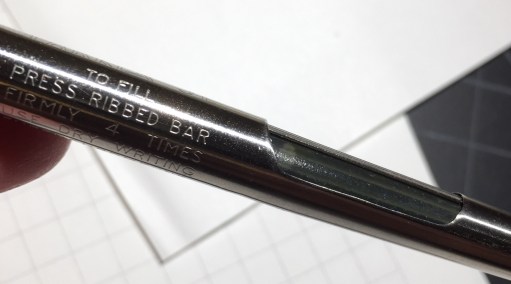
With this filling system there is a flexible ink sac built into the barrel that acts a lot like a pipette bulb. A small cutout inside the barrel will allow you to compress the sac, squeezing air out of it. With the sac still compressed, all you need to do is dip the nib into a bottle of ink and release the sac – ink will be sucked inside. It’s a very simple mechanism, yet one that is rather unique.
img_5640

I like this Parker 51. It’s such a classic that every fountain pen enthusiast should probably own one. If it weren’t for that slow nib leak, I’d probably carry this one around with me a lot more. As it stands, I’m a little paranoid about it, but I’m hoping that the problem will be solved by using a different ink. Currently, it’s filled with Noodler’s Black, which looks great but seems a little on the thin side.

Overall, however, I’ve found the vintage fountain pen world to be fairly daunting. There’s really a lot to learn in order to properly become a vintage collector. Still, I’ve had fun getting my feet wet with the Parker 51, and I can easily see myself buying another one someday.

img_5641


Review: Pilot Couleur, Ballpoint, 0.5mm


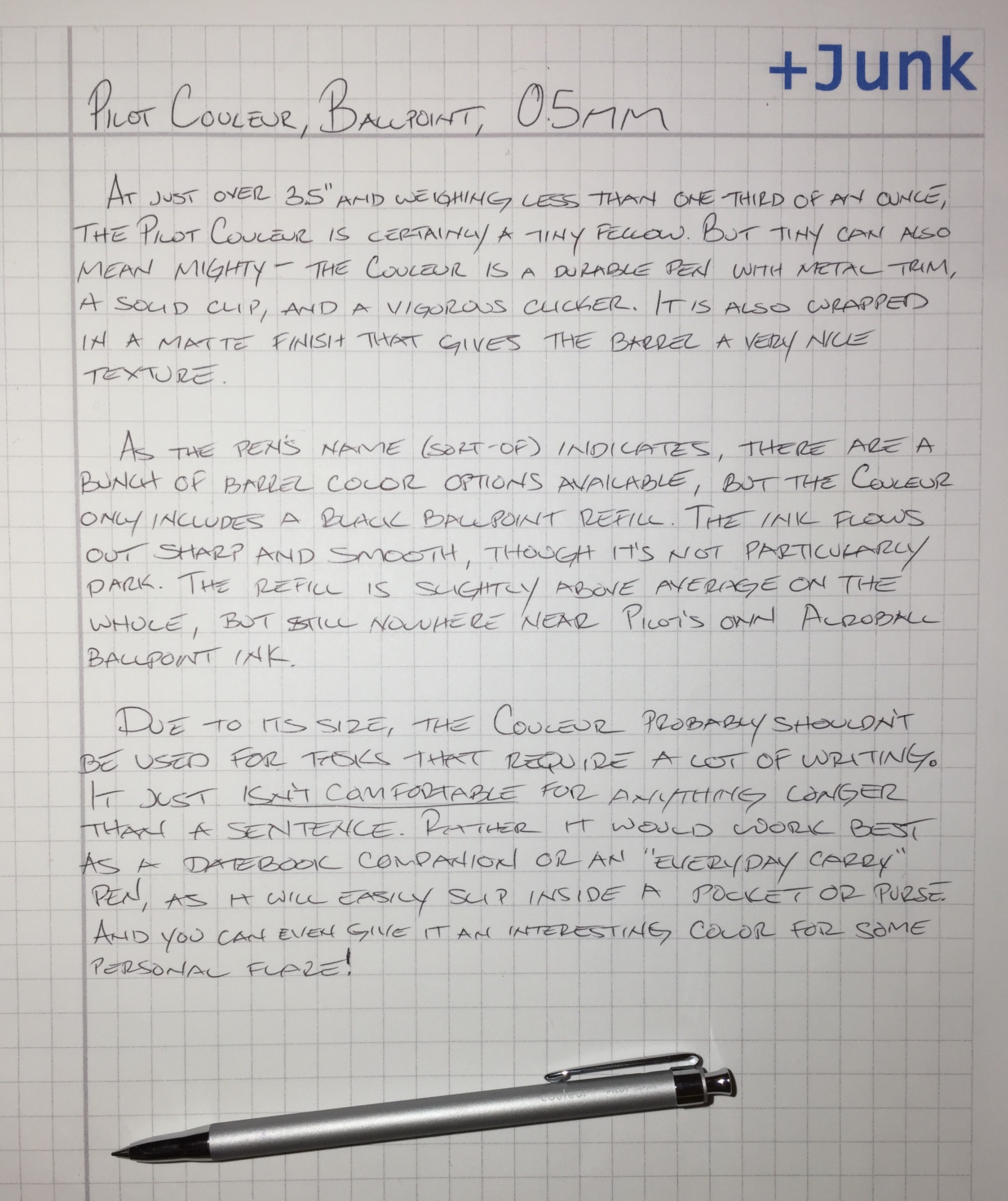
At just over 3.5″ in length and weighing less than one-third of an ounce, the Pilot Couleur is certainly a tiny fellow. But tiny can also mean mighty – the Couleur is a durable pen with metal trim, a solid clip, and vigorous clicker. It is also wrapped in a matte finish that gives the barrel a nice texture.

As the pen’s name (sort-of) indicates, there are a bunch of color options available for the barrel, but the Couleur only includes a black ballpoint refill. The ink flows out sharp and smooth, though it’s not particularly dark. The refill is slightly above average on the whole, but nowhere near Pilot’s own Acroball ink.

img_5616
Due to its size, the Couleur probably shouldn’t be used for tasks that require a lot of writing. It just isn’t comfortable for anything longer than a sentence. Rather, it would work best as a datebook companion or an ‘everyday carry’ pen, as it will easily slip inside a pocket or purse.

Overall, it’s a reliable little pen that can definitely take some abuse.

Review: Spiffy Lab Carbon Fiber G2 Pen, Gel Ink, 0.5mm

img_5568

Originally crowdfunded on Kickstarter to the tune of $23,181, the Carbon Fiber G2 Pen by Spiffy Lab is a monster. Its long, rotund barrel reminds me of a Maglite, and its machined-aluminum and carbon fiber body makes it look like something that ought to be stored in a tool bench. On seeing it, I was enamored, and I didn’t think twice before throwing $25 at the Kickstarter campaign so that I could secure a pen for myself.

When I received the pen a while later, I quickly discovered that the Carbon Fiber G2 Pen isn’t really an item I can use on an everyday basis. I should have known better; it’s really too large to comfortably fit in a pocket. Moreover, the cap screws on and off, requiring three full, squeaky rotations. And to make things a little more difficult, the cap doesn’t post to the end of the pen, and the clip juts out much too far for most practical purposes – though you can remove it with a hex wrench if you’d be okay with no clip at all.

img_5573

On the positive side, I find the thick barrel fairly comfortable to write with, and I especially like the carbon fiber texture. If there’s one lesson I take away from this pen, it’s that carbon fiber should be used more often. And given its size, it weighs less than you might expect, though anyone with smaller hands might still have some trouble. Also, as indicated by the pen’s name, it includes a 0.5mm Pilot G-2 refill, which shouldn’t dry out if left uncapped for an extended period of time. However, the refill included with my pen seems to be a dud – it skips in and out a lot. Luckily, G-2 refills are easy to replace, as they are available nearly everywhere, in many sizes and colors.

While the Carbon Fiber G2 Pen probably isn’t sensible for most situations, I still like it. Though, honestly, I probably wont get much use from it. But for those that might be interested in this gargantuan pen, it looks like you can still order one through the Spiffy Lab website for $55. That’s a markup from the Kickstarter campaign, but it will at least feel like you’re getting something substantial for the money.

Retro Talk: The Pen Addict Tornado

img_5474

Over the past year, I’ve become a fan and collector of the Retro 51 Tornado, but it was an old episode of The Pen Addict Podcast that first brought the pen to my attention. So, last month, when Retro 51 announced a new Tornado made in collaboration with Brad Dowdy, the creator of The Pen Addict website, I jumped at the chance to order one. And it turned out that I was lucky to act so fast, as this edition – limited to 300 pieces – sold out within a week.

img_5473

Made in the image of The Pen Addict, this Tornado has a shiny, orange lacquered barrel (like the one first reviewed by Dowdy in 2012) with weathered, metal hardware. However, the principal element is the finial, the little disk inset at the top of the twist, which features The Pen Addict logo. I’ve always felt that the pen-syringe hybrid is one of the more clever logos I’ve seen.

Though you can no longer purchase The Pen Addict Tornado, it is very similar to the orange Classic Lacquer Tornado, which is still widely available.  Personally, I would have preferred a brighter orange, like a safety yellow or an umbra orange, but I’m not complaining. Cheesy as it may sound, I feel like I’ve got myself a small piece of history.

img_5475

…and if you haven’t had your fill of orange, check out this, this, and also this.

Notes on Byline Field Notes

I’m a die-hard user of 3.5″ x 3.5″ pocket notebooks, especially those made by the ever-creative people at Field Notes. In fact, I subscribe to their Quarterly Edition notebooks just so I can get their latest designs as soon as possible. And though I’m usually excited when I get a new set of pocket notebooks in the mail, when Field Notes announced the new Byline edition earlier this summer, my enthusiasm wasn’t as immediate.

img_4636

Instead of the standard pocket size, which I’m used to, Byline is a 4.75″ x 7.5″ reporter-style notebook. It flips open vertically and uses wire binding. After ripping open the shrink wrap and looking it over, it’s likely that most Field Notes subscribers like me were forced to ask themselves, “what the heck am I going to use this for?”

Putting that question aside for a moment, I think it’s obvious that the people at Field Notes put a lot of thought into this product. According to their website, they are frequently asked for a reporter-style notebook, but they didn’t commit to producing one until the request came from the host of CBS’ Face the Nation, John Dickerson, who also offered to lend a hand in the project.

Together they came up with this 70-page, wrought iron (gray) book. It has durable, 120# cover stock, and it contains 70#, college-ruled inner paper. The pages are double-sided, and they are wire-bound with precision for easy flipping. The inside of the front and back covers are loaded with information, much of it more interesting than useful, such as an explanation of why the news media is sometimes called “The Fourth Estate.” The back cover also has a little pocket that comes with a promotional chapter from John Dickerson’s latest book printed on a cutesy mini-newspaper.

img_5038

Where the traditional Field Notes pocket notebook is great for keeping lists or taking down shorter bits of information, the Byline edition is much better when longer notes are required. The obvious application is for in-the-field interviews, as Byline slips nicely into a jacket’s vest pocket, but I found that it works great for things like writing out book references or keeping notes for movie reviews. I tested out that latter use case, taking notes for brief movie reviews (which I’ve published on Rotten Tomatoes).

Still, I don’t currently have much use for this format, though I can’t deny that it’s a good notebook. Many others will certainly love the classic aesthetic of the Byline edition, and Field Notes has produced a limited number of 2-packs, so they may sell out sooner rather than later. So if you think you’ll find it useful, it might be a good idea to order soon. But, sadly, the amazing Byline sticker that came with my subscription cannot be purchased separately.

img_5039

Additional Notes

-30-