Review: Fisher Cap-O-Matic Space Pen, Ballpoint, 1.0mm

img_3388

Perhaps you’ve heard this story of the Space Pen:

During the space race of the 1960s, NASA quickly realized that a standard ballpoint pen would not work in space, as it relies on gravity to function properly. So, after spending millions and millions of dollars, they developed the Space Pen.

The Russian cosmonauts were faced with the same problem. They just used a pencil.

It’s an interesting story about government waste, bureaucratic incompetence, and the elegance of a simple solution. Of course, the story is mostly a myth.

In truth, NASA did originally use pencils in space – both wood-case and mechanical – but they were worried about the tiny bits of eraser, graphite, and wood shavings. All this detritus would float around the spacecrafts’ cabins, potentially damaging sensitive electronics and creating a fire hazard. Then in 1965, Paul C. Fisher  approached NASA with an invention; a ballpoint pen with a pressurized ink cartridge. After testing it for a couple of years, NASA agreed to use the Space Pen, paying Fisher six dollars per unit.
img_3389

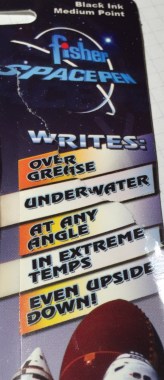
Today you can buy the Fisher Space Pen in several different models and styles, such as this Cap-O-Matic version with a tiny space shuttle embossed in the middle of the barrel. It’s on the small side, comparable in size to the Zebra F-301, making it a pen that’s not particularly comfortable to write with for long periods of time. However, the pressurized ink definitely has advantages that aren’t offered by many other pens. Writing upside-down or against walls is the obvious one, but it also works well for writing on glossy, dirty, or even wet paper.

While I’m not personally inclined to pick up the Fisher Cap-O-Matic Space Pen on a regular basis, it will definitely come in handy during travel. Those who spend a lot of time outdoors will also find a pen like this incredibly useful. It’s got a solid build, and it’s definitely worth the 10 or 20 dollars it costs today. At the very least, people will be impressed that you have the pen that (supposedly) cost NASA millions of dollars to make.

img_3390

Extra Links

Review: Parker 1M, Ballpoint, 1.0mm

IMG_3295

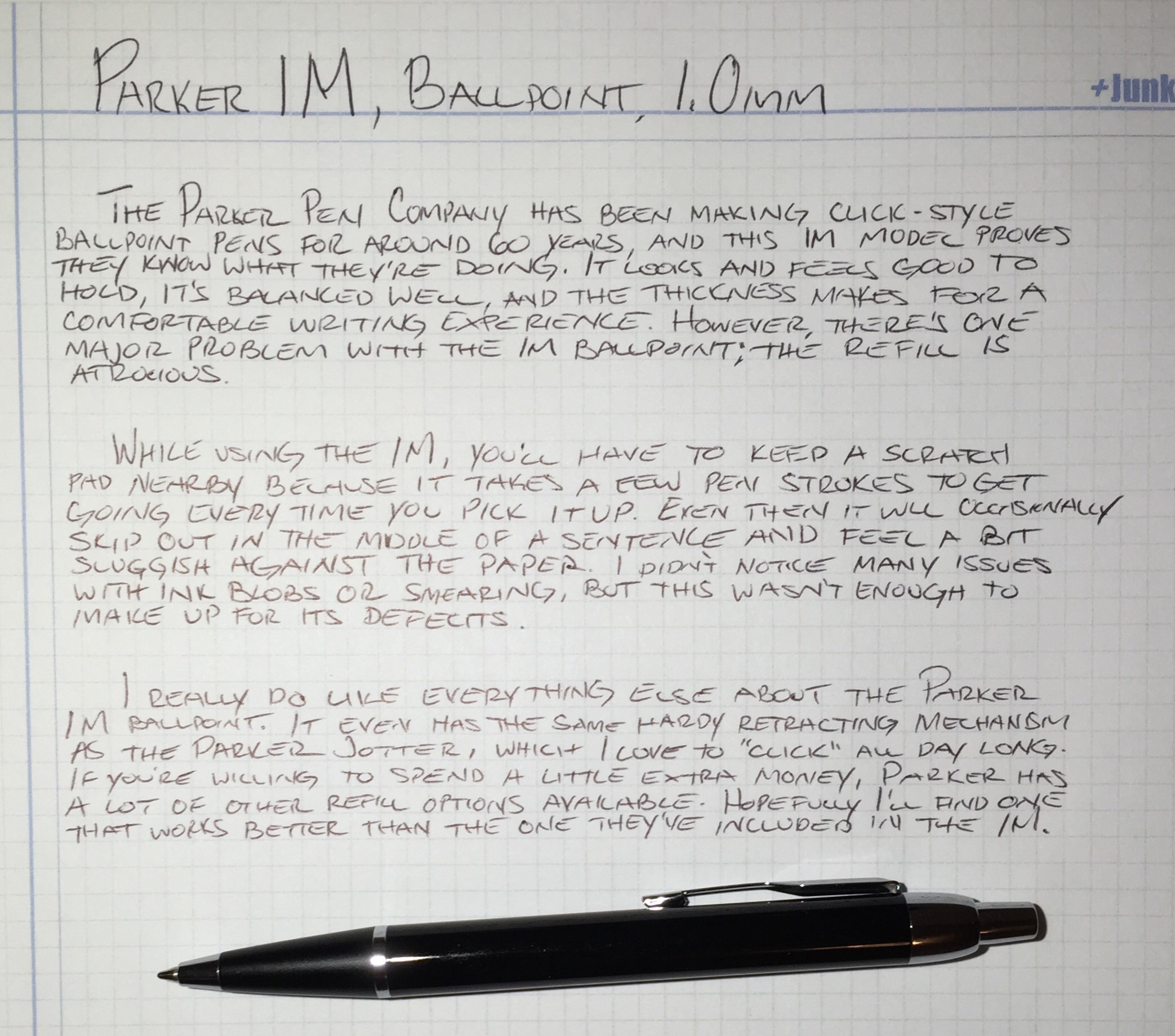
The Parker Pen Company has been making click-style ballpoint pens for more than 60 years, and this 1M model proves they know what they’re doing. It looks and feels good to hold, it’s balanced well, and the thickness makes for a comfortable writing experience. However, there’s one major problem with the 1M ballpoint; the refill is atrocious.

While using the Parker 1M, I have to keep a scratch pad nearby because it takes a few pen strokes to get going. Even then it occasionally skips out in the middle of a sentence, and it always feels a bit sluggish against the paper. I didn’t notice many issues with ink blobs and smearing, but this wasn’t enough to make up for its deficits.

IMG_3296

I really do like everything else about the Parker 1M ballpoint. It even has the same hardy retracting mechanism as the Parker Jotter, which I love to “click” incessantly whenever I use it. If you’re willing to spend a little extra money, Parker has a lot of other refill options available. Hopefully I’ll find one that works better than the one included here.

IMG_3294

Review: Parker Jotter, Ballpoint Pen, 1.0mm (blue ink)

IMG_3201

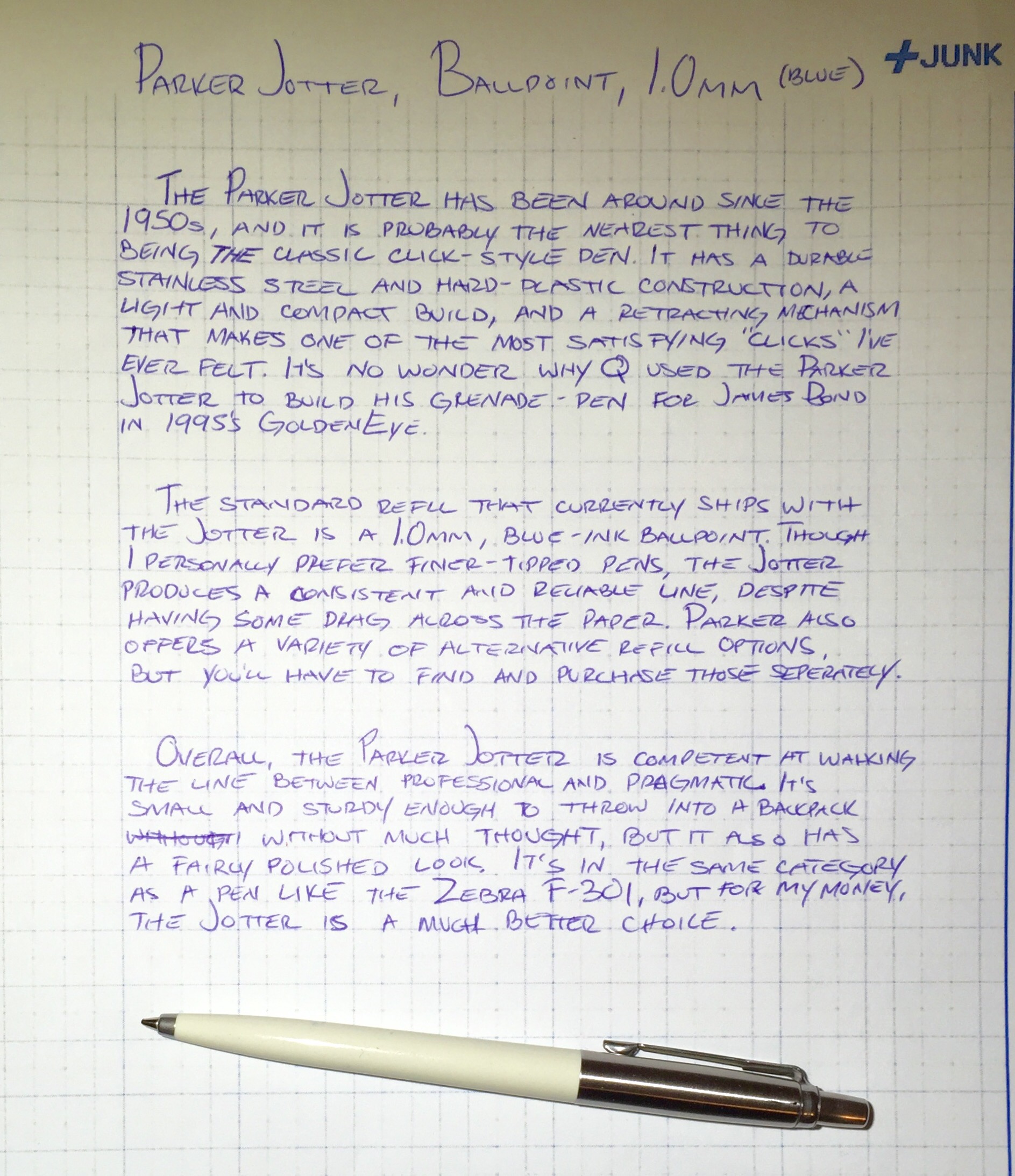
The Parker Jotter has been around since the 1950s, and it is probably the nearest thing to being the classic click-style pen. It has a durable stainless steel and hard-plastic construction, a light and compact build, and a retracting mechanism that makes one of the most satisfying “clicks” I’ve ever felt. It’s no wonder why Q used the Parker Jotter to build his grenade-pen for James Bond in 1995’s GoldenEye.

IMG_3200

The standard refill that currently ships with the Jotter is a 1.0mm, blue-ink ballpoint. Though I personally prefer finer-tipped pens, the Jotter produces a consistent and reliable line, despite having some drag across the paper. Parker also offers a variety of alternative refill options, but you’ll have to find and purchase those separately.

Overall, the Parker Jotter is competent at walking the line between the professional and the pragmatic. It’s small and sturdy enough to throw in a backpack without much thought, but it also has a fairly polished look. It’s in the same category as a pen like the Zebra F-301, but for my money, the Jotter is a much better choice.

IMG_3199

Extra Links

Review: Zebra 301A, Ballpoint, 0.7mm

IMG_3132

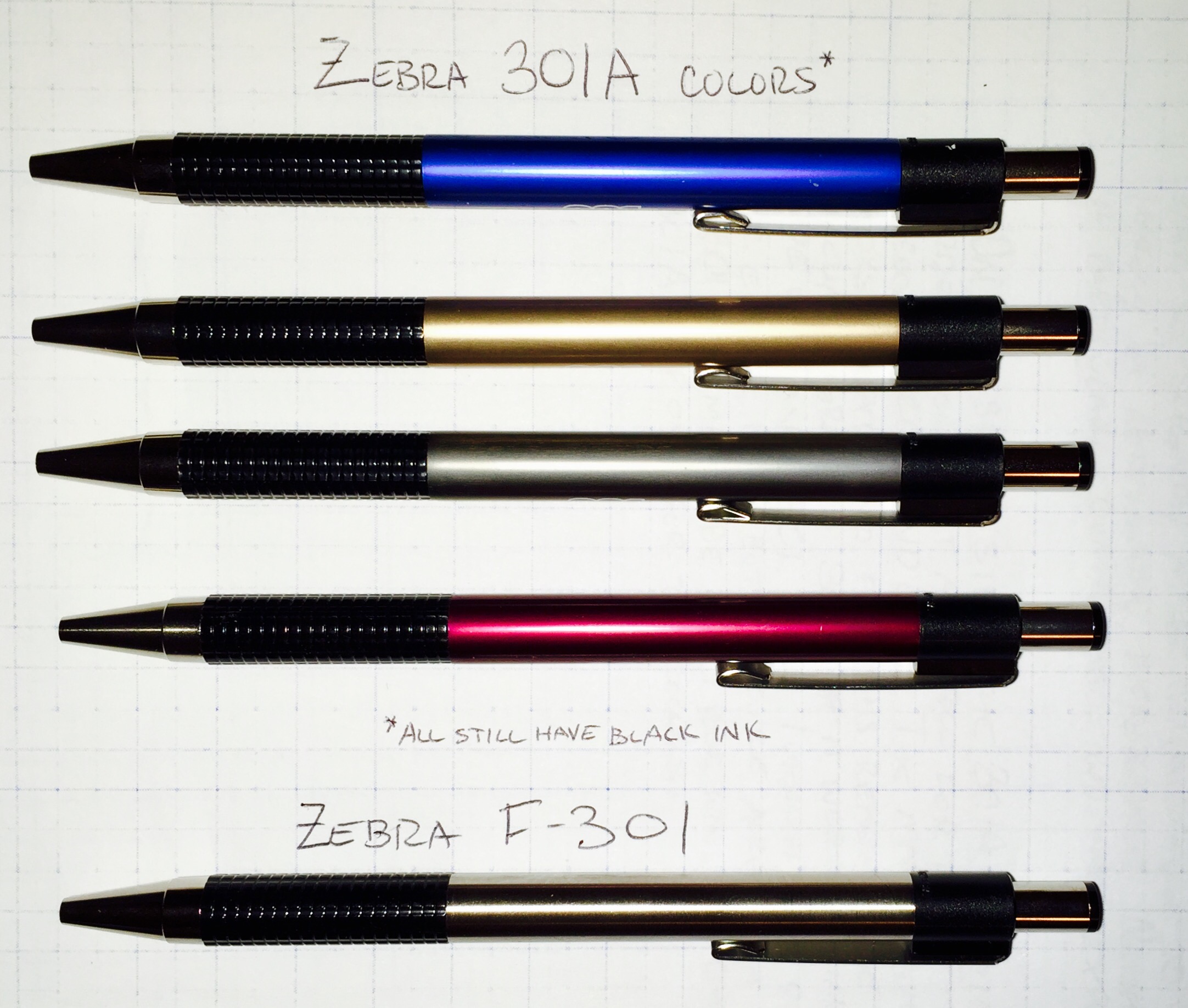
There isn’t much I can say about the Zebra 301A that I havent already said about the Zebra F-301. The only difference between the two is that the 301A has an aluminum barrel in place of the F-301’s stainless steel barrel. Other than that, the grip, the ink refill, the clip, and the retracting mechanism are all exactly the same.

I had expected aluminum to make for a lighter pen, but the weight seems to be about even with the stainless steel F-301. And while the 301A barrel is ever-so-slightly thicker (which makes it ever-so-slightly more comfortable to hold), it’s hardly a noteworthy difference. Neither pen offers a particularly comfortable writing experience.

IMG_3133

On the bright side, the 301A comes in four decorative barrel colors not available for the F-301: blue, maroon, grey, and gold. The maroon, in particular, looks great, and for this reason alone, I’d be more likely to grab a 301A if it were sitting side-by-side with an F-301. Still, I wouldn’t go out of my way for either pen, but if you’re already a fan of the F-301, it might be worth your while to check out the Zebra 301A.

IMG_3131

Extra Links

Review: Zebra F-301 Compact, Ballpoint Pen, 0.7mm

IMG_3038

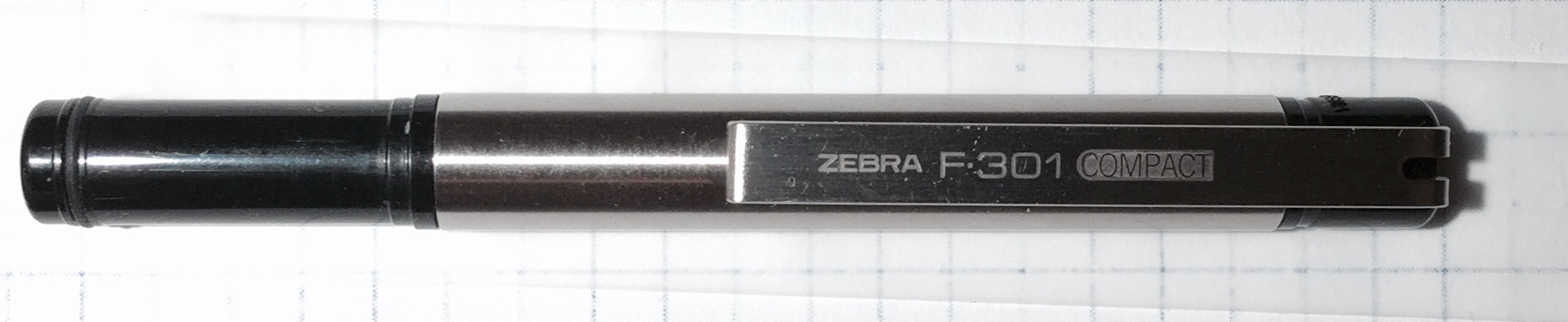
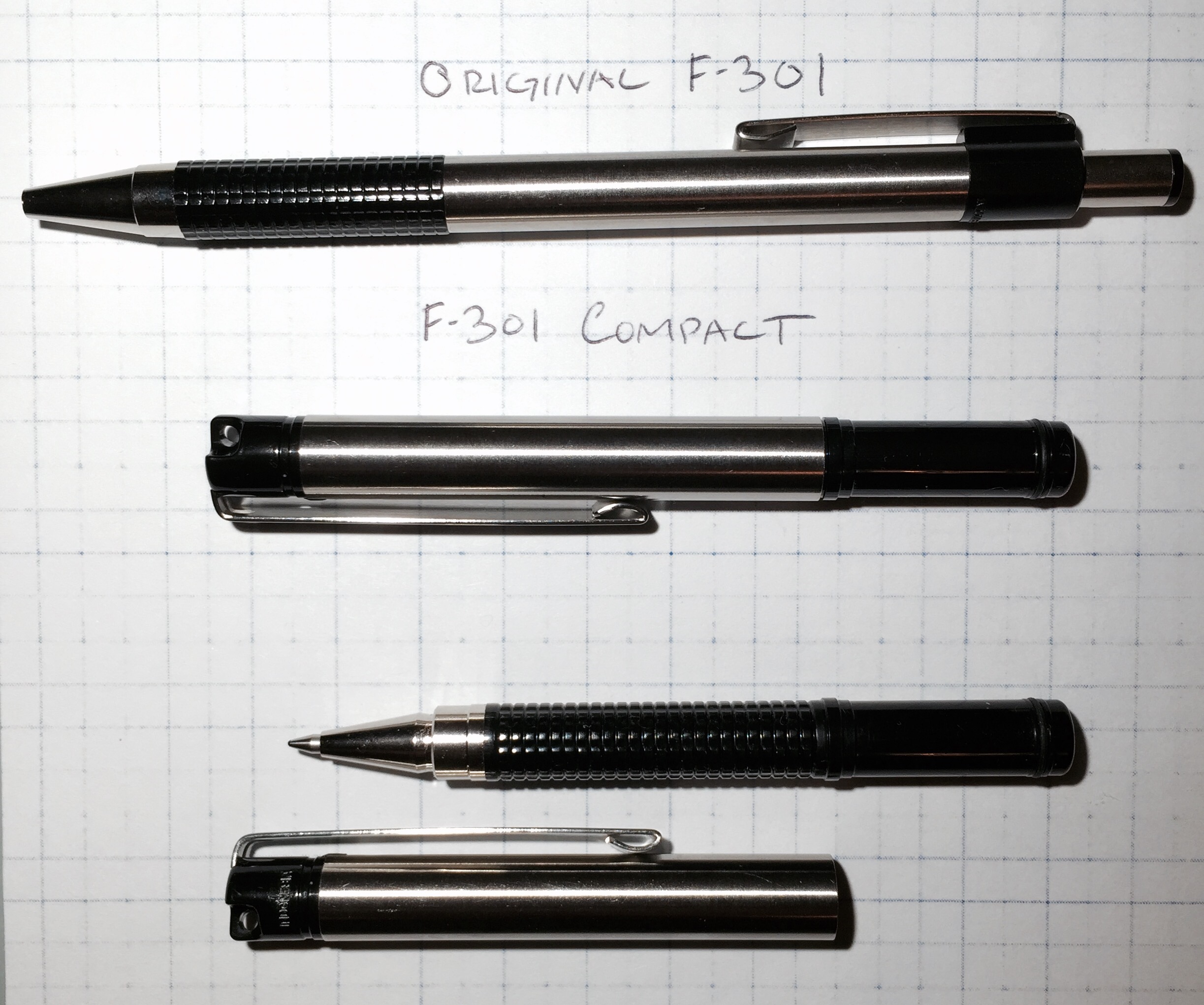
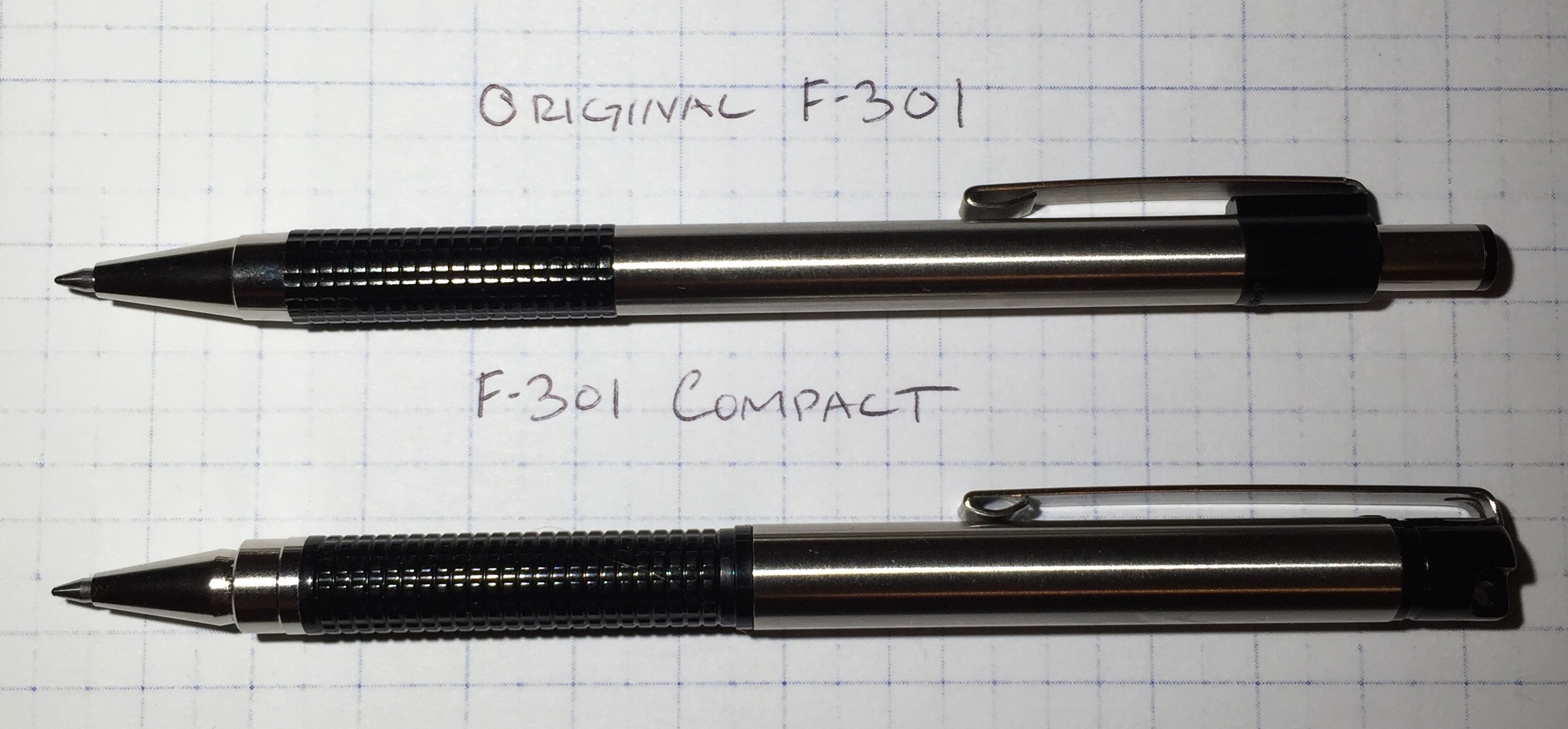
At a measly 5-inches, nobody could criticize the original Zebra F-301 for being a large pen. But in case you find yourself in a situation where every inch counts, Zebra has produced the F-301 Compact, a version measuring only 3.75 inches. The Compact retains the original aesthetic of stainless steel and hard, black plastic, but it otherwise feels like a much different pen.

To achieve this extra-small size, Zebra has created a rather clever design which uses the standard 0.7mm F-301 ballpoint refills, but replaces the original retracting mechanism with a cap. When the cap is on, the pen can be stowed in its 3.75-inch form, but when the cap is posted to the end of the pen, it creates a 5-inch writing instrument. It’s certainly a small, durable design, but it’s unfortunately much more uncomfortable to write with – and comfort wasn’t the F-301’s strong suit to begin with.

IMG_3039

Really, don’t plan on using the F-301 Compact for anything more than jotting down a few notes here and there. The cap posts to the end of the pen loosely, so it tends to twist and slide while writing, and though the extra-large clip is very sturdy, it really just gets in the way. If, on the other hand, you decide to write with the cap off to the side, you’ll find that the pen is too small and unbalanced.

Such a small pen is a neat idea, and I’m sure there are some situations where it might be useful. Most of the time, however, it isn’t worth using such an uncomfortable pen. Instead, either stick with the original F-301 or try a Tombow Airpress for a much more comfortable writing experience.

IMG_3035

Extra Links