Review: Baoke Simple, Gel Ink, 0.5mm

img_3959

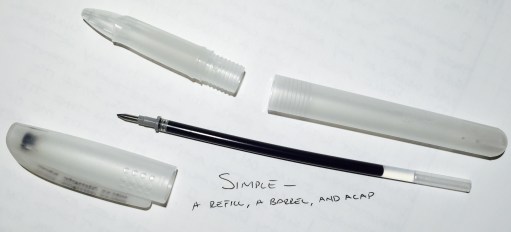
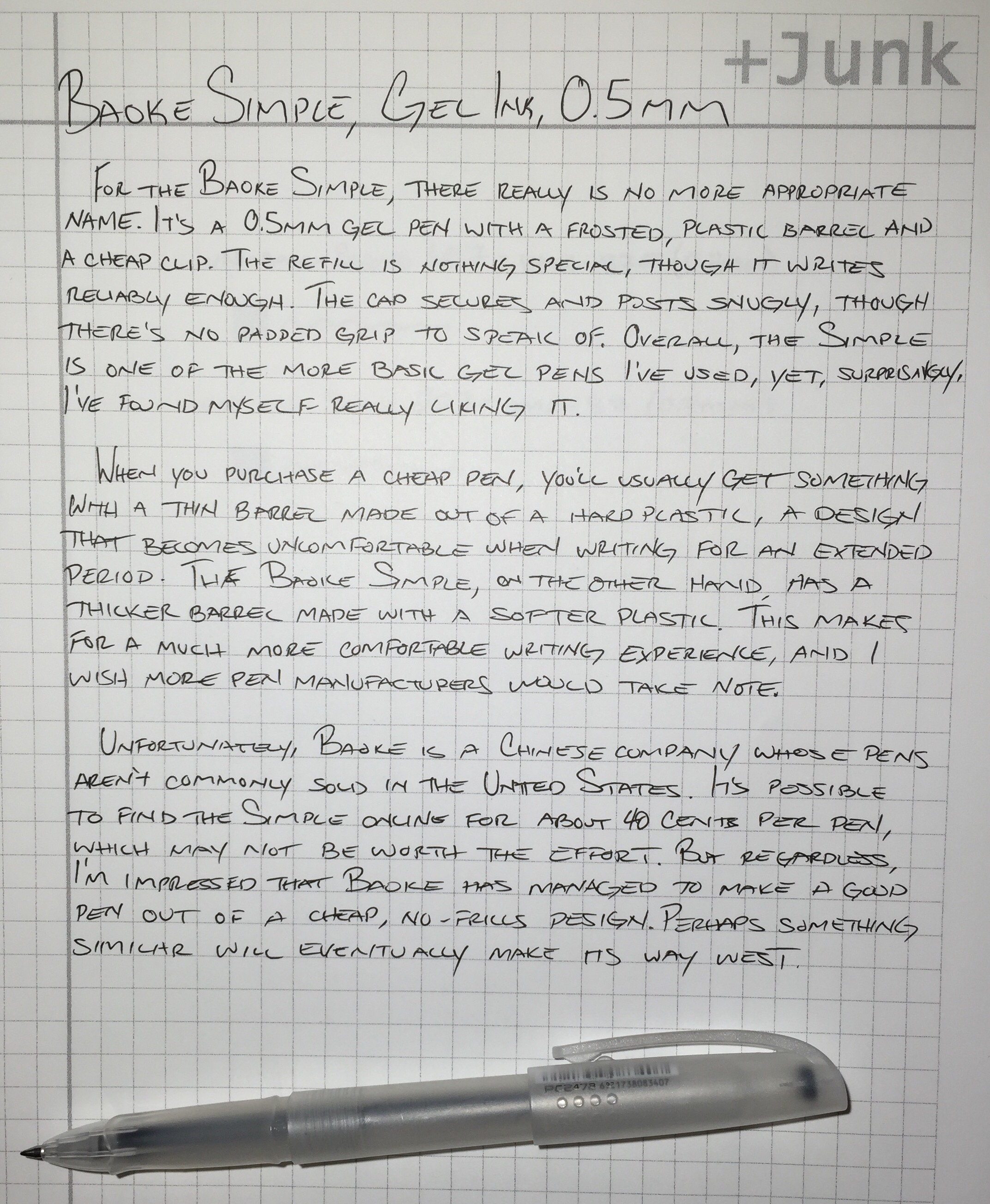
For the Baoke Simple, there really is no more appropriate name. It’s a 0.5mm gel pen with a frosted, plastic barrel and a cheap clip. The refill is nothing special, though it writes reliably enough. The cap secures and posts snugly, and there’s no padded grip to speak of. Overall, the Simple is one of the more basic gel pens I’ve used, yet, surprisingly, I’ve found myself really liking it.
img_3960

When you purchase a cheap pen, you’ll usually get something with a thin barrel made out of a hard plastic, a design that becomes uncomfortable when writing for an extended period. The Baoke Simple, on the other hand, has a thicker barrel made with a softer plastic. This makes for a much more comfortable writing experience, and I wish more pen manufactures would follow suit.

Unfortunately, Baoke is a Chinese stationery manufacturer whose pens aren’t commonly sold in the United States. It’s possible to find the Simple online for about 40 cents per pen, which may not be worth the effort. But regardless, I’m impressed that Baoke has a managed to make a good pen out of a cheap, no-frills design. Perhaps something similar will eventually make its way to store shelves in the West.
img_3958

Review: Pilot Down Force, Pressurized Ballpoint, 0.7mm

img_3955

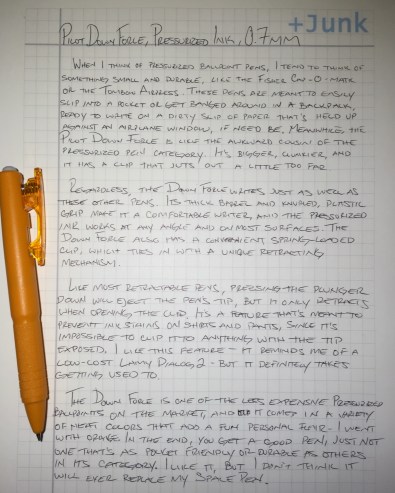
When I think of pressurized ballpoint pens, I tend to think of something small and durable, like the Fisher Cap-O-Matic Space Pen or the Tombow Airpress. These pens are meant to slip easily into a pocket or get banged around in a backpack, ready to write on a dirty slip of paper held up against an airplane window, if need be. Meanwhile, the Pilot Down Force is like the awkward cousin of the pressurized pen category. It’s bigger, clunkier, and it has a clip that juts out a little too far.

Regardless, the Down Force writes just as well as these other pens. Its thick barrel and knurled, plastic grip make it a comfortable writer, and the pressurized ink works at any angle and on most surfaces. The Down Force also has a convenient spring-loaded clip, which ties in with a very unique retracting mechanism.

DownForceRetract

Like most retractable pens, pressing the plunger down will eject the pen’s tip, but it only retracts when opening the clip. It’s a feature that’s meant to prevent ink stains on shirts and pants, since it’s impossible to clip the pen to anything with its tip exposed. I like this feature – it reminds me of a low-cost version of the Lamy Dialog 2 – but it definitely takes a little getting used to.

The Down Force is one of the less expensive pressurized ballpoints on the market, and it comes in an array of neat colors that add a fun personal flair – I went with the orange. In the end you get a good pen, just not one that’s as pocket-friendly or durable as others in its category. I like it, but I don’t think it will ever replace my space pen.

img_3956

Extra Links

Review: Zebra F-701, Ballpoint, 0.7mm

img_3942

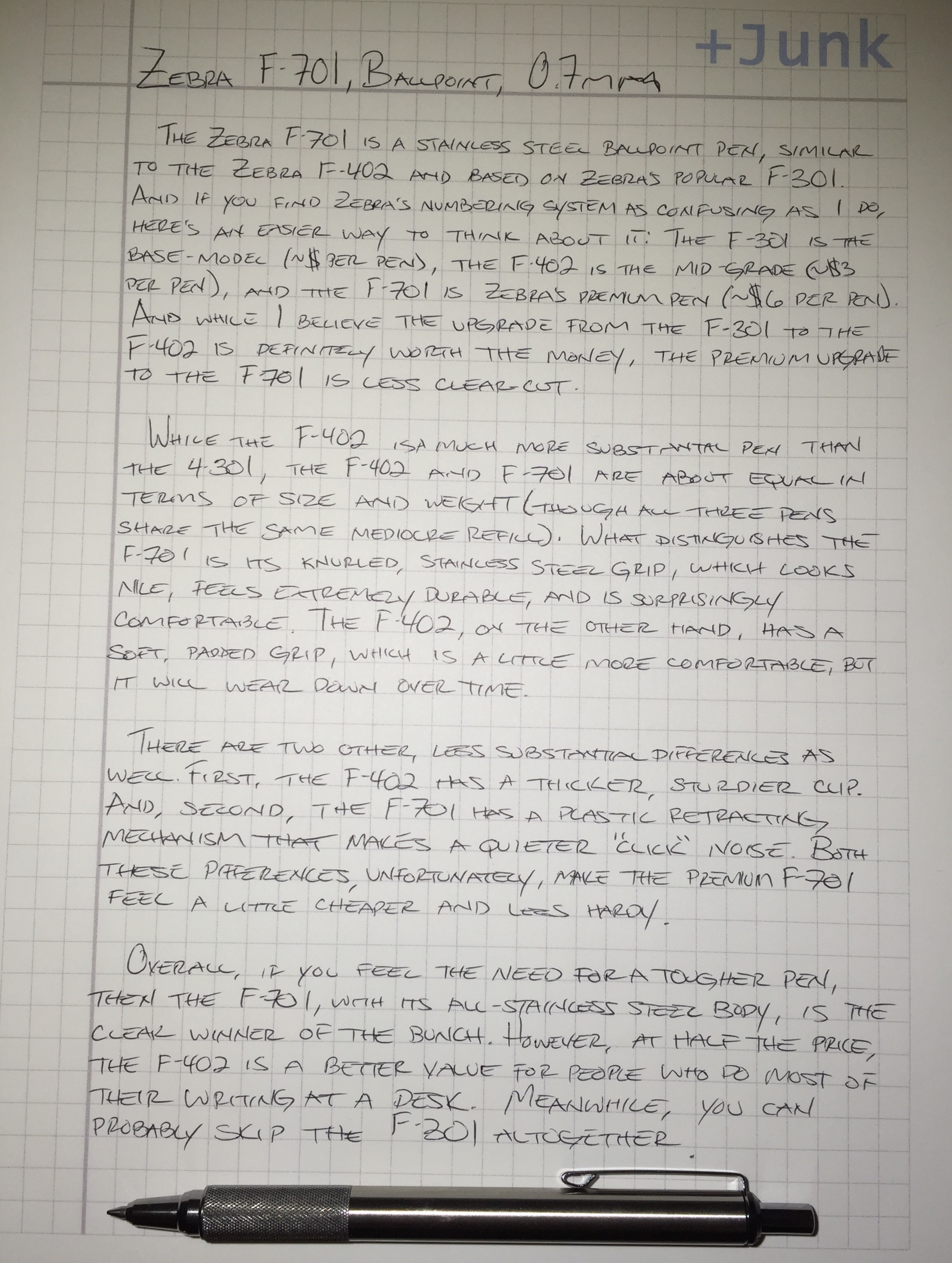
The Zebra F-701 is a stainless steel ballpoint, similar to the Zebra F-402 and based on Zebra’s popular F-301. And if you find Zebra’s numbering system as confusing as I do, here’s an easier way to think about it: the F-301 is the base-model (~$2 per pen) , the F-402 is the mid-grade (~$3 per pen), and the F-701 is Zebra’s premium pen (~$6 per pen). And while I believe the upgrade from F-301 to F-402 is definitely worth the money, the premium upgrade to the F-701 is less clear-cut.

img_3941
The F-301 (top) has a hard-plastic grip, the F-402 (middle) has a rubberized grip, and the F-701 (bottom) has a stainless steel grip.

While the F-701 is a much more substantial pen than the F-301, it’s about equal to the F-402 in terms of size and weight (though all three pens share the same mediocre ballpoint refill). What distinguishes the F-701 is its knurled, stainless steel grip, which looks nice, feels extremely durable, and is surprisingly comfortable. The F-402, on the other hand, has a soft, padded grip, which is a little more comfortable but will wear down over time.

There are two other, less substantial differences as well. First, the F-402 definitely has a thicker, sturdier clip. And, second, the F-701 has a plastic retracting mechanism that makes a quieter “click” noise. Both these differences, unfortunately, make the premium F-701 feel a little cheaper and less hardy.

Still, if you feel the need a tougher pen, then the F-701, with its all-stainless steel body, is still the clear winner of the group. However, at half the price, the F-402 is a better value for people who are less hard on their pens, such as those who do most of their writing at a desk. Meanwhile, you can probably skip the F-301 altogether.

img_3944

Extra Links

Review: BIC Cristal, Ballpoint, 1.0mm

img_3935

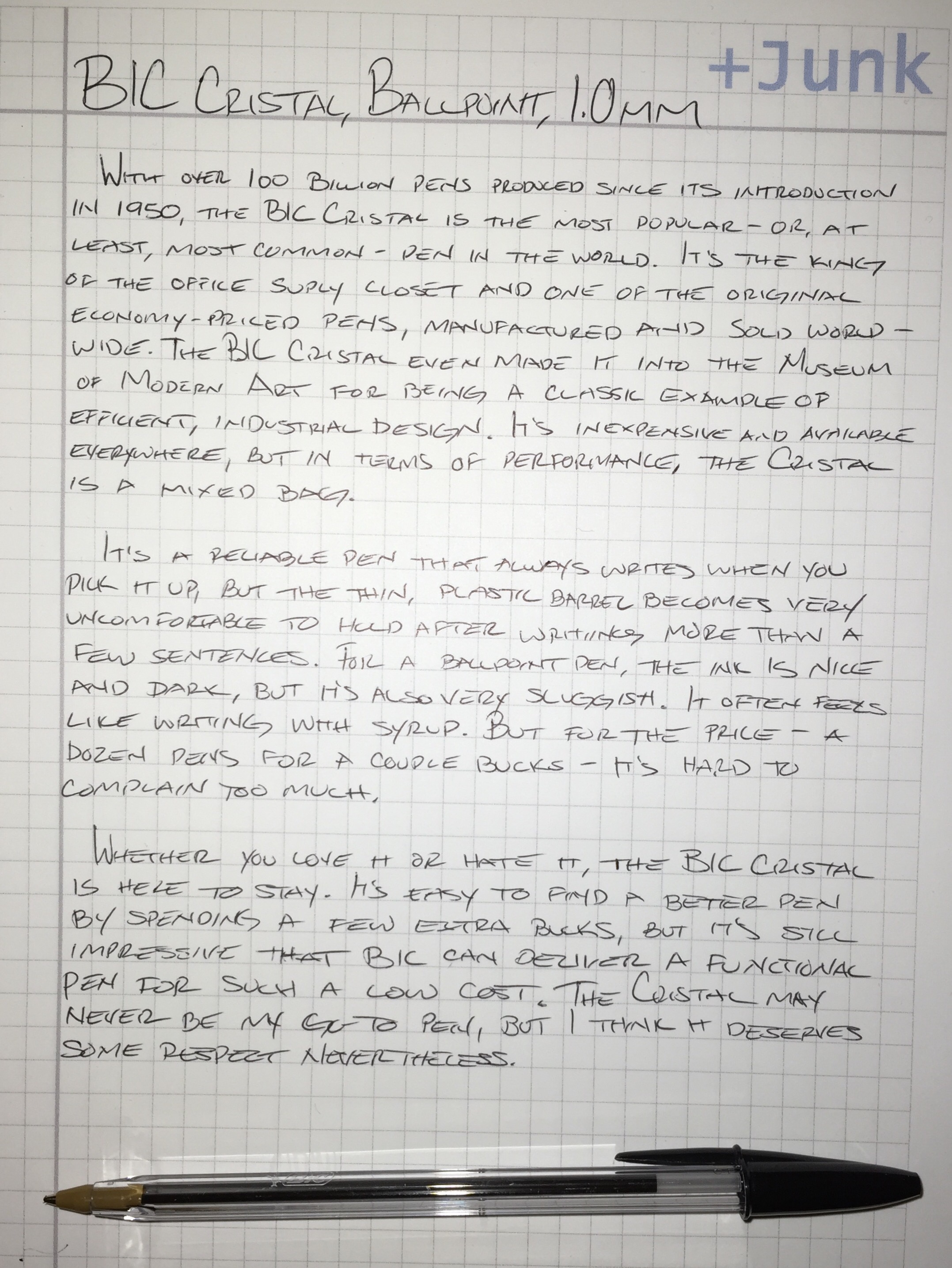
With over 100 billion pens produced since 1950, the BIC Cristal is the most popular – or, at least, most common – pen in the world. It’s the king of the office supply closet and the original economy pen, manufactured and sold worldwide. The Cristal even made it into the Museum of Modern Art for being a classic example of efficient, industrial design. It’s inexpensive and available everywhere, but, in terms of performance, the Cristal is a mixed bag.

img_3934

It’s a reliable pen that always writes when you pick it up, but the thin, plastic barrel becomes very uncomfortable to hold after writing more than a few sentences. For a ballpoint pen, the ink is nice and dark, but it’s also very sluggish. It often feels like writing with syrup. But for the price – a dozen pens for a couple bucks – it’s difficult to complain too much.

Whether you love it or hate it, the BIC Cristal is an icon that’s here to stay. It’s easy to find a better pen by pending a few extra bucks, but it’s impressive that BIC can deliver a functional product for such a low cost. The Cristal may never be my go-to pen, but it has my respect nevertheless.

img_3936

Extra Links

  • A history of the BIC Cristal, produced by BIC at the Cristal’s 60th anniversary. It’s an interesting read, especially if you want to see Salvador Dali holding a Cristal.
  • A review at Scribomechanica summarizes the Cristal really well: you can do better with other pens, but that’s not the point. The point is that the Cristal is really inexpensive, yet reliable.
  • The review at The Pen Addict is very positive towards the Cristal, with his primary complaint being the white-space within the lines of ink.

Review: M&G Wisdom, Erasable Gel Ink, 0.5mm 

img_3917

I don’t know why M&G chose to name their erasable pen “Wisdom,” but it makes me think of the Serenity Prayer, the aphorism that asks for wisdom to know the difference between the things that can and cannot be changed. I guess that makes it a bit ironic, then, that the M&G Wisdom has such an awful eraser. With this pen, you’re better off not trying to change anything.

img_3918

As erasable pens go, the Wisdom pales in comparison to the Pilot Frixion. The Frixion uses a  heat-activated ink that disappears with a few swipes of its eraser. The Wisdom, on the other hand, uses a very wet ink, and its eraser simply smears it across the paper. Instead of a clean writing area, a large, gray blob will take the place of any mistake you attempt to correct.

The Wisdom’s ink flow is also unreliable. It cuts out frequently, requiring a nearby scratch pad to get flowing again. It’s not particularly comfortable to write with either. For some reason, the soft, rubbery barrel makes way for a hard, plastic grip section.

So, in the end, you’re better off sticking with the Frixion and leaving the Wisdom behind.

img_3919