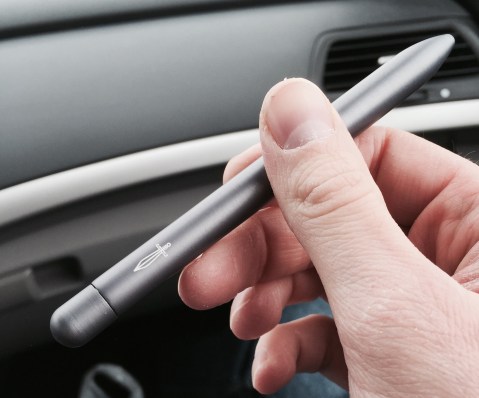
Review: Baron Fig Squire, Rollerball Ink, 0.6mm

img_4019

Many might know Baron Fig best for being one of those Kickstarter success stories. In late 2013, they raised over $168,000 to create “notebooks for thinkers,” a project which was subsequently spun-off into an online business with a growing product line. And not content to rest on those laurels, Baron Fig launched another Kickstarter project late last year for a companion product to their notebooks: a pen dubbed the Squire. This second project was also successful, raising $145,249 – of which I contributed $50 so that I could have a Squire of my very own.

As a fan of the Retro 51 Tornado, the Squire immediately felt very comfortable. In fact, it’s easy to see that the Squire took much of its inspiration from the Tornado; the comparisons are obvious. Both have a twist-style retracting mechanisms at the top of the barrel, both use a branded Schmidt rollerball refill (though the Tornado uses a 0.7mm point, as opposed to the Squire’s 0.6mm point), and even their packaging is very similar.

img_4318

Sadly, I had a couple issues with the Squire right out of the box. First, the refill that came with the pen was a dud – no big deal for me, though, because I have plenty of extra refills laying around. Second, the retracting mechanism was a bit defective. When twisted, it felt as if there were gravel stuck inside the threads, and it jammed every now and again. After a couple days, however, this kink worked itself out, and it was smooth sailing.

It took a couple weeks of use, but I grew to like the Squire quite a lot. The anodized finish looks and feels great, the aluminum body has a great weight, and I love the shape of the barrel, which thickens near the bottom before contracting at the tip – it looks like the blade of a xiphos sword (the type used for the pen’s logo). And after a while, I only had one big complaint left: there’s no clip.

It’s certainly a slick design, but without a clip, the Squire is really best used as a desk-only pen. In my everyday use, this pen rolled off tables and fell out of my pocket frequently, which is probably why I eventually lost it. And take my word for it, it’s a pretty awful feeling when you’ve realized a $50 pen has gone missing. My only hope is that it’s become the prized possession of a hapless pedestrian who stumbled onto it.

Honestly, I’ve been tempted to buy another (the Squire is now available from Baron Fig’s website for $55 for those who missed the Kickstarter campaign), but I don’t know if I could handle misplacing a second one.

img_4319
The Baron Fig’s empty (bah!) packaging.

Extra Links

  • Here’s a review at The Well Appointed Desk that shows off the silver version of the pen, which apparently picks up a lot of visible dirt. I chose the charcoal version, the only other option, which I think looks cooler anyway.
  • Another review at Woodclinched. Here you can see the silver and charcoal versions side by side. I guess the silver version might be better if you’re looking to match your Apple gear. Side note: it seems like I’m not the only one who prefers to have a pocket clip attached to a pen.
  • A review at Office Supply Geek where he highly recommends the Squire. In fact, he prefers the pen without a clip! Well, to each their own.

Retro Talk: The Joey Feldman Edition

Earlier this year, before I was blown away by Retro 51’s Summer 2016 catalog (pdf), Vanness Pens cropped up with its very own Retro 51 exclusive that drew my eye: The Joey Feldman “Artist Series” Tornado.

img_4298

Primarily known for his colorful and “cartoon-ish” portraits of pop-culture icons like Peewee Herman, Eminem, and Donald Trump, Feldman also has a knack for drawing some pretty creepy monsters. So, when commissioned to design the wrap for this Tornado, it seems that he came up with something that’s both vibrant and (on close inspection) a little ghoulish. It’s definitely one of the most visually stunning pens I own, making it very nice to both use and display.

This Tornado was limited to 500 total pieces; 250 were made with a black clip and 250 were made with a red clip. Both versions are individually numbered (I have #149), but the red-clip version, besides costing $20 more, also comes with a signed print of Feldman’s design. Though, take it from me, it’s difficult to find a frame that will fit its 12.75″ x 5.75″ dimensions.

img_4299

Whenever artists or designers get involved in stationery, it usually makes for an interesting product. Even though it’s quite expensive for a Retro 51 pen, I’m happy to own this one. And though this is currently the only pen in Retro 51’s Artist Series, I sincerely hope its not the last.

img_4300

…and, as The Analog points out in their extremely detailed review, that eye inlaid at the top is pretty awesome.

Review: Baoke Office, Gel Ink, 0.5mm

img_4276

From a good distance the Baoke Office may look like an expensive executive pen. In the hand, however, it’s easy to tell that this pen isn’t worth very much money. But don’t let that discourage you, the Office is still a pen that has some worthwhile aspects.

img_4275

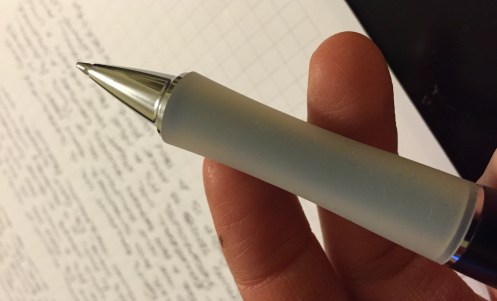
To start, the Office is reliable. It doesn’t skip or stutter, even when I’ve left it sit with the cap off for too long. The gel ink is dark, and it smears only slightly. But the best thing about the Office is its barrel, which is covered in a soft, almost velvety material – though I’m pretty sure its just some sort of rubber. It makes the pen easy to grip and comfortable to use.

Sure, there are better gel pens out there, and Baoke pens are not easy to get in the States (I bought mine off eBay for about $10 a dozen). So, I’m certain acquiring the Office is not worth the effort for most people. Still, despite the fake-gold trim, I find that I’m actually enjoying this pen.

img_4277

Notes on Sweet Tooth Field Notes

When the time comes for Field Notes to produce their quarterly edition of limited notebooks, I always appreciate when they attempt something different, and they’ve definitely accomplished that with Sweet Tooth, the recent Spring 2016 release.

img_3982

While the 3-packs of Sweet Tooth notebooks come in the typical pocket-size, 3.5″ x 5.5″, there are many new features lurking inside these little books. Most obviously, each notebook has blank and colored paper. The three colors – “Blu Raspberry,” “Banana Split,” and “Tangy Orange” (which looks more red to me) – match the colors of their respective covers.

In addition, both the covers and the paper inside these books are much more hearty than usual, clocking in at 100# and 70#, respectively – that makes for a relatively thick Field Notes notebook. For comparison’s sake, a standard Field Notes notebook has a cover stock that is 80# and paper that is 50#.


Each notebook page also comes perforated, for easy tearing. Anyone who leaves a lot of notes would do well to slip a Sweet Tooth book into a desk drawer, plucking out a page now and then whenever a scrap piece of paper is needed. The colors also allow for a color-coded note system, if you are nerdy and dedicated enough to develop one. There’s even a couple extra aesthetic flares – all the text on the notebooks’ covers are stamped with a shiny foil, and, of course, there are the black staples.

Although I appreciate the novelty of these Sweet Tooth books, I’m sorry to say that they really aren’t for me. Unlike the typical Field Notes design, these don’t offer much utility for the type of person who carries a notebook in his or her back pocket. The extra heft of the paper and cover stock makes it noticeable and, at times, uncomfortable to carry around. And though I find the perforations occasionally handy, those who like to save everything written in their notebooks will find them mostly useless.

However, if you work at a desk, prefer blank paper, and tear out a lot of pages, then Sweet Tooth will be the perfect edition of Field Notes for you. And, frankly, it’s a terrific notebook for keeping track of your next dentist appointment. You just have to leave yourself a note, hidden amongst your candy stash.

img_4239

Additional Notes

  • Of the 30 “Practical Applications” listed in the notebooks’ inside-back cover, my favorites are the following: #07. “C6H8O7 vs. C12H22O11” (i.e. sour vs. sweet); #14. “Egg Hiding Spots”; and #18. “Easter Ham Recipes.”
  • Here’s a great review at The Well Appointed Desk, who loved it, and another at Three Staples, where you can find a ton of amazing photos.
  • In case you missed it: On March 1st, I jokingly predicted that the Spring 2016 Field Notes release would be “edible notebooks.” I think I came pretty darn close with Sweet Tooth!


Review: Pilot Dr. Grip, Ballpoint, Medium Point

img_4200

If you walk through a stationery aisle every now and again, it’s likely that you’ll have at least a passing familiarity with the Pilot Dr. Grip. At my corner store, for example, there’s always one situated alone and awkwardly, hanging between a row of BICs and a row of store-brand gels. Well, Dr. Grip, the time has come to take you off the rack and out for a spin.

img_4225

Despite the small amount of shelf space it’s often given, the Dr. Grip has its fair share of fans out there. It’s a thick pen with a large and rubbery grip, which makes it quite comfortable to write with. In fact,  it is probably intentional that the pen’s name, Dr. Grip, suggests a somewhat therapeutic product.

The Dr. Grip’s ballpoint ink is surprisingly good too, darker and smoother than most – it comes close to the nice ballpoint ink of Pilot’s Acroball. Still, for a pen that is geared toward comfort,  a smoother gel or rollerball ink might have worked better. Regardless,  it’s a nice pen overall, and if writing tends to make your hand cramp up, the Dr. Grip is a pen worth considering.

img_4224