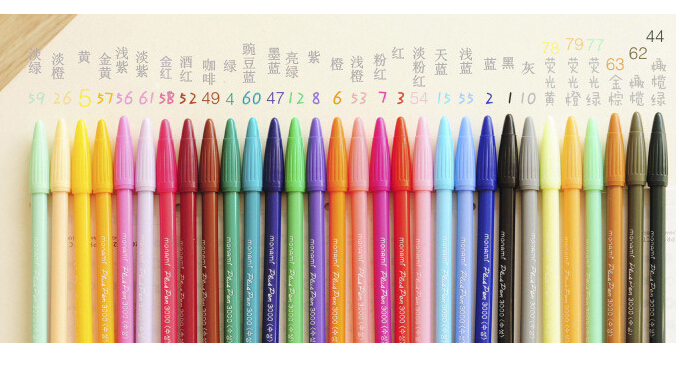
Review: Monami Plus Pen 3000, Porous Point, Fine

IMG_3146

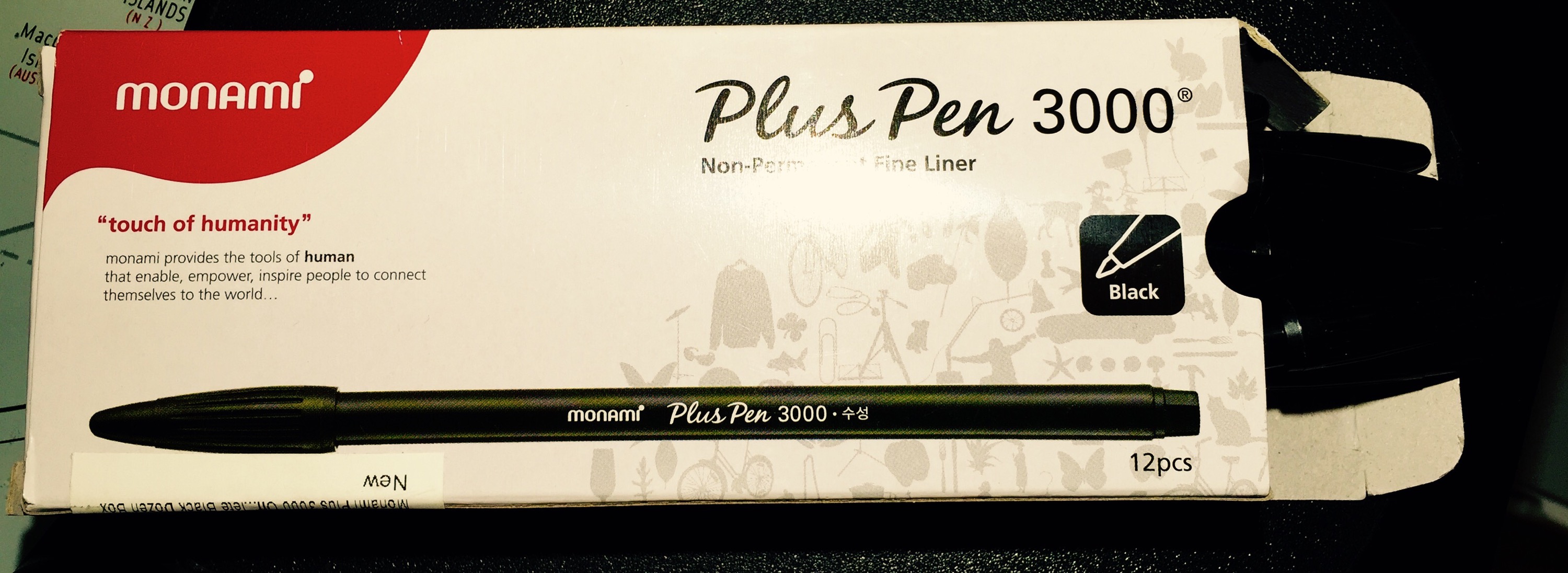
I generally like writing with porous-point pens, and the Monami Plus Pen 3000 is no exception. And while their slogan – “touch of humanity” – is a bit confusing, the pen draws a good, clean line. However, that isn’t to say that the Plus Pen 3000 is without flaws; it certainly has a few.
IMG_3134

To start, the body of the Plus Pen 3000 is very cheaply made. It’s composed of a thin, black plastic that flexes and bends. It has no grip, and it’s not particularly comfortable to write with. It also has a very short cap with no clip. So basically, it’s not the type of pen you’d want banging around in your bag or backpack, or else the cap might easily be knocked off and ink-stain everything you own.

Still, as a porous-point pen, it creates very neat lettering when writing. The ink has a moderate amount of smear, and I wouldn’t want to rely on it in a pinch. But a dozen of these in a pen cup would work fine – just call it the poor man’s Sharpie Pen.

IMG_3145

Extra Links

Review: Parker Jotter, Ballpoint Pen, 1.0mm (blue ink)

IMG_3201

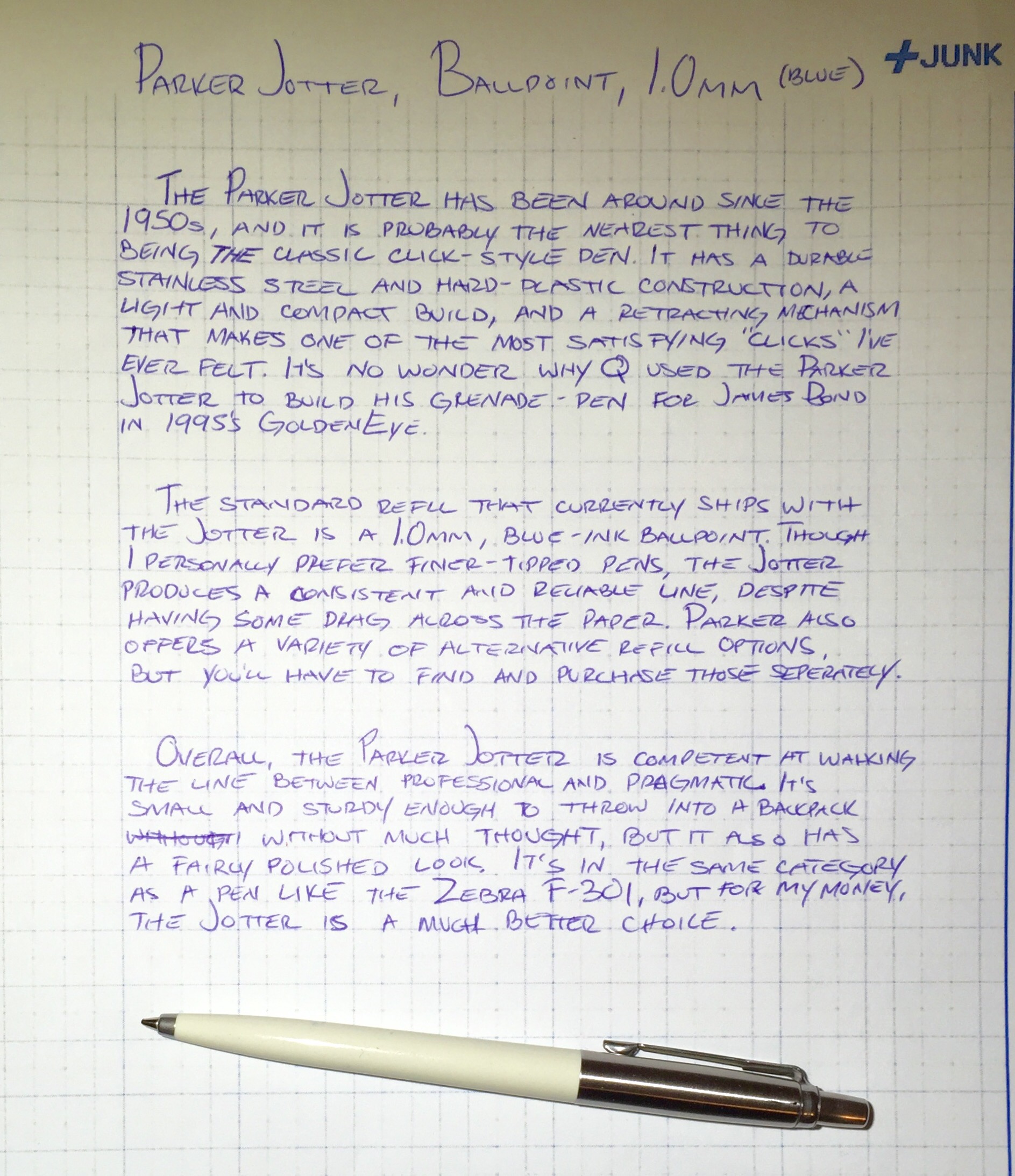
The Parker Jotter has been around since the 1950s, and it is probably the nearest thing to being the classic click-style pen. It has a durable stainless steel and hard-plastic construction, a light and compact build, and a retracting mechanism that makes one of the most satisfying “clicks” I’ve ever felt. It’s no wonder why Q used the Parker Jotter to build his grenade-pen for James Bond in 1995’s GoldenEye.

IMG_3200

The standard refill that currently ships with the Jotter is a 1.0mm, blue-ink ballpoint. Though I personally prefer finer-tipped pens, the Jotter produces a consistent and reliable line, despite having some drag across the paper. Parker also offers a variety of alternative refill options, but you’ll have to find and purchase those separately.

Overall, the Parker Jotter is competent at walking the line between the professional and the pragmatic. It’s small and sturdy enough to throw in a backpack without much thought, but it also has a fairly polished look. It’s in the same category as a pen like the Zebra F-301, but for my money, the Jotter is a much better choice.

IMG_3199

Extra Links

Review: Zebra 301A, Ballpoint, 0.7mm

IMG_3132

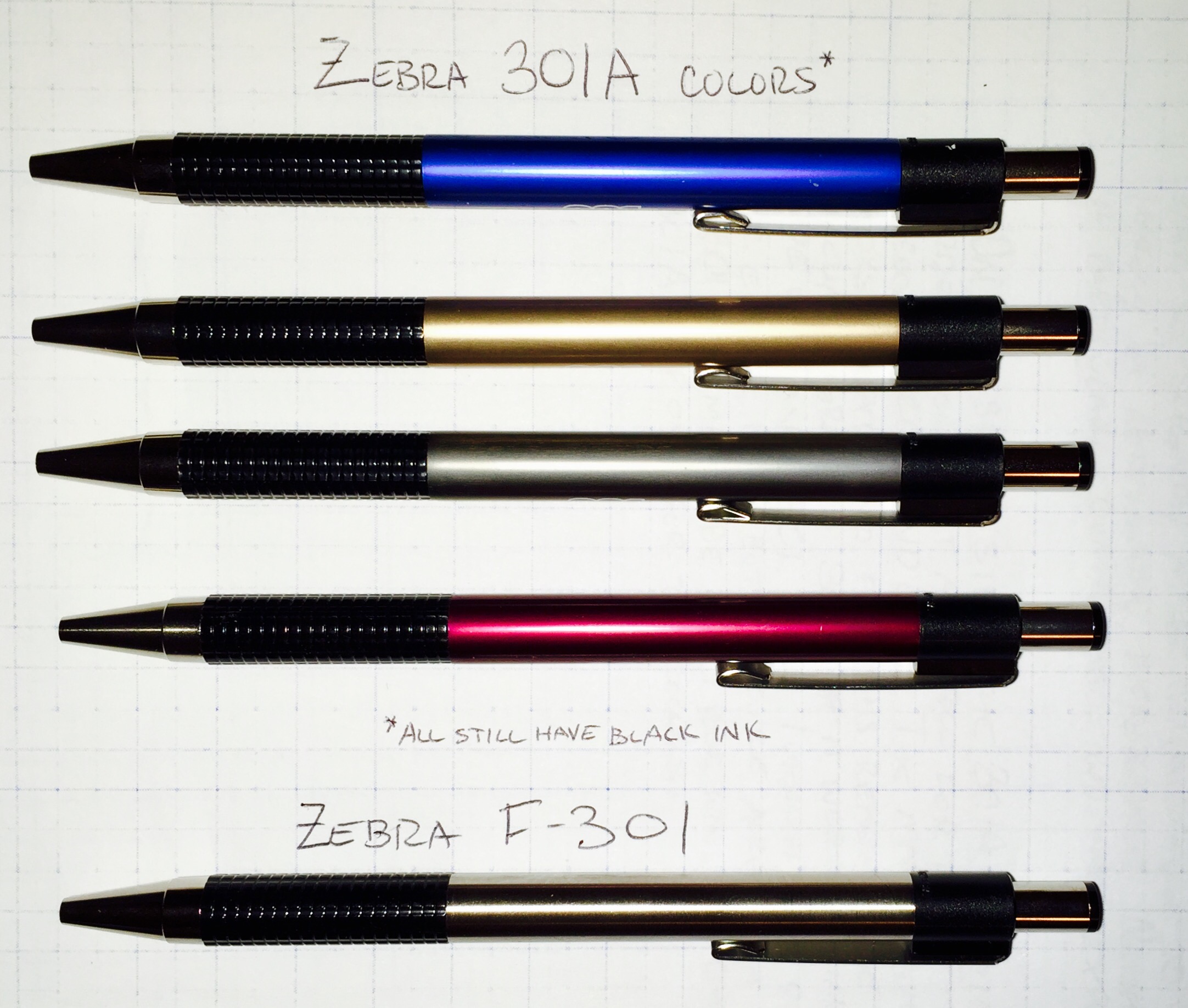
There isn’t much I can say about the Zebra 301A that I havent already said about the Zebra F-301. The only difference between the two is that the 301A has an aluminum barrel in place of the F-301’s stainless steel barrel. Other than that, the grip, the ink refill, the clip, and the retracting mechanism are all exactly the same.

I had expected aluminum to make for a lighter pen, but the weight seems to be about even with the stainless steel F-301. And while the 301A barrel is ever-so-slightly thicker (which makes it ever-so-slightly more comfortable to hold), it’s hardly a noteworthy difference. Neither pen offers a particularly comfortable writing experience.

IMG_3133

On the bright side, the 301A comes in four decorative barrel colors not available for the F-301: blue, maroon, grey, and gold. The maroon, in particular, looks great, and for this reason alone, I’d be more likely to grab a 301A if it were sitting side-by-side with an F-301. Still, I wouldn’t go out of my way for either pen, but if you’re already a fan of the F-301, it might be worth your while to check out the Zebra 301A.

IMG_3131

Extra Links

Review: Pentel Energel Deluxe RTX, Gel Ink, 0.3mm

IMG_3127

I’ve always liked Pentel Energel pens. In fact, red-ink Energels are my go-to red pen at work for their sturdy clip, minimal smear, and comfortable grip.  However, this is the first time I’ve used the extra-fine 0.3mm Deluxe RTX version, and I’m happy to say that my high regards for the Energel have not been let down.

For most people, the Pilot G-2 0.38mm is the gateway to extra-fine-tipped pens, and, while it’s a decent pen, a lot of people are turned off by its scratchiness (or the feeling like the tip of the pen is literally going to tear through the paper). The Energel Deluxe RTX, with its smoother writing experience, does a much better job of avoiding this problem. And it’s a good pen overall, really: it doesn’t bleed, doesn’t skip, and draws consistent lines.

IMG_3129

This Energel even beats out my previous favorite extra-fine-point pen, the 0.28mm uni-ball Signo RT1. While I love the stealth design of the Signo RT1, the Energel Deluxe RTX edges it out in terms of smoothness and richness of ink, and it has a much more durable design overall. So, if you’re looking for a good extra-fine tipped pen, the 0.3mm Energel Deluxe RTX is definitely the way to go.

IMG_3126

Extra Links

Review: Zebra Sarasa, Gel Pen, 0.5mm

Zebra Sarasa

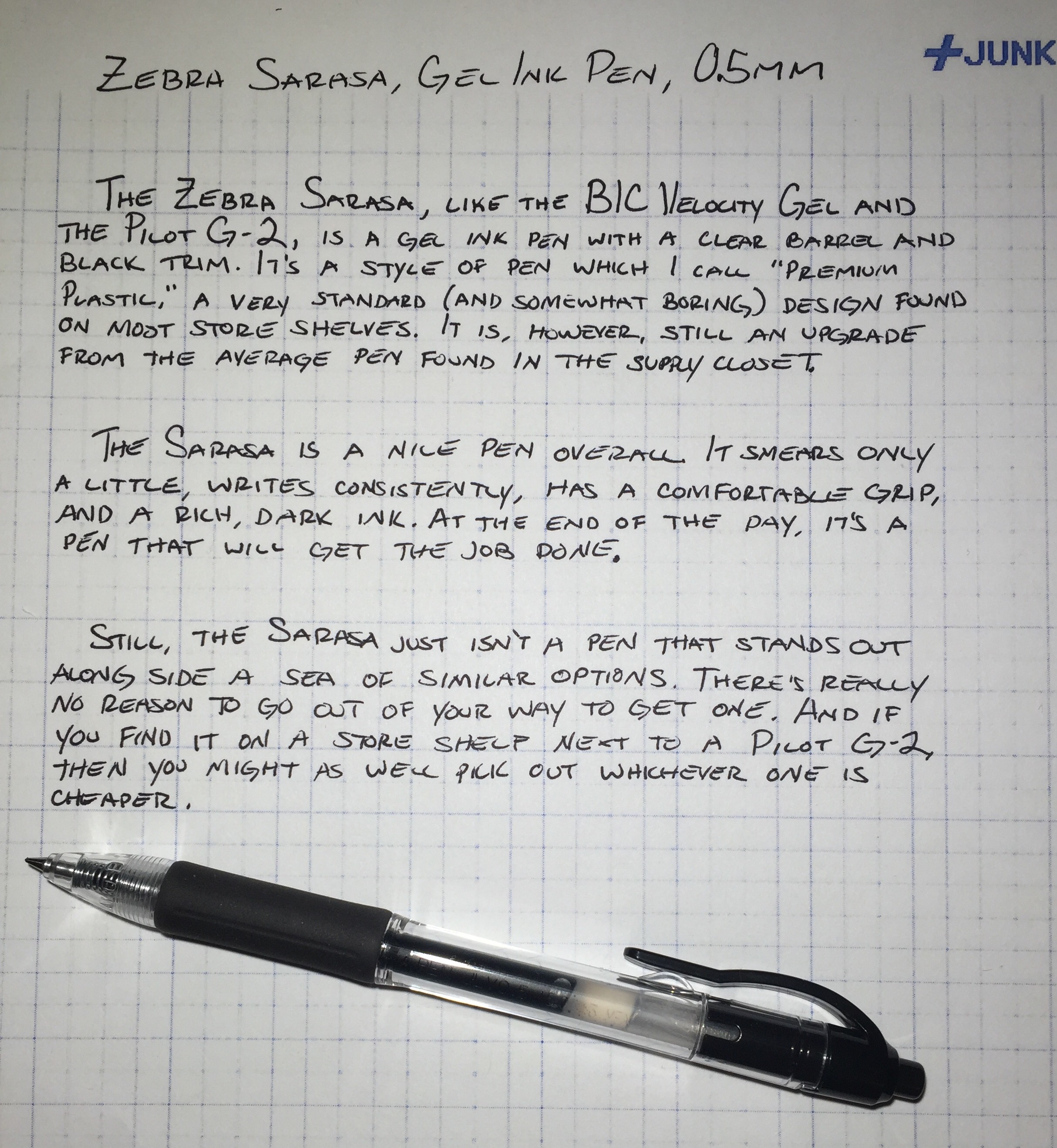
The Zebra Sarasa, like the BIC Velocity Gel and the Pilot G-2, is a gel ink pen with a clear barrel and black trim. It’s a style of pen which I call “premium plastic,” a very standard (and somewhat boring) design found on most store shelves. It is, however, still an upgrade from the average pen found in the office supply closet.

Sarasa, G-2, and Velocity Gel

The Sarasa is a nice pen overall. It smears only a little, writes consistently, has a comfortable grip, and a rich dark ink. At the end of the day, it’s a pen that will get the job done.

Still, the Sarasa just isn’t a pen that stands out along side a sea of similar options. There’s really no reason to go out of your way to get one. And if you find it on a store shelf next to a Pilot G-2, then you might as well pick out whichever one is cheaper.

Zebra Sarasa Review

Extra Links