Review: Sunacme Classical Press, Gel Ink, 0.5mm

img_7366

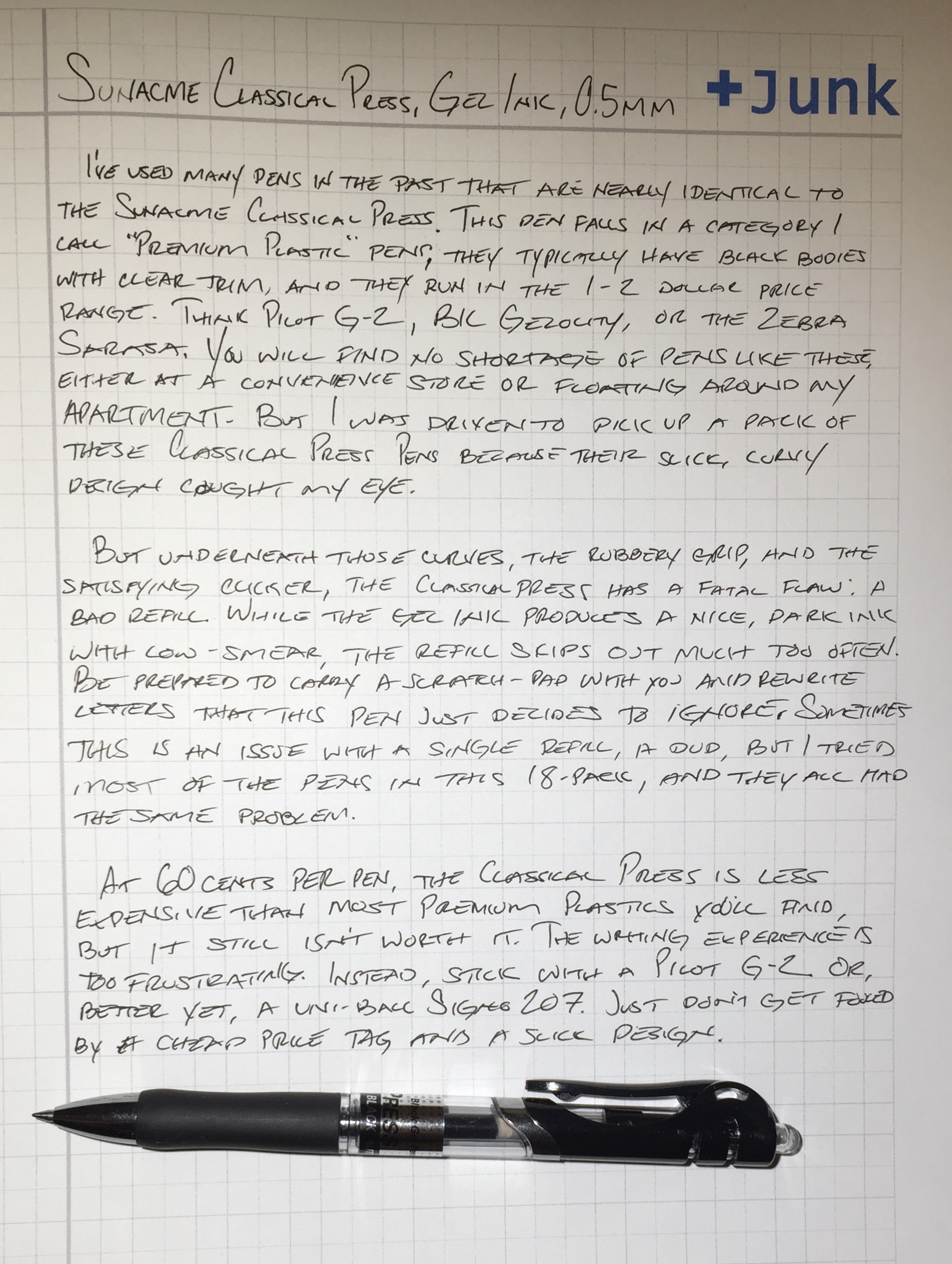
I’ve used many pens in the past that are nearly identical to the Sunacme Classical Press. It’s a pen that falls into a category I refer to as “premium plastic.” These premium plastic pens typically have clear bodies, black trim, use gel ink, and run in the $1-$2 price range. Think Pilot G-2, the BIC Gelocity, or the Zebra Sarasa. You’ll find no shortage of premium plastic pens at any convenience store, drug store, or big box store. In fact, I have plenty of these premium plastic pens floating around my apartment, but I was still driven to pick up a pack of these Classical Press pens because their slick, curvy design caught my eye.

img_7368

Besides aesthetics, the Classic press has a comfortable, rubbery grip, and gel ink that produces a respectably dark, low-smear line. Unfortunately, this is all undercut by the fact that the refill skips out much, much to frequently. When using a classic press, a scratch pad and patience for re-writing letters/words are both must-haves. I had initially hoped it was just one bad refill – a dud – but all the pens in the 18-pack I bought have this same problem.

At 60 cents per pen, the Classical Press was significantly less expensive than most other premium plastics, but it’s still not worth it for what is ultimately a frustrating writing experience. If you want a nice gel pen in the 1 or 2 dollar range, you’re better off just sticking with the Pilot G-2 or, even better, a uni-ball Signo 207. Just be sure to steer clear of the Classical Press – a slick design is no substitute for a poor refill.
img_7365

Review: Muji, Gel Ink, 0.38mm

img_7138

Muji, a Japanese retail company, has been slowly entering the United States from the coasts, with stores in Massachusetts, New York, New Jersey, and California. From across the Ocean, the company has brought its sense of frugalness, selling “no-brand” items like this gel pen that has no proper name, logo, or any such marking, aside from a “0.38” tip-size indicator located on the top of the cap.

This Muji gel pen is lightweight, thick-barreled, and made of a soft plastic that makes it fairly comfortable to grip. On the other hand, the plastic body feels fairly cheap, and even though the cap secures and posts well, it comes with a very flimsy clip. Overall, the style is similar to the Sakura Gelly Roll and the Baoke Simple.

img_7139

But one very good feature of this Muji gel pen is its ink. It flows out clean, and it barely smears. It also produces a satisfyingly dark black, and, considering its 0.38mm tip size, it flows out fairly smooth.

This pen is certainly not the best gel you’ll find – I’d consider it middle of the pack. But if you’re a fan of fine-tipped gel pens and happen across a Muji store, it’d be worth your while grab a couple. They are fairly inexpensive, and, if nothing else, it’s different enough from the typical gel pen found in American stores to at least make it interesting.

img_7141

Extra Links

Review: Skilcraft U.S. Government, Ballpoint, Medium Point

img_6963

The Skilcraft U.S. Government pen, like the Fisher Space Pen or the Parker 51, is a classic pen with a storied history. Created decades ago by the National Industries for the Blind, this pen was made to comply with a 16-page government document that mandates the specifications for ballpoint pens to be used by federal employees. For example, in order to comply with these specs, these pens must perform between -40°F up to 160°F. The ink cartridges have to write for at least 5,000 feet, and they can averaging no more than 15 ink blobs per 1,000 feet of writing. The average ballpoint wouldn’t be up to the task.

img_6964

At it’s core, however, the Skilcraft U.S. Government pen is a basic, retractable ballpoint pen, albeit one that has a professional, yet frugal quality to it. In my experience, it writes reliably with little smearing. It’s a light pen, though it still feels fairly durable, and the retracting mechanism provides a satisfyingly chunky ‘click.’ The clip is on the tight side, and it’s neither the smoothest nor is it the fanciest ballpoints around.

But, overall, I like it. Maybe the main reason I like it so much is that it’s so easy to imagine a cupful of these ballpoints atop an FBI agent’s desk. So, if I had to order pens in bulk for the government (or even for an office or a restaurant), I’d probably go with these by Skilcraft. It’s a retractable ballpoint that works well and looks nice.

img_6962

Extra Links

  • If you’re interested in more history about the Skilcraft U.S. Goverment pen, The Washington Post has this good article. Apparently, Skilcraft used to produce 21 million of these pens per year (about 30 years ago).
  • Here’s a review from No Pen Intended. It points out that this pen, mainly due to its smaller-than-average size, wouldn’t be great for marathon note-taking sessions. If find this to be true of most ballpoints, as they are not as smooth as gel or rollerball pens.
  • There’s a lot more info about Skilcraft and this pen on the Tiger Pens blog. Apparently the length of this pen equals 150 nautical miles on a Navy map. I’m sure that comes in useful from time to time.

Review: Linc Glycer, Ballpoint, Fine

img_6908

I don’t recall where I found the Linc Glycer (and I have absolutely no idea what the name Glycer means), but it’s a pen that’s remarkably similar to the Pentel R.S.V.P., only a bit smaller (or, rather, more average-sized). The Glycer is a fine-tipped ballpoint and writes cleanly with little smudging, smearing, or ink-blobbing to speak of. It has a small rubbery grip area that does little, yet is still fairly comfortable to write with.

img_6910

Besides a somewhat rinkydink clip, it’s a decent ballpoint pen. My only big complaint is that the Glycer purports to be a “super smooth ball pen,” but that just isn’t true. Its smoothness is average, at best, and it comes nowhere close to the smoothness of a hybrid ballpoint like the Pilot Acroball or a pressurized ballpoint like the Fisher Space Pen. Not that I’d expect a standard ballpoint to be able to compete with those pens, but when “super smooth” is the set expectation, it just ends up feeling more sluggish by comparison.

Anyone that would rather opt for a much cheaper ballpoint (like the BIC Round Stic, for example) instead of the Glycer won’t be missing much. Though, as a fine-tipped ballpoint that works well, nobody would be too disappointed by the Glycer either. In other words, it’s a relatively good pen, but it wouldn’t be worth expending any effort to obtain one.

img_6907

Review: Pentel Finito, Porous Point, Extra Fine

img_6866

It was practically a foregone conclusion that I was going to like the Pentel Finito, a fine-tipped, porous-point pen. Like other porous point pens, such as the BIC Intensity or the Sharpie Pen, the Finito produces a clean line that manages to make any handwriting look neater. It’s fully disposable, but it has the benefit of being a little thicker than an average plastic-bodied pen. So, it’s comfortable to use and seems fairly durable.

Unlike most porous-point pens, the Finito uses a feed system that helps keep the ink flowing smoothly, but having a feed sometimes can help a little too much. Given that it’s labeled as an “extra fine” pen, it produces a thicker line than one might expect. The Finito also suffers from some smearing and bleeding issues, though nothing I’d consider out of the ordinary.

img_6868

It’s a good pen and one that I’d recommend, but, in my experience, the Finito is difficult to find in stores – I had to order a box online. On the other hand, the Pilot V Razor Point, a very similar pen, is quite common. So even though the Finito is a bit longer, thicker, and sturdier than the V Razor Point, you might as well grab whichever you can find at your local drug store instead of shelling out extra money for shipping fees.

img_6867

Extra Links

  • A review at A Pen a Day says that the Finito bleeds through paper less than the Sharpie Pen. That’s probably true, but expect bleeding from both if you’re using thin or cheap paper.
  • The Pen Addict also laments the fact that the Finito can be difficult to find and complains of massive ink flow and bleeding. I wouldn’t call the ink flow “massive,” but, as I noted, I definitely wouldn’t call it “extra fine” either.
  • Art Supply Critic did not seem too pleased at all, calling thing Finto “mediocre.”