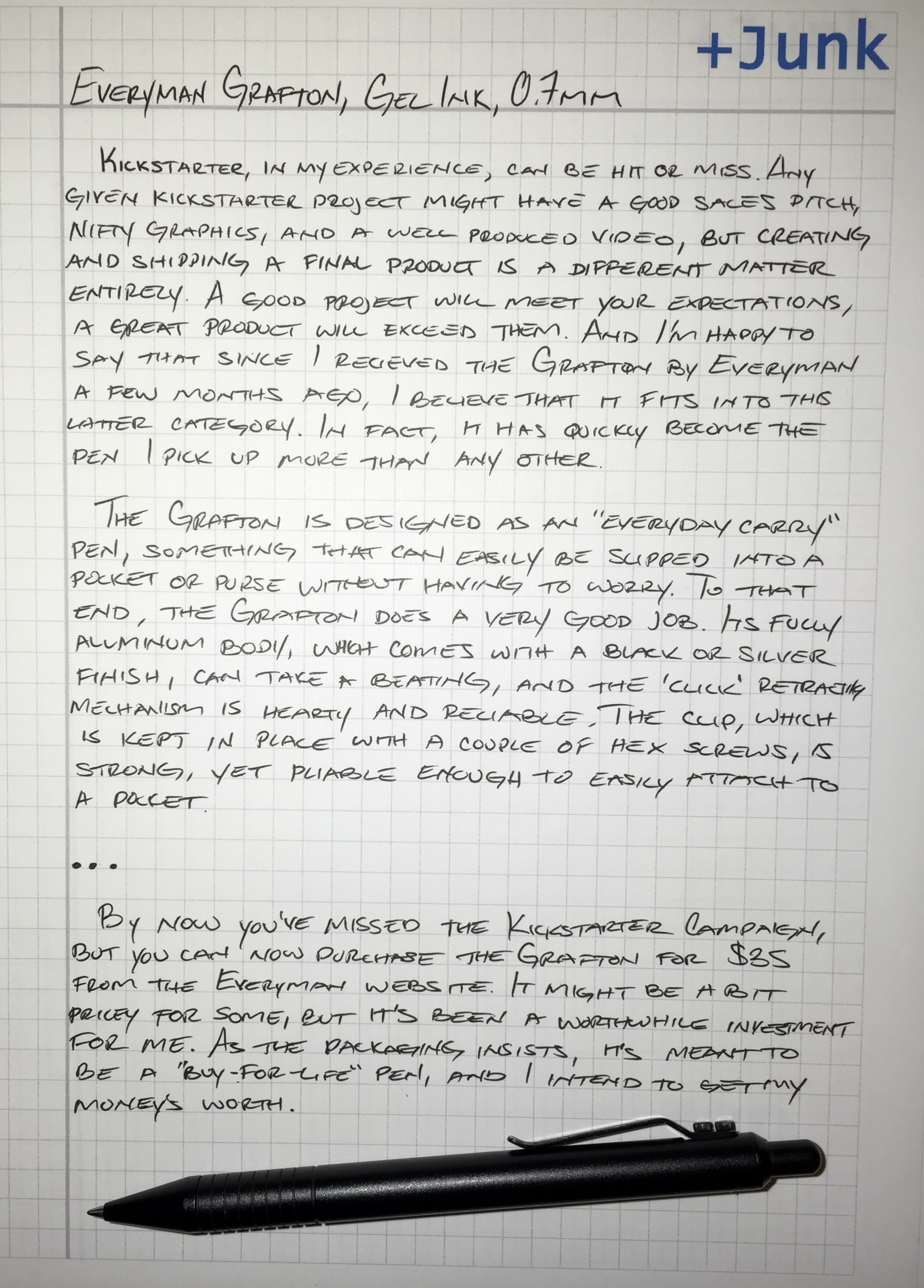
Review: Everyman Grafton, Gel Ink, 0.7mm

Kickstarter, in my experience, can be hit or miss. Any given Kickstarter project might have a good sales pitch, nifty graphics, and a well produced video, but creating and shipping a final product is a different matter entirely. A good project will meet your expectations, and a great project will exceed them. And I’m happy to say that since I received the Grafton by Everyman a few months ago, I believe that it fits into this latter category. In fact, it’s quickly become the pen I pick up more than any other.

img_4799

The Grafton is designed as an “everyday carry” pen, something that can easily be slipped into a pocket or purse without having to worry. To that end, the Grafton does a very good job. Its fully aluminum body, which comes with a black or silver finish, can take a beating, and the ‘click’ retracting mechanism is hearty and reliable. The clip, which is kept in place by a couple of tiny hex screws, is strong, yet pliable enough to easily attach to a pocket.

Inside the pen, a branded 0.7mm gel ink cartridge is included. The ink is dark and smears a bit, similar to what you might find in a Pilot G-2. But if you prefer a refill that can write through dirt and water, I was pleased to see that the Grafton also comes with parts that allow a Fisher Space Pen refill to fit inside the barrel.

img_4801

I really like this pen, but that obviously doesn’t mean it’s for everybody (despite the company’s name being “Everyman”). As you can see from my picture, the black finish does get worn with heavy use. I’m actually a fan of this worn look, but it would obviously be bothersome for anyone who likes keeping their pens looking pristine. From a dimensional standpoint, it might also be a bit big for some people. It fits into my pocket nicely, but it’s noticeably longer and thicker than other “everyday carry” pens like the Fisher Cap-O-Matic or the Zebra F-301.

My only complaint is that the threading on the barrel sometimes comes a little loose. It’s not so much that the pen falls apart, but it’s enough that I have to re-tighten it at least once a day. It takes a fraction of a second to fix and only occurs when I’ve been using the pen a lot, but I think that it’s a minor annoyance worth noting. Obviously this hasn’t deterred me at all from using the pen.

If you’re interested in the Grafton, you’ve unfortunately missed the Kickstarter campaign. However, you can now purchase one from the Everyman website for a little more money – $35. It might be a tad pricey for some, but it’s been a worthwhile investment for me. As the packaging insists, it’s meant to be a “Buy-For-Life” pen, so I intend to get my money’s worth.
img_4802

Notes on Coal x DDC x USA Field Notes

img_4311

Back in January of 2014, Draplin Design Co. and Coal Headwear came together to produce a set of Field Notes in homage of Old Glory. This special edition, known as the Coal X DDC X USA Edition, was limited to 5,000 3-packs, which – of course – sold out quickly. Luckily, many 3-packs were held back for inclusion in a special “USA Kit” sold by the Coal and DDC websites, and much to my surprise, I found that this kit is still available for purchase. So, I happily ordered one, and it came in time for Independence Day this year.
img_4305

The kit includes a USA patch and trucker hat, along with the pack USA-themed Field Notes pocket notebooks. Each notebook cover features a solid blue background atop a red and white-striped lower third. The cover stock is a hefty 100#, heavier than the 80# stock used in the standard Kraft edition. The innards contain a gray-inked graph, printed on 50# white paper.

If you’re a fan of pocket notebooks, then it’s obviously a perfect choice for July. As usual with Field Notes, I love their look as the book slowly gets used and worn. The red ink on the inside cover does seem to rub off onto the outer layers of paper over time, but as far as complaints go, that’s pretty minor. 

Otherwise, it feels like a pretty typical Field Notes notebook. It’s worth the cost of the Kit only if you’re feeling extra patriotic. My only real concern is that I look pretty goofy in a trucker hat, USA-themed or otherwise.

img_4748

Additional Notes

  • Though the practical application list (printed in the back, inside cover) is very similar to that of the standard Kraft Field Notes, the Coal X DDX X USA edition varies somewhat. Among my favorite variants: “02. Color Predictions”; “08. Badge Schematics”; and “16. Couches To Crash On.”
  • According to Jinnie at Three Staples, the paper used in this edition is different from what Field Notes typically uses. And it’s worth noting, she feels this paper isn’t as smooth. Personally, I hadn’t noticed a difference.
  • As usual, the notebook’s specifications page names each color used in the printing. Apparently, the notebook uses “Wenatchee White,” “Ballard Blue,” and “Rainier Red” (with a little bit of “Yakima Yellow” text) for the cover. However, the official names of colors used on the United States flag are “White,” “Old Glory Red,” and “Old Glory Blue.”

Book Review: Paper by Mark Kurlansky

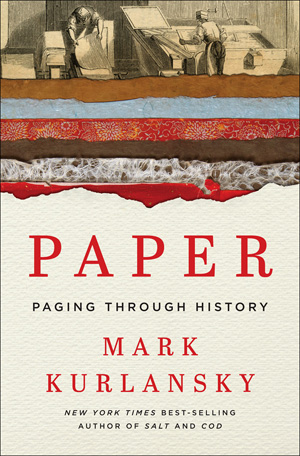
Most of us spend very little time thinking about paper, but for a moment, consider its abundance in our day-to-day lives. Even for those that eschew physical books, notepads, and snail mail, it can be hard to ignore paper’s many other forms: wall paper, toilet paper, movie posters, restaurant receipts, product packaging, and billboard advertisements, to name just a handful. The stuff is everywhere, and since its invention in China around 2,000 years ago, paper has played a pivotal role in art, education, communication, and bureaucracy. In his new book Paper: Paging Through History, Mark Kurlansky chronicles the impact paper has had in our society over these many years.

9780393239614_300

Anyone familiar with Steven Johnson’s How We Got to Now, the book or the PBS documentary, will be familiar with the style Kurlansky uses in Paper. Rather than dictating a straight timeline of events, Kurlansky describes the history of society with paper at its center-point. In other words, while the invention and technical development of paper is a main feature, the broader lesson is in how paper affected subjects like literacy, spoken language, science, religion, and record-keeping throughout the millennia.

Paper begins with the invention of written language and the use of pre-paper products (such as papyrus, wax tablets, and parchment), as well as a bit of speculation paper’s origins. It then follows the trail of paper from the East, through the Middle East , and into Europe and North America. Along the way the process has changed, new uses for the product were found, and paper-making became a large-scale industry. You might be surprised, but it’s a long journey from manually-produced paper, made primarily from discarded rags, to the machine-produced paper, made primarily from farmed wood-chips. Also included is a discussion of the future of paper in our digital world, the resurgence of artisanal paper, and the environmental impact of the mass-production in paper.

Overall, the style might be a bit on the dry side for some readers. The book isn’t written in the fun, light style of non-fiction authors like Mary Roach or Sarah Vowell. But for those interested in a bit of history, much of it will be truly fascinating. Consider the following question: if paper was invented in China, why did the printed book industry take hold in Europe first? If that’s the sort of thing that makes you scratch your chin, then I’d definitely recommend picking up a copy of Paper.

Review: Retro 51 Slim Tornado, Ballpoint, Medium Point

img_4662

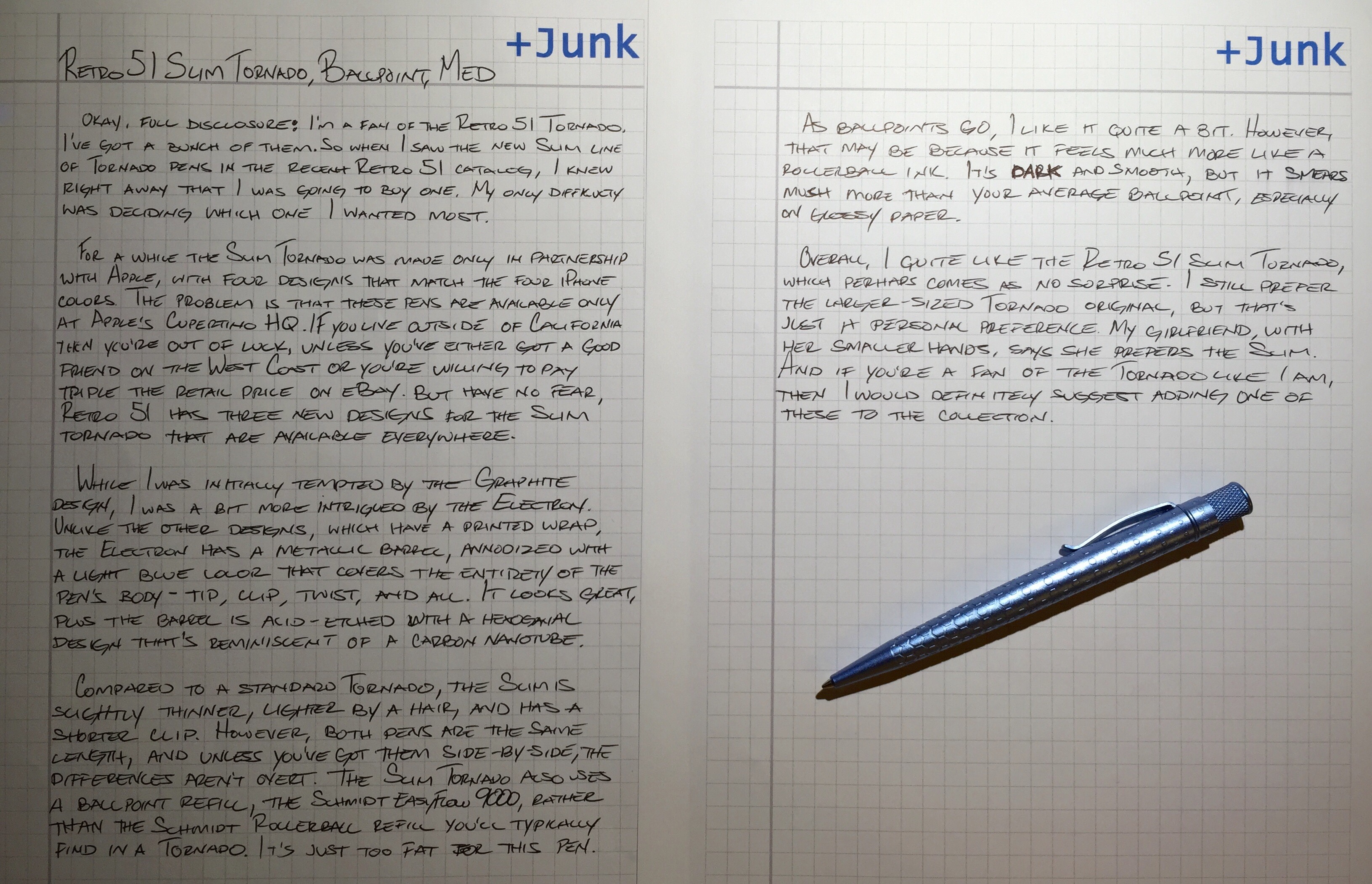
Okay, full disclosure: I’m a fan of the Retro 51 Tornado. I’ve got a bunch of them. So when I saw the new Slim line of Tornado pens in the recent Retro 51 catalog, I knew right away that I was going to buy one. My only difficulty was deciding which one I wanted most.

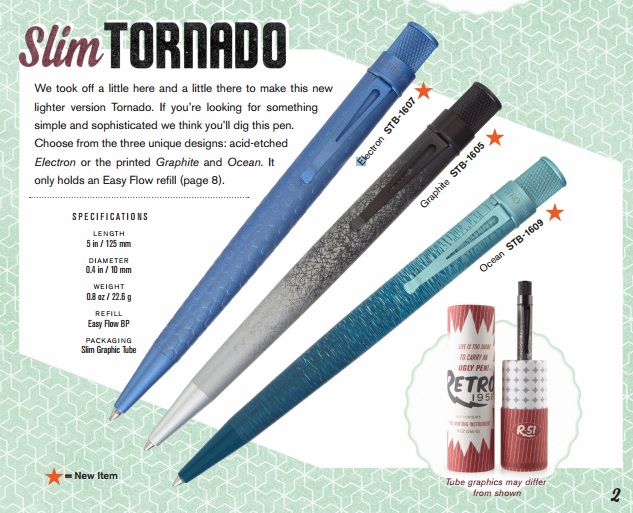
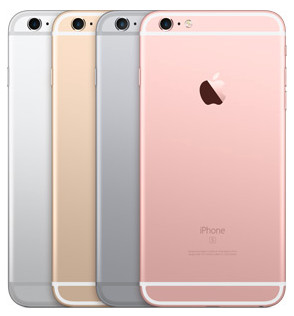
For a while the Slim Tornado was made only in partnership with Apple, with four designs that match the four iPhone colors. The problem is that these pens are available only at Apple’s Cupertino headquarters. If you live outside of California then you’re out of luck, unless you’ve either got a good friend on the West Coast or you’re willing to pay triple the retail price on eBay. But have no fear, Retro 51 has three new designs for the Slim Tornado that are available everywhere.

Retro-51-Slim-cat

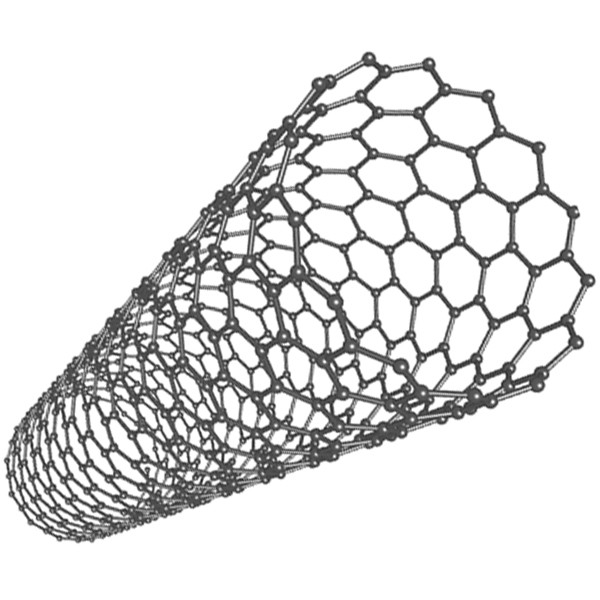
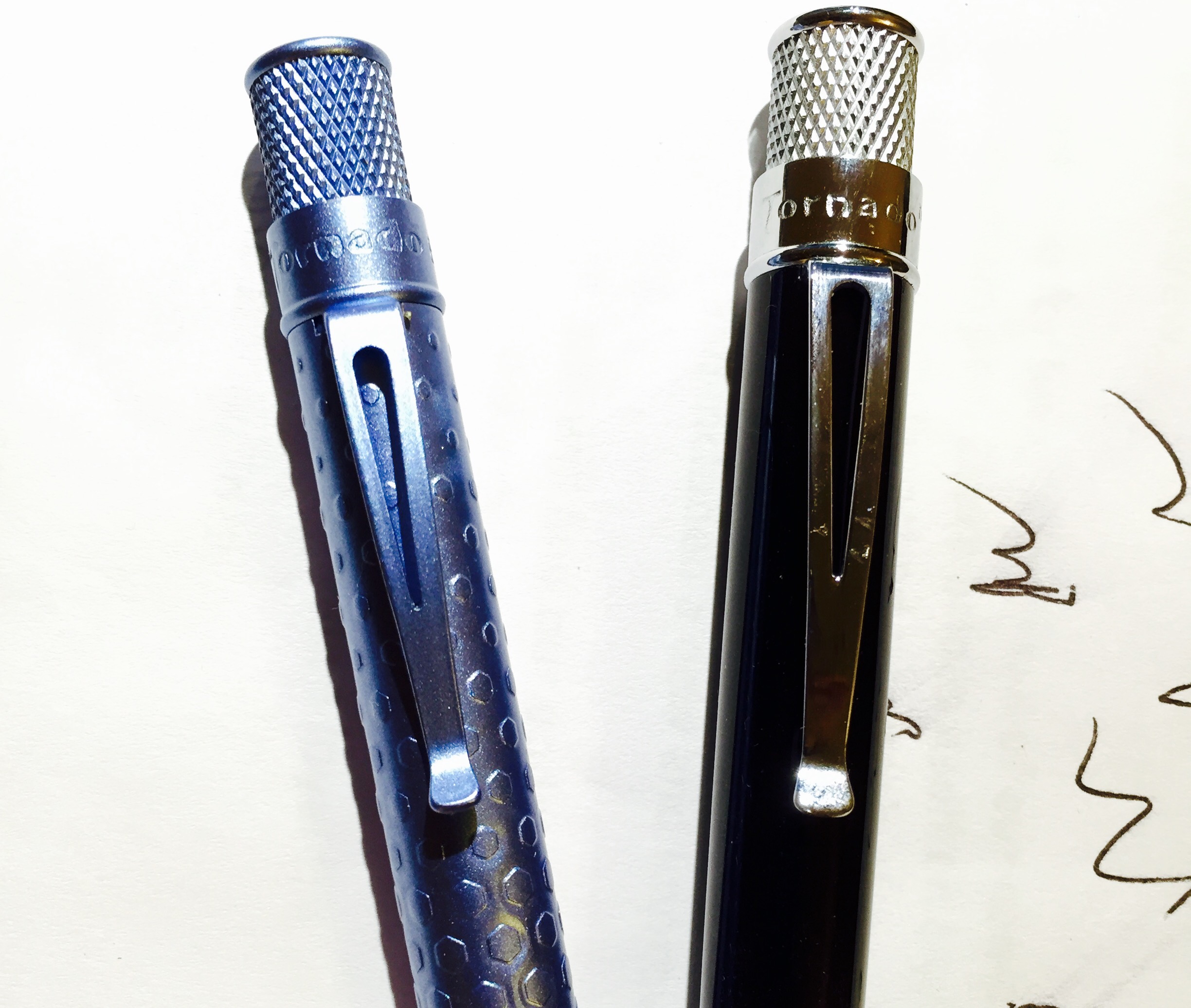
While I was initially tempted by the Graphite design, I was a bit more intrigued by the Electron. Unlike the other designs, which have a printed wrap, the Electron has a metallic barrel, anodized with a light blue color that covers the entirety of the pen’s body – tip, clip, twist, and all. It looks great, plus the barrel is acid etched with a hexagonal design that’s reminiscent of a carbon nanotube.

Compared to a standard Tornado, the Slim is slightly thinner, lighter by a hair, and has a shorter clip. However, both pens are the same length, and unless you’ve got them side-by-side, the differences aren’t overt. The Slim Tornado also uses a ballpoint refill, the Schmidt EasyFlow 9000, rather than the Schmidt Rollerball refill typically found in a Tornado  (which is just too fat for this pen). As ballpoints go, I like it quite a bit. However, that may be because it feels much more like rollerball ink. It’s dark and smooth, but it smears more than your average ballpoint, especially on glossy paper.

Overall, I really like this Retro 51 Slim Tornado, which perhaps is no surprise. I still prefer the larger-sized Tornado original, but that’s just a personal preference. My girlfriend, with her smaller hands, says she prefers the Slim. And, regardless, if you’re a fan of the Tornado like I am, then I would definitely suggest adding one of these to the collection.

Review: Paper Mate Inkjoy 550RT, Ballpoint Ink, 1.0mm

img_4619

While there’s a huge variety to Paper Mate’s line of Inkjoy pens, the Inkjoy 550RT is the only one which is “designed for fun.” At least, that’s according to Paper Mate’s marketing department. In reality, however, there’s nothing that’s exactly “fun” about the 550RT, but it still manages to be a decent, disposable ballpoint pen.

PaperMateInkJoy-DesignedForFun

Really, the design of the Inkjoy 550RT is nice but also relatively plain. Each end of the barrel is covered with a rubbery grip that narrows towards the pen’s middle, creating a very subtle and relatively comfortable hourglass shape. It has faux-chrome accents, a sturdy clip, and a clicker that’s reliable, though not terribly robust.

The ballpoint ink is surprisingly smooth and smear-free, and it dries darker than what you’d find with a cheaper ballpoint. Although it’s not quite up there with the Pilot Acroball or uni-ball Jetstream, it’s still a worthwhile product if you’re looking to buy a handful of ballpoints for only a few bucks. Only, you should be sure that your expectation for “fun” isn’t set too high.

img_4620