Retro Talk: The Albert and the Schmidt P8126

IMG_3282

Since I began this blog four months ago, there’s been one pen I’ve picked up more than any other: the Retro 51 Tornado. It looks good, feels good, and writes great, and at 20 to 30 dollars, it manages to be a really nice pen without being too expensive. Retro 51 also offers the Tornado in a lot of different colors and designs that can give the pen a nice personal flair. One of these designs that stuck me immediately was the Albert.

It’s technically part of Retro 51’s Vintage Metalsmith series, but the construction of the Albert Tornado is identical to their Classic Lacquers with a special design wrapped around the barrel. It’s meant to look like a chalkboard, and written on it is a proof for the famous equation E = mc². As far as I can see, the proof is accurately depicted, and the science nerd inside of me really loves this design.

IMG_3283
The metal twist, clip, and tip of the Albert also has a more “aged” look to it, compared to the Classic Lacquer

As for the innards of the pen, it comes with the standard 0.7mm Retro 1951 rollerball refill. It’s a good refill – smooth and dark – but I tend to prefer a tip that’s a bit finer. One popular refill that fits the Retro 51 Tornado is the Schmidt P8126. From what I understand, the standard Retro 51 refill is a re-branded Schmdt, and the P8126 is the 0.6mm version of that same refill.

IMG_3285

Like the branded version, the Schmidt p8126 is a great refill, and while there is definitely a difference in line width, it is far from substantial to my eye. At the end of the day, I’ll still go for the finer 0.6mm refill, but I’d really be happy with either.

No matter what, I’m looking forward to playing around with other Retro 51 pens, and I’ll be sure to write about it when I do.

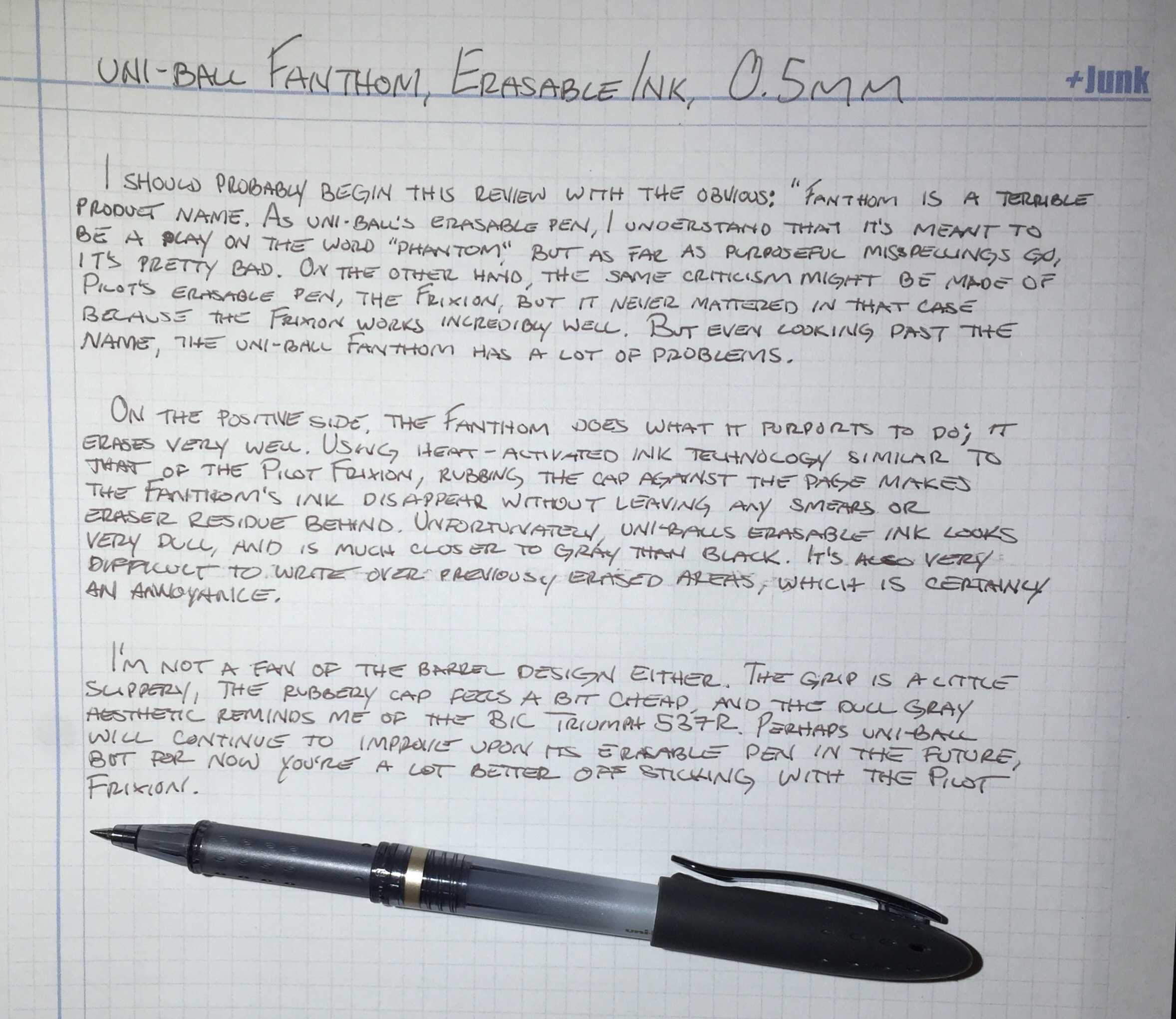
Review: uni-ball Fanthom, Erasable Ink, 0.5mm

IMG_3241

I should probably begin this review with the obvious: “Fanthom” is a terrible product name. As uni-ball’s erasable pen, I understand that it’s meant to be a play on the word “phantom,” but as far as purposeful misspellings go, it’s pretty bad. On the other hand, the same criticism might be made of Pilot’s erasable pen, the Frixion,  but it never mattered in that case because that Frixion works incredibly well. But even looking past the name, the uni-ball Fanthom has a lot of problems.

On the positive side, the Fanthom does what it purports to do; it erases very well. Using heat-activated ink technology similar to that of the Pilot Frixion, rubbing the the cap against the page makes the Fanthom’s ink disappear without leaving any smears or eraser residue behind. Unfortunately, uni-ball’s erasable ink looks very dull and is much closer to gray than black. It’s also difficult to re-write over previously erased areas, which is certainly an annoyance.

IMG_3240

I’m not a fan of the barrel design either. The grip area is a little slippery, the rubbery cap feels a bit cheap, and the dull gray aesthetic reminds me of the BIC Triumph 537R. Perhaps uni-ball will improve upon its erasable pen in the future, but for now you’re a lot better off sticking with the Pilot Frixion.

IMG_3239

Extra Links

  • Well Appointed Desk has a nice post reviewing the Fanthom and Frixion pens. Lots of pictures. She saw some residue from the eraser of the Fanthom, which looks more like residue from the erased ink to my eye.
  • A review from No Pen Intended, which she says is overall on par with the Frixion. My favorite sentence from this review: “For those of you looking to build up your writer’s callous, look no further.”
  • A review from Pen Addict. He also had trouble re-writing over previously erased areas. The Frixion has this issue too (see above picture), but not nearly to the same extent.

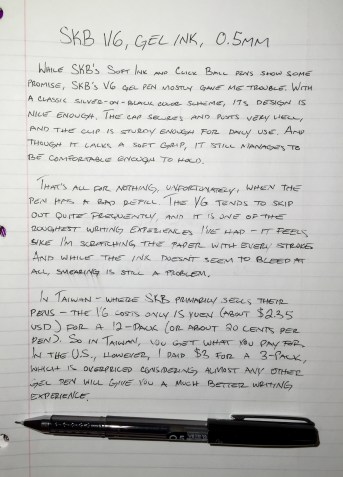
Review: SKB V6, Gel Ink, 0.5mm

IMG_3230

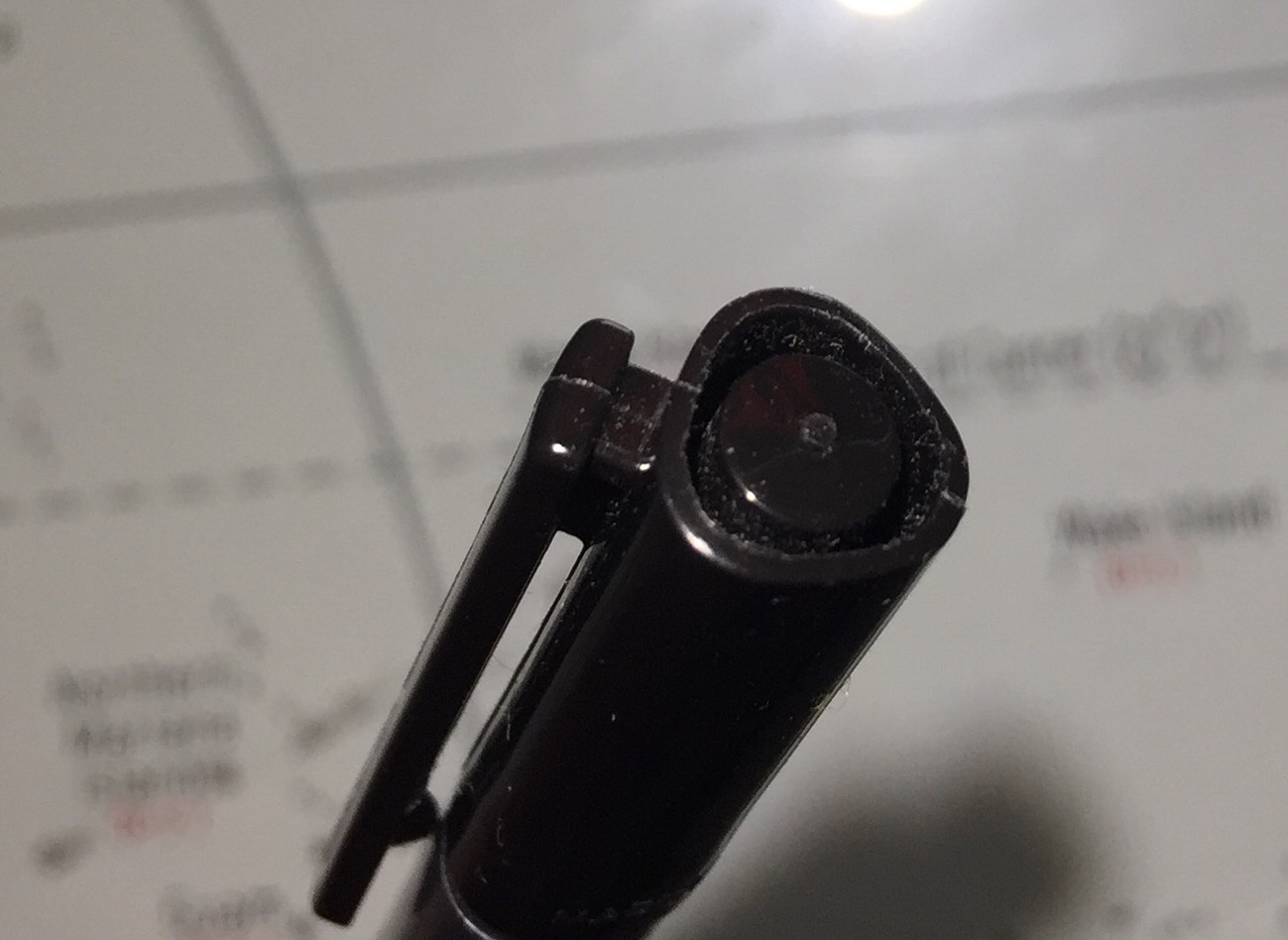
While SKB’s Soft Ink and Click Ball pens showed some promise, SKB’s V6 gel pen mostly gave me trouble. With a classic silver-on-black color scheme, its design is nice enough. The cap secures and posts very well, and the clip is sturdy enough for daily use.  And though it lacks a soft grip, it still manages to be somewhat comfortable to hold.

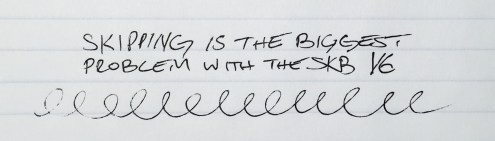
That’s all for nothing, unfortunately, when the pen has a bad refill. The V6 tends to skip out quite frequently, and it is one of the roughest writing experiences I’ve had – it feels like I’m scratching the paper with every stroke. And while the ink doesn’t seem to bleed at all, smearing is still a problem.

IMG_3228

In Taiwan – where SKB primarily sells their pens – the V6 costs 15 Yuen (about $2.35 US dollars) for a 12-pack (or about 20 cents per pen). So in Taiwan, you get what you pay for. In the U.S., however, I paid $3 for a 3-pack, which is overpriced considering almost any other gel pen will give you a much better writing experience.

IMG_3229

Review: Staedtler Triplus Fineliner, Porous Point, 0.3mm

IMG_3218

The Staedtler Triplus Fineliner is a porous point pen, similar to the Sharpie Pen or the Monami Plus Pen 3000, but the most interesting thing about the Triuplus Fineliner is its shape. Instead of a standard round barrel, the body is more of a rounded-off triangle. According to Staedtler’s website, this shape is meant for “relaxed and easy writing,” which I’m not so sure about, but it definitely prevents the pen from rolling off my desk.

IMG_3215

As with most porous-point pens, the Triplus Fineliner produces those consistent and clean lines that make all handwriting look a little neater. Compared to the Sharpie Pen, one of my top five pens, the ink appears a tiny bit darker and smears a tiny bit less, but those differences are trivial. The big difference comes down to the barrel: which one is more comfortable?

I still prefer the slightly wider barrel of the Sharpie Pen, which I personally find a lot more comfortable to grip. However, I can see how the Triplus Fineliner might be a better fit for others. So if you’re a fan of the Sharpie Pen, it might be worth testing out the Triplus Fineliner to see if it’s right for you.

IMG_3217

Extra Links

  • Steven Combs has a great comparison of Sharpie Pens and Staedtler Triplus Fineliners. He shows that the Triplus Fineliners bleed very slightly, but not enough to be problematic. He also doesn’t like the thin barrel of the Triplus Fineliners.
  • Review at Pen Addict. Apparently, you can leave then pen uncapped for days without it drying out.
  • Review at Journaling Arts. She didn’t like the barrel either, particularly the soft-angled edges.

Review: BIC Triumph 537RT, Gel Ink, 0.5mm

IMG_3205

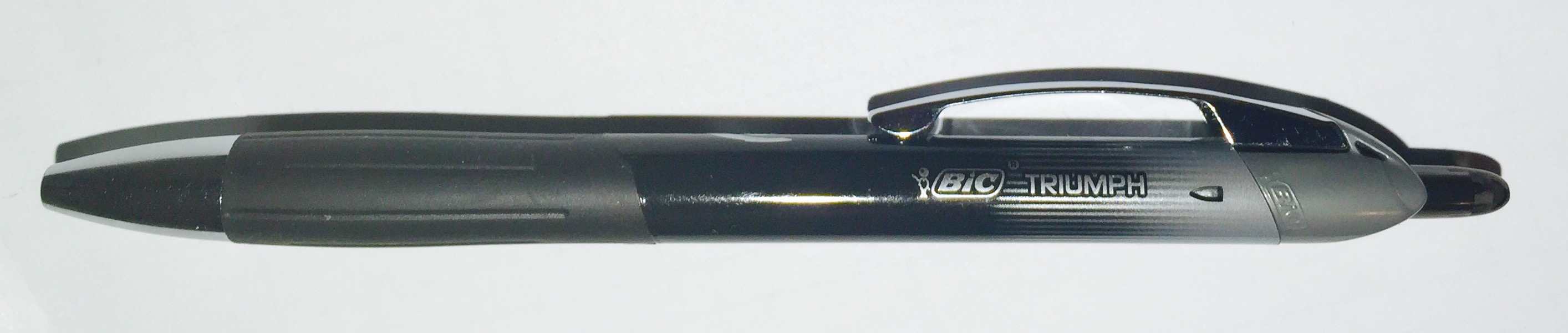
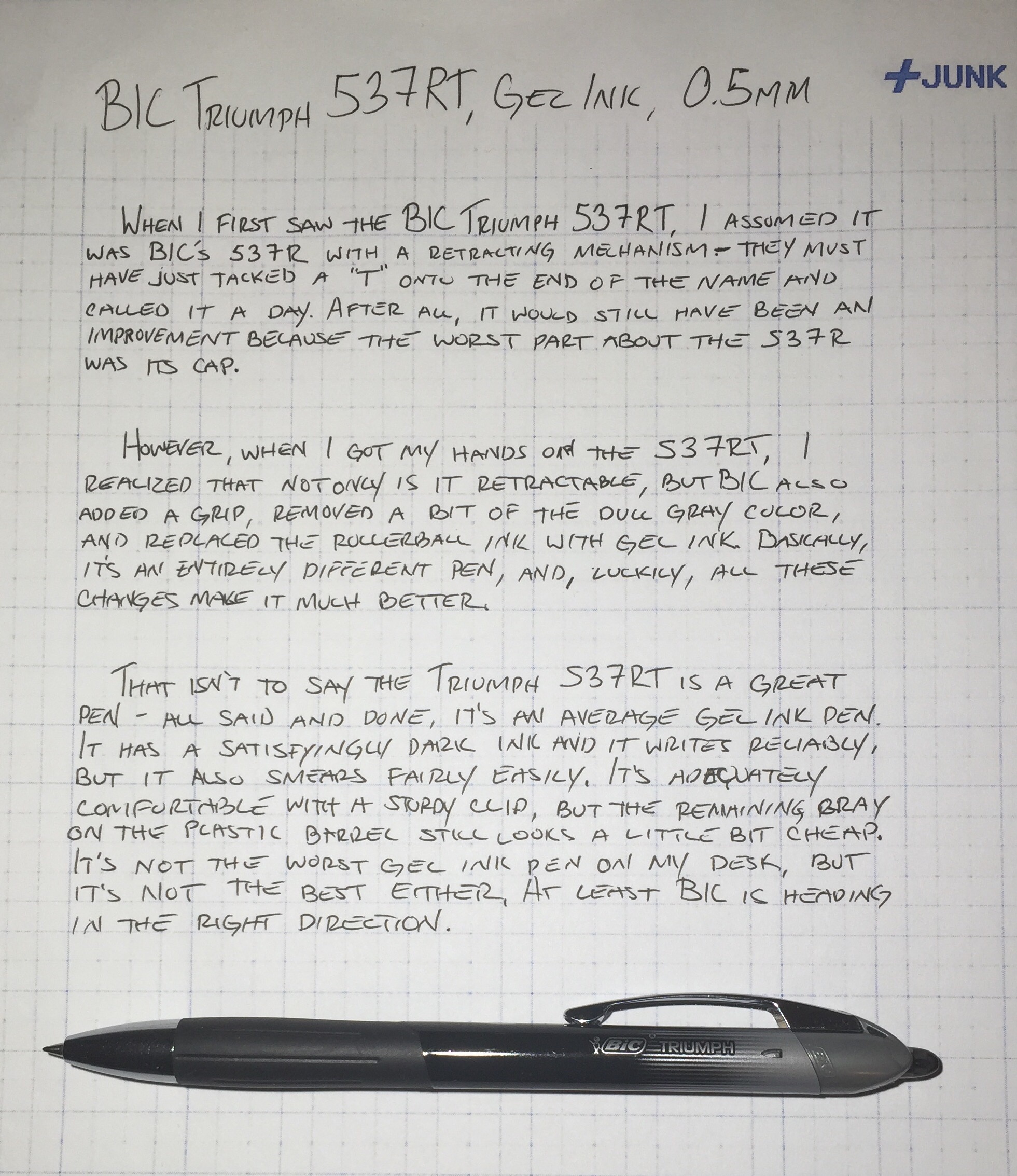
When I first saw the BIC Triumph 537RT, I assumed that BIC just took its Triumph 537R pen, added a retracting mechanism, tacked a “T” onto the end of the name, and called it a day. After all, it would have still been an improvement because the worst part about the 537R was its cap.

However, when I got my hands on the Triumph 537RT, I realized that not only is it retractable, but BIC also added a grip, removed a bit of the dull gray color, and replaced the rollerball ink with gel ink. It’s practically a different pen altogether, and, luckily, all these changes make it much better.

IMG_3206

That isn’t to say the Triumph 537RT is a great pen – all said and done, it’s an average gel ink pen. It has a satisfyingly dark ink and it writes reliably, but it also smears fairly easily. It’s adequately comfortable with a sturdy clip, but the remaining gray on the plastic barrel still looks a little cheap. It’s not the worst gel ink pen on my desk, but it’s not the best either. At least BIC is heading in the right direction.

IMG_3204