Review: Jot Roller-Tip, Rollerball Pen, 0.5mm

img_3490

Though it serves little other purpose, the Jot Roller-Tip rollerball is a good example of why people should care, at least a little, about purchasing a decent pen. After all, it’s the sort of pen that typically doesn’t warrant a second thought. It is very inexpensive, it looks nice enough, and it even has a relatively fine, 0.5mm tip . But even for the dollar or two I paid for a 3-pack, these pens are really just a waste of money.

The Jot Roller-Tip is probably one of the more inconsistent pens I’ve ever written with. Thick lines, thin lines, or no lines, you never know what you’re going to get when you put this pen to paper. It’s scratchy and rough to write with, the clip is flimsy, and the plastic end of the barrel even pops off when it clearly shouldn’t. Throw this pen in a backpack or purse at your own peril.

img_3491
Uh… I don’t think that’s supposed to just pop off like that.

On the positive side, the ink is quick-drying and, though it lacks a soft-grip section, it’s certainly comfortable enough for most uses. Still, it’s not enough to make a difference. The bottom line is that the Jot Roller-Tip is just not worth your money – no matter how little they’ll charge.


img_3489

Review: M&G R1, Gel Ink, 0.5mm

img_3483

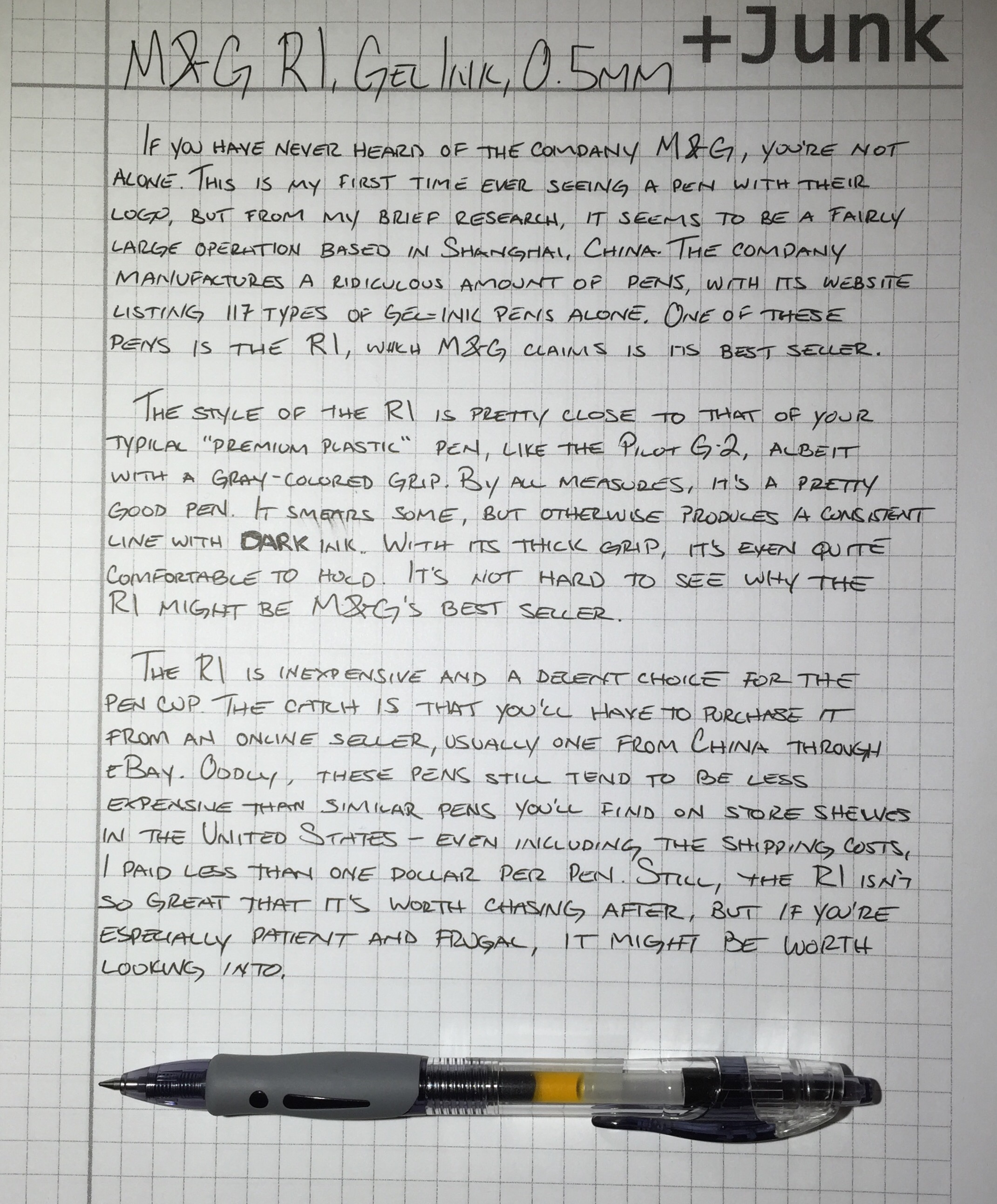
If you have never heard of the company M&G, you’re not alone. This is my first time ever seeing a pen with its logo, but from my brief research, it seems to be a fairly large operation based in Shanghai, China. The company manufactures a ridiculous amount of pens, with its website listing 117 different types of gel-ink pens alone. One of these pens is the R1, which M&G claims is its best seller.

img_3481

The style of the R1 is pretty close to that of your typical “premium plastic” pen, like the Pilot G-2, albeit with gray-colored grip. By all measures, it’s a pretty good pen. It smears some, but otherwise produces consistent lines with dark ink. With its thick grip, it’s even quite comfortable to hold. It’s not hard to see why the R1 might be M&G’s best seller.

The R1 is inexpensive and a decent choice for the pen cup. The catch is that you’ll have to purchase it from an online seller, usually one from China through eBay. Oddly, these pens still tend to be less expensive than similar pens you’ll find on store shelves in the United States – even including the shipping costs, I paid less than one dollar per pen. Still, the R1 isn’t so great that it’s worth chasing after, but if you’re especially patient and frugal, they might at least be worth looking into.

img_3482

Review: BIC Intensity, Porous Point, 0.5mm

img_3369

To date, one of my favorite pens has been the Sharpie Pen. It’s relatively inexpensive, comfortable to write with, and it has a porous point tip that delivers crisp, clear lines. Every other porous point pen has had to measure up to the Sharpie Pen, and many, like the Sakura Pigma Micron and the Staedtler Triplus Fineliner, have come very close. But for one reason or another, I always go back to the Sharpie Pen.

And then there was the BIC Intensity.

img_3365

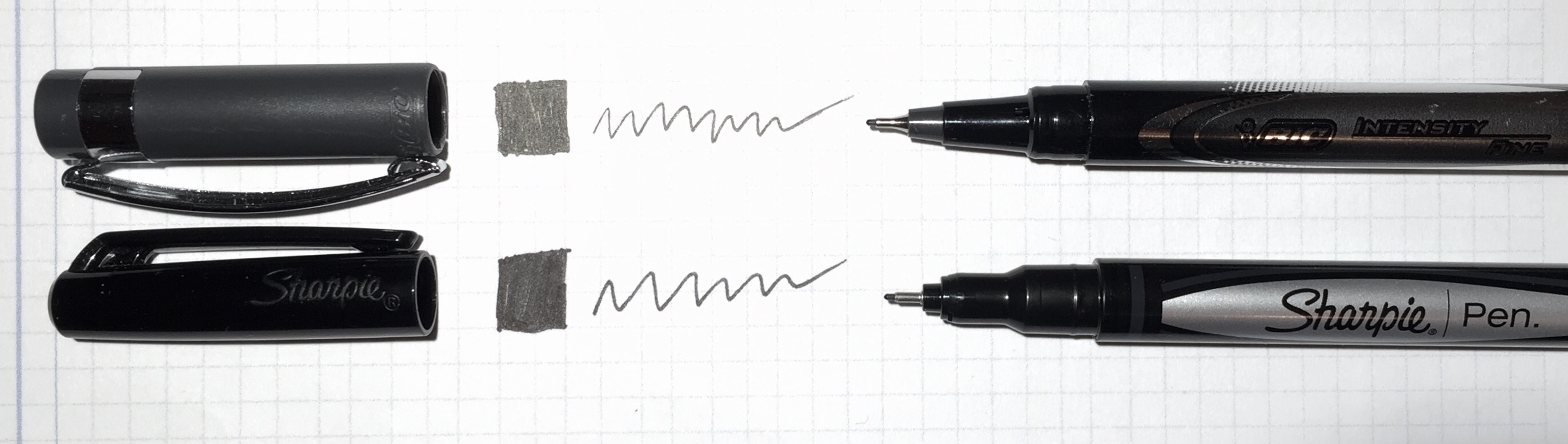
It’s not that the BIC Intensity is much different from the sharpie Pen. In fact, it’s very similar in most ways. The length and thickness are about the same, they are both fully disposable, and they both contain a nice-quality ink (perhaps the Sharpie Pen’s ink is even a bit darker). But the Intensity edges out the Sharpie Pen for one reason; it has a more durable build.

Holding the two pens together, it’s easy to see and feel. The BIC Intensity has a thicker cap with a metal clip. The plastic construction seems harder, and it feels ever-so-slightly heavier. All of this makes the Intensity better for throwing in a pocket, backpack, or bag – perhaps only slightly, but enough to make a noticeable difference.

I still like the Sharpie Pen, and I have no doubt that I’ll continue to use and recommend it. However, it’s the BIC Intensity that I’ll reach for first.

img_3366

Extra Links

  • Rhonda Eudaly’s review points out that the porous tip will break down over time. Though, that’s true for all of these porous point pens.
  • A review at Well Appointed Desk shows off some of the colors. Also, she has a paragraph at the end about why you might choose the Intensity over the Sakura Pigma Micron or Sharpie Pen, but overall she says the performance is very comparable.
  • My favorite line from the Pen Addict review: “Overall, there aren’t any standout negatives, which is a rarity coming from Bic.”


Review: SKB Roller Tip, Rollerball Ink, 0.5mm

img_3363

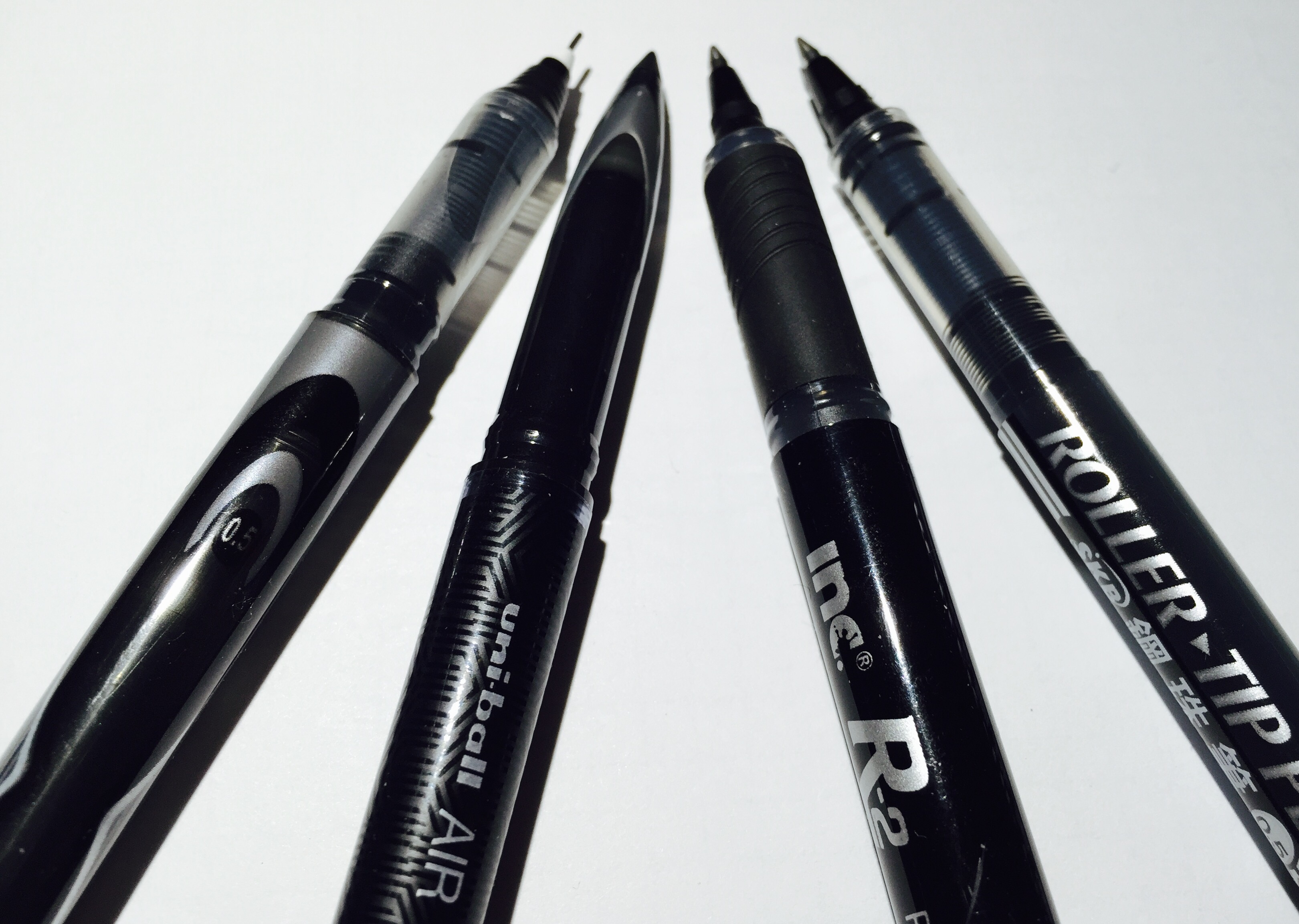
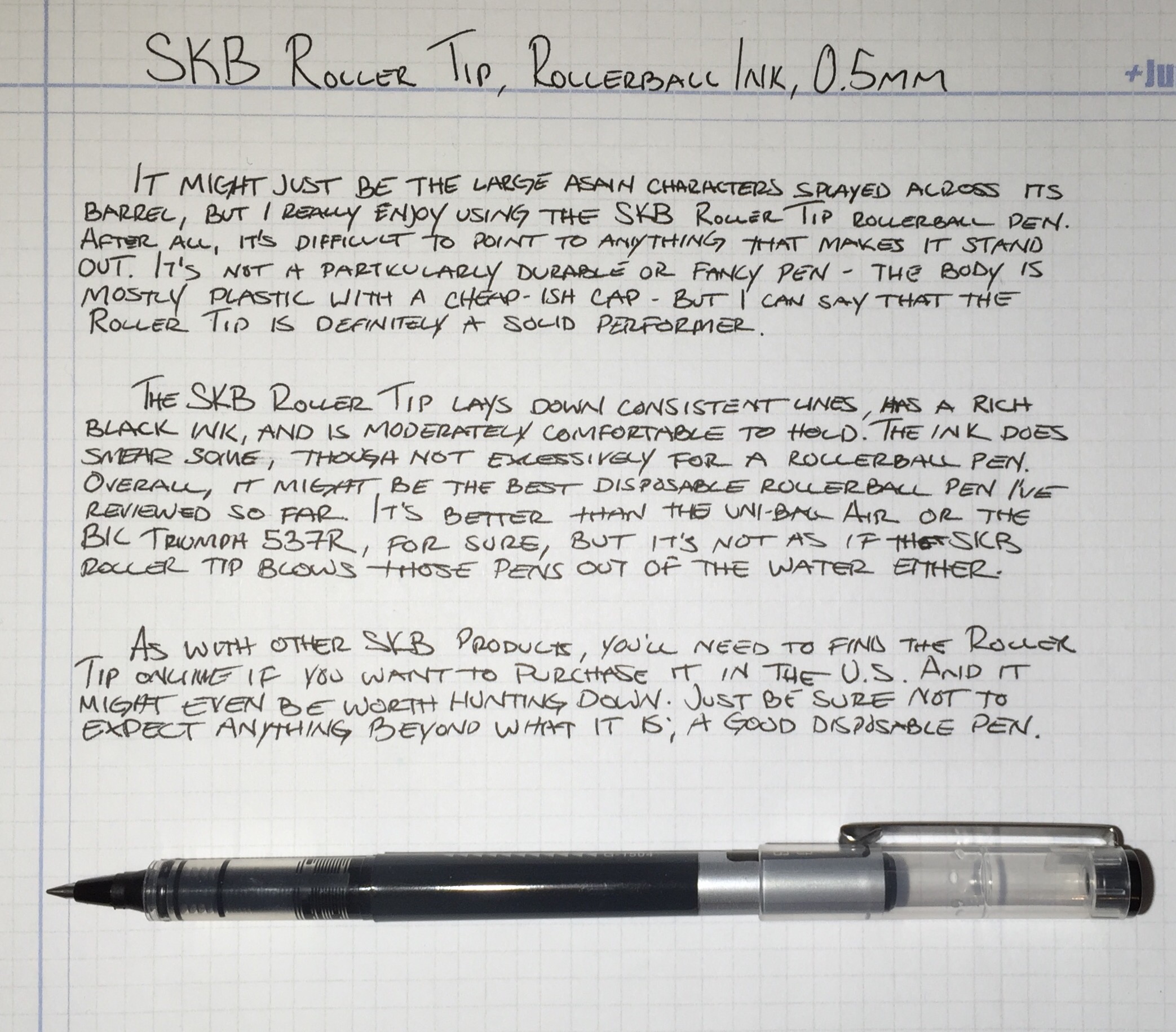
It might just be the large Asain characters splayed across its barrel, but I really enjoy using the SKB Roller Tip rollerball pen. After all, it’s difficult to point to anything that makes it stand out. It’s not a particularly durable or fancy pen – the body is mostly plastic with a cheap-ish cap –  but I can say that the Roller Tip is definitely a solid performer.

The SKB Roller Tip lays down consistent lines, has a rich black ink, and is moderately comfortable to hold. The ink does smears some, though not excessively for a rollerball pen. Overall, it might be the best disposable rollerball pen I’ve reviewed so far. It’s better than the uni-ball Air or the BIC Triumph 537R for sure, but it’s not as if the SKB Roller Tip blows those pens out of the water.

img_3364

As with SKBs other products (e.g. the Soft Ink SB-1000, the Click Ball, and the V6), you’ll need to find the Roller Tip online if you want to purchase it in the U.S. And it might be even be worth hunting down. Just be sure not to expect anything beyond what it is; a good disposable pen.

img_3362

Review: uni-ball Fanthom, Erasable Ink, 0.5mm

IMG_3241

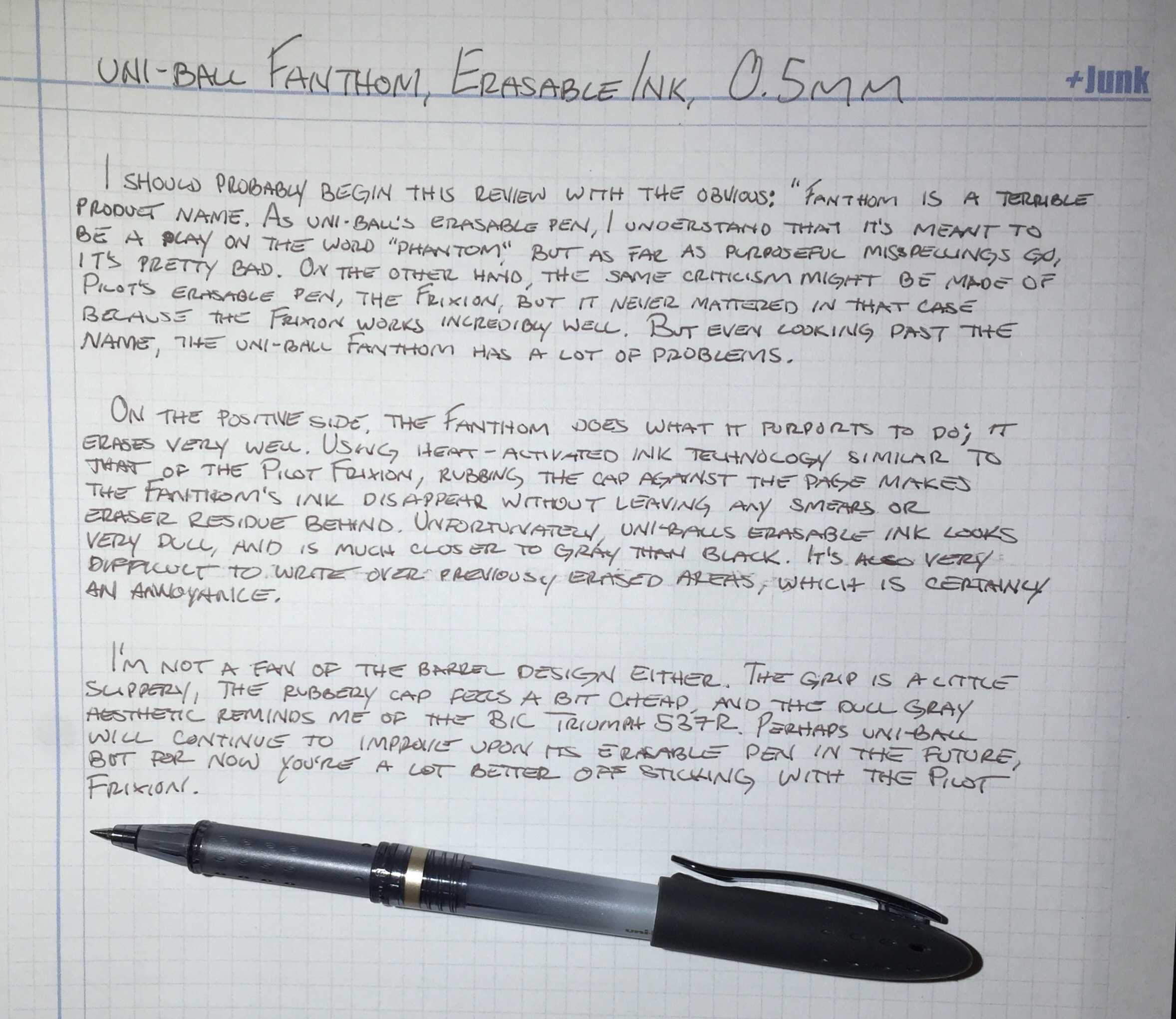
I should probably begin this review with the obvious: “Fanthom” is a terrible product name. As uni-ball’s erasable pen, I understand that it’s meant to be a play on the word “phantom,” but as far as purposeful misspellings go, it’s pretty bad. On the other hand, the same criticism might be made of Pilot’s erasable pen, the Frixion,  but it never mattered in that case because that Frixion works incredibly well. But even looking past the name, the uni-ball Fanthom has a lot of problems.

On the positive side, the Fanthom does what it purports to do; it erases very well. Using heat-activated ink technology similar to that of the Pilot Frixion, rubbing the the cap against the page makes the Fanthom’s ink disappear without leaving any smears or eraser residue behind. Unfortunately, uni-ball’s erasable ink looks very dull and is much closer to gray than black. It’s also difficult to re-write over previously erased areas, which is certainly an annoyance.

IMG_3240

I’m not a fan of the barrel design either. The grip area is a little slippery, the rubbery cap feels a bit cheap, and the dull gray aesthetic reminds me of the BIC Triumph 537R. Perhaps uni-ball will improve upon its erasable pen in the future, but for now you’re a lot better off sticking with the Pilot Frixion.

IMG_3239

Extra Links

  • Well Appointed Desk has a nice post reviewing the Fanthom and Frixion pens. Lots of pictures. She saw some residue from the eraser of the Fanthom, which looks more like residue from the erased ink to my eye.
  • A review from No Pen Intended, which she says is overall on par with the Frixion. My favorite sentence from this review: “For those of you looking to build up your writer’s callous, look no further.”
  • A review from Pen Addict. He also had trouble re-writing over previously erased areas. The Frixion has this issue too (see above picture), but not nearly to the same extent.