Review: Pilot G-2 Limited, Gel Ink, 0.7mm

img_4088

Pilot has produced many iterations of the popular G-2 gel pen, but the Pilot G-2 Limited is the only one I’ve used that I’d actually consider an upgrade. Rather than simply changing the color or design of the barrel, the G-2 Limited actually uses aluminum parts. This makes for a heftier, more durable pen with a very solid clip.
img_4083

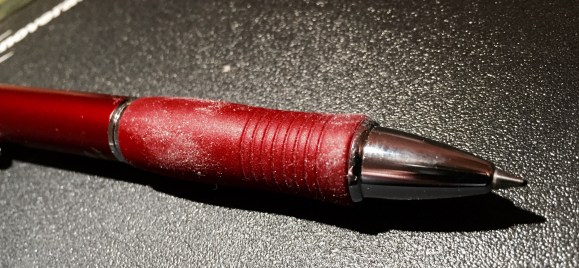
In addition to the aluminum, the G-2 Limited has a rubber grip that is noticeably softer than standard G-2’s grip – and it’s also a magnet for dust and dirt. It’s comfortable, but the downside is that this rubber grip will wear down faster than the rest of the metallic barrel. Personally, I tend to prefer a more durable grip with a metallic pen, such as the knurling on the Zebra F-701 or the ridges on the Pentel Energel Alloy RT.

Maybe it goes without saying, but if you don’t like the standard Pilot G-2, then the G-2 Limited won’t change your mind. On the other hand, if you’re a fan of the Pilot G-2, then, at around $10, the Limited might be an upgrade worth getting. And with six barrel-color options (gold, silver, purple, red, gray, and blue), you’re likely to find something that matches your style.

img_4089

Extra Links

Review: Pilot G-2 Pro, Gel Ink, 0.7mm

img_3971

The Pilot G-2 is such a ubiquitous and popular pen, it’s really no surprise that Pilot has attempted to build on the brand by creating this “upgraded” version, the Pilot G-2 Pro. The G-2 Pro is little beefier: it’s slightly thicker, slightly heavier, and has a larger “clicker.” It’s a nice pen, but at double the price of the standard G-2, it’s hard to find a compelling reason to spend the extra money.

img_3972

When it comes right down to it, the G-2 Pro is mostly an aesthetic upgrade. Instead of the cheap, clear plastic of the original, the G-2 Pro comes with a painted barrel. Four color options are available – gray, dark blue, olive green, and maroon. The upgraded design even includes a faux-metal trim. But don’t be fooled; the body is still entirely made of plastic.

For an upgrade like this to make sense, it should give die-hard G-2 users something worthwhile. For example, Pentel produced the Energel Alloy RT, a durable, aluminum version of the popular Energel Deluxe RTX. The G-2 Pro, on the other hand, is more of a paint job. So, unless you’re really itching for a prettier G-2, it’s hard to justify purchasing the G-2 Pro.

img_3968

Review: Pilot Down Force, Pressurized Ballpoint, 0.7mm

img_3955

When I think of pressurized ballpoint pens, I tend to think of something small and durable, like the Fisher Cap-O-Matic Space Pen or the Tombow Airpress. These pens are meant to slip easily into a pocket or get banged around in a backpack, ready to write on a dirty slip of paper held up against an airplane window, if need be. Meanwhile, the Pilot Down Force is like the awkward cousin of the pressurized pen category. It’s bigger, clunkier, and it has a clip that juts out a little too far.

Regardless, the Down Force writes just as well as these other pens. Its thick barrel and knurled, plastic grip make it a comfortable writer, and the pressurized ink works at any angle and on most surfaces. The Down Force also has a convenient spring-loaded clip, which ties in with a very unique retracting mechanism.

DownForceRetract

Like most retractable pens, pressing the plunger down will eject the pen’s tip, but it only retracts when opening the clip. It’s a feature that’s meant to prevent ink stains on shirts and pants, since it’s impossible to clip the pen to anything with its tip exposed. I like this feature – it reminds me of a low-cost version of the Lamy Dialog 2 – but it definitely takes a little getting used to.

The Down Force is one of the less expensive pressurized ballpoints on the market, and it comes in an array of neat colors that add a fun personal flair – I went with the orange. In the end you get a good pen, just not one that’s as pocket-friendly or durable as others in its category. I like it, but I don’t think it will ever replace my space pen.

img_3956

Extra Links

Nib Novice, Part 1 – The Pilot VPen

Fountain pens, frankly, are intimidating. For someone like me who’s never used one, they seem a bit finicky and archaic. Learning to become a fountain pen user seems almost like learning to drive stick or learning how to ferment homemade vinegar. There are fervent advocates for all these practices, but to an outsider, they seem like they might be more trouble than they’re worth. So why bother?

Type “why use a fountain pen?” into Google, and you’ll be met with a host of reasons listed on various websites and blogs.  Unfortunately, most of these reasons just don’t speak to me. For example, a blog at oPENions describes how fountain pens can be great for left-handed writers, but I’m not a lefty. A blog at Writer’s Bloc does a great job of explaining how fountain pens are good for people with weak wrists, carpel tunnel, or hand-cramping issues, but none of these are problems for me. A post at Goulet Pens even mentions that fountain pens can save you money in the long run, though if this were a major concern, it would be cheaper for me just to swipe ballpoints from bank lobbies.

For me, there’s only one reason that makes sense. All of those blogs touch on it in one way or another, but I think blogger Ed Jelly puts it best: “Maybe it’s the inner pen geek speaking, but I find it fascinating that there are several parts and either a steel or gold piece of pointed metal that deliver ink to page. Capillary action draws ink from the internal reservoir through a feed to regulate the flow, all the way to the tip of the pen… Different pens have different filling systems and clear pens (called ‘demonstrators’) let you see all the inner workings. Tell me that isn’t more interesting than your standard ballpoint?!” In other words, fountain pens are just kind of neat.

So, in order to learn about fountain pens and decided for myself whether they’re worth the trouble, I’m starting this new series of posts to explore them. Because fountain pens come in a wide range of varieties – different types of nibs, ink refill systems, barrel materials, etc –  I intend to look at a broad spectrum. And I’m beginning with the simplest fountain pen on the market, the Pilot VPen.

At $2.60, the Vpen is also probably the cheapest fountain pen you’ll find on the market, and it definitely looks the part. Its body is light and made of plastic, It’s non-refillable, and entirely disposable. Still, it was fun to use, and surprisingly smooth.

Of course, nobody would consider this a great pen. The ink flow skips in and out occasionally, and it bleeds through paper fairly easily. A decent gel pen beats it any day, but it nevertheless has me looking forward to trying another fountain pen. And perhaps next time I’ll spend  few more dollars.

Interested in reading more? Subscribe to the blog here.

Review: Pilot Juice, Gel Ink, 0.38mm

img_3505

Picture a Pilot G-2 with a spring-loaded clip, and you’ll have a good idea of what the Pilot Juice is all about. Like the G-2, the Juice has the clear-plastic body and black trim that looks like so many other pens you’ll find on most store shelves – I call it the “premium plastic” style. But that isn’t to say that the Juice is a bad pen, and, to the contrary, it’s probably a lot better than most of the other pens in its category.

img_3511

Compared to the G-2, the Juice’s ink is a bit smoother, the grip is a little softer, and the refill lacks that ugly brown gunk. And while these minor improvements might not make anyone go out of their way, the Juice’s aforementioned spring-loaded clip might. Never underestimate the usefulness of a good clip. Whether attaching it to a notebook or a pocket, it’s nice having a pen that knows how to stay put.

It’s easy to see that the Pilot Juice is a good gel-ink pen, but its competition can’t be ignored either. For my money, the Juice still doesn’t beat the nearly smear-free ink and the professional look of pens like the Pentel Energel and the uni-ball Signo 207. However, if the Juice’s spring-loaded clip speaks to you, it might be worth a try.

img_3504

Extra Links

  • A review at The Clicky Post says that the Juice delivers a top notch writing experience. He also notes that the tip-size and color options are “literally insane.”
  • Speaking of colors, you can see many of the Juice’s color options over at The Well Appointed Desk.
  • Another review at The Finer Point calls the Juice “middle of the park.” In particular she dislikes the cheap-looking barrel, and she describes the pen as best for taking shorter notes.