Retro Talk: The Terabyte Tornado

img_3963

From time to time, Retro 51 announces new editions to its popular line of Tornado pens. They are always fun to see, but I’m not usually excited enough to drop the $20 to $40 they typically cost.  That was not the case, however, when I saw the Terabyte Tornado announced last year, which I pre-ordered without hesitation. It arrived last December, and it’s been a regular in my pen rotation since.

Limited to 500 pieces and sold only through Anderson Pens, the Terabyte Tornado is wrapped with a circuit-board design, and its metallic bits – the tip, clip, and twist – are given a dark, matted finish that is reminiscent of solder alloy. There’s also a dark green disk inset into the top of the twist, which adds a nice accent. Careful, though – after accidentally dropping the pen, the disk popped right out (but a little Krazy glue quickly fixed it).
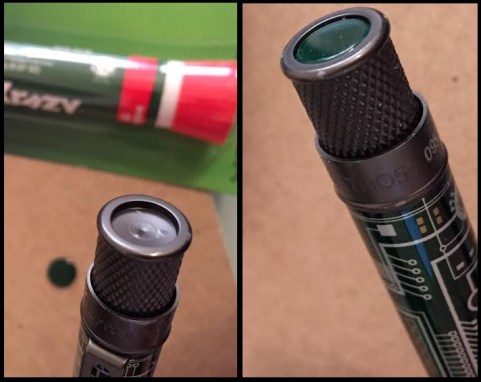
TerabyteTornado_disk

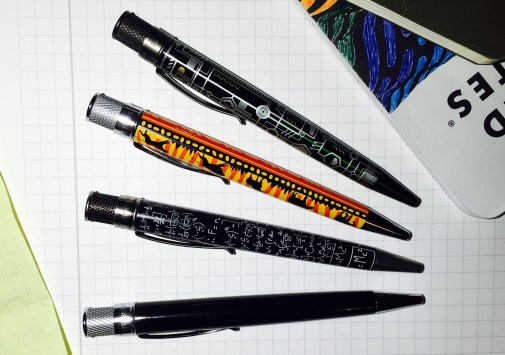
I really like the design, but I think an actual circuit-board pattern (or perhaps texture) would have really knocked this one out of the park. For example, I really love what Retro 51 did with the Albert, which is wrapped in a design that’s an accurate proof for Einstein’s famous E=MC² equation. Instead, the Terabyte’s design is an artistic rendering of a circuit board. It looks cool to me, but a hardcore computer enthusiast might disagree.

Other than that, the Terabyte Tornado is your standard Retro 51 fare. If the design appeals to you, you might want to pick it up soon. These things tend to sell out. Otherwise, there will be plenty more designs to come in the future, and I’m sure I’ll be adding at least a few of them to my Retro 51 collection.
img_3979


Review: Pilot G-2 Pro, Gel Ink, 0.7mm

img_3971

The Pilot G-2 is such a ubiquitous and popular pen, it’s really no surprise that Pilot has attempted to build on the brand by creating this “upgraded” version, the Pilot G-2 Pro. The G-2 Pro is little beefier: it’s slightly thicker, slightly heavier, and has a larger “clicker.” It’s a nice pen, but at double the price of the standard G-2, it’s hard to find a compelling reason to spend the extra money.

img_3972

When it comes right down to it, the G-2 Pro is mostly an aesthetic upgrade. Instead of the cheap, clear plastic of the original, the G-2 Pro comes with a painted barrel. Four color options are available – gray, dark blue, olive green, and maroon. The upgraded design even includes a faux-metal trim. But don’t be fooled; the body is still entirely made of plastic.

For an upgrade like this to make sense, it should give die-hard G-2 users something worthwhile. For example, Pentel produced the Energel Alloy RT, a durable, aluminum version of the popular Energel Deluxe RTX. The G-2 Pro, on the other hand, is more of a paint job. So, unless you’re really itching for a prettier G-2, it’s hard to justify purchasing the G-2 Pro.

img_3968

Review: Pilot Down Force, Pressurized Ballpoint, 0.7mm

img_3955

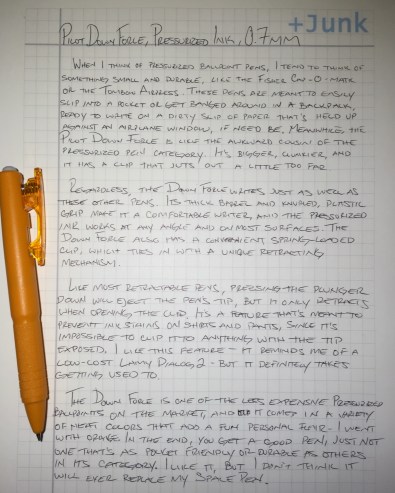
When I think of pressurized ballpoint pens, I tend to think of something small and durable, like the Fisher Cap-O-Matic Space Pen or the Tombow Airpress. These pens are meant to slip easily into a pocket or get banged around in a backpack, ready to write on a dirty slip of paper held up against an airplane window, if need be. Meanwhile, the Pilot Down Force is like the awkward cousin of the pressurized pen category. It’s bigger, clunkier, and it has a clip that juts out a little too far.

Regardless, the Down Force writes just as well as these other pens. Its thick barrel and knurled, plastic grip make it a comfortable writer, and the pressurized ink works at any angle and on most surfaces. The Down Force also has a convenient spring-loaded clip, which ties in with a very unique retracting mechanism.

DownForceRetract

Like most retractable pens, pressing the plunger down will eject the pen’s tip, but it only retracts when opening the clip. It’s a feature that’s meant to prevent ink stains on shirts and pants, since it’s impossible to clip the pen to anything with its tip exposed. I like this feature – it reminds me of a low-cost version of the Lamy Dialog 2 – but it definitely takes a little getting used to.

The Down Force is one of the less expensive pressurized ballpoints on the market, and it comes in an array of neat colors that add a fun personal flair – I went with the orange. In the end you get a good pen, just not one that’s as pocket-friendly or durable as others in its category. I like it, but I don’t think it will ever replace my space pen.

img_3956

Extra Links

Review: Zebra F-701, Ballpoint, 0.7mm

img_3942

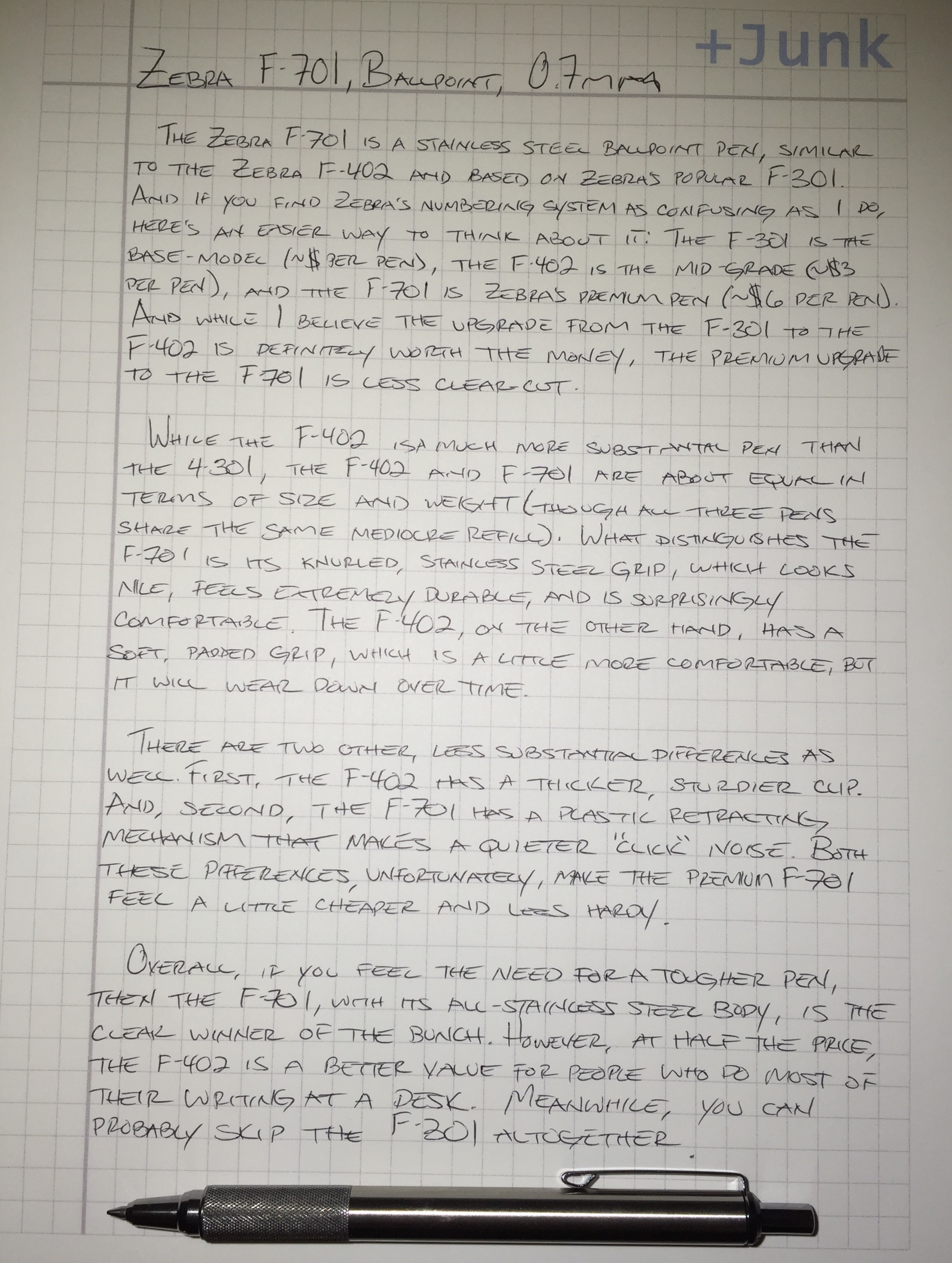
The Zebra F-701 is a stainless steel ballpoint, similar to the Zebra F-402 and based on Zebra’s popular F-301. And if you find Zebra’s numbering system as confusing as I do, here’s an easier way to think about it: the F-301 is the base-model (~$2 per pen) , the F-402 is the mid-grade (~$3 per pen), and the F-701 is Zebra’s premium pen (~$6 per pen). And while I believe the upgrade from F-301 to F-402 is definitely worth the money, the premium upgrade to the F-701 is less clear-cut.

img_3941
The F-301 (top) has a hard-plastic grip, the F-402 (middle) has a rubberized grip, and the F-701 (bottom) has a stainless steel grip.

While the F-701 is a much more substantial pen than the F-301, it’s about equal to the F-402 in terms of size and weight (though all three pens share the same mediocre ballpoint refill). What distinguishes the F-701 is its knurled, stainless steel grip, which looks nice, feels extremely durable, and is surprisingly comfortable. The F-402, on the other hand, has a soft, padded grip, which is a little more comfortable but will wear down over time.

There are two other, less substantial differences as well. First, the F-402 definitely has a thicker, sturdier clip. And, second, the F-701 has a plastic retracting mechanism that makes a quieter “click” noise. Both these differences, unfortunately, make the premium F-701 feel a little cheaper and less hardy.

Still, if you feel the need a tougher pen, then the F-701, with its all-stainless steel body, is still the clear winner of the group. However, at half the price, the F-402 is a better value for people who are less hard on their pens, such as those who do most of their writing at a desk. Meanwhile, you can probably skip the F-301 altogether.

img_3944

Extra Links

Review: uni-ball Signo 307, Gel Ink, 0.7mm

img_3877

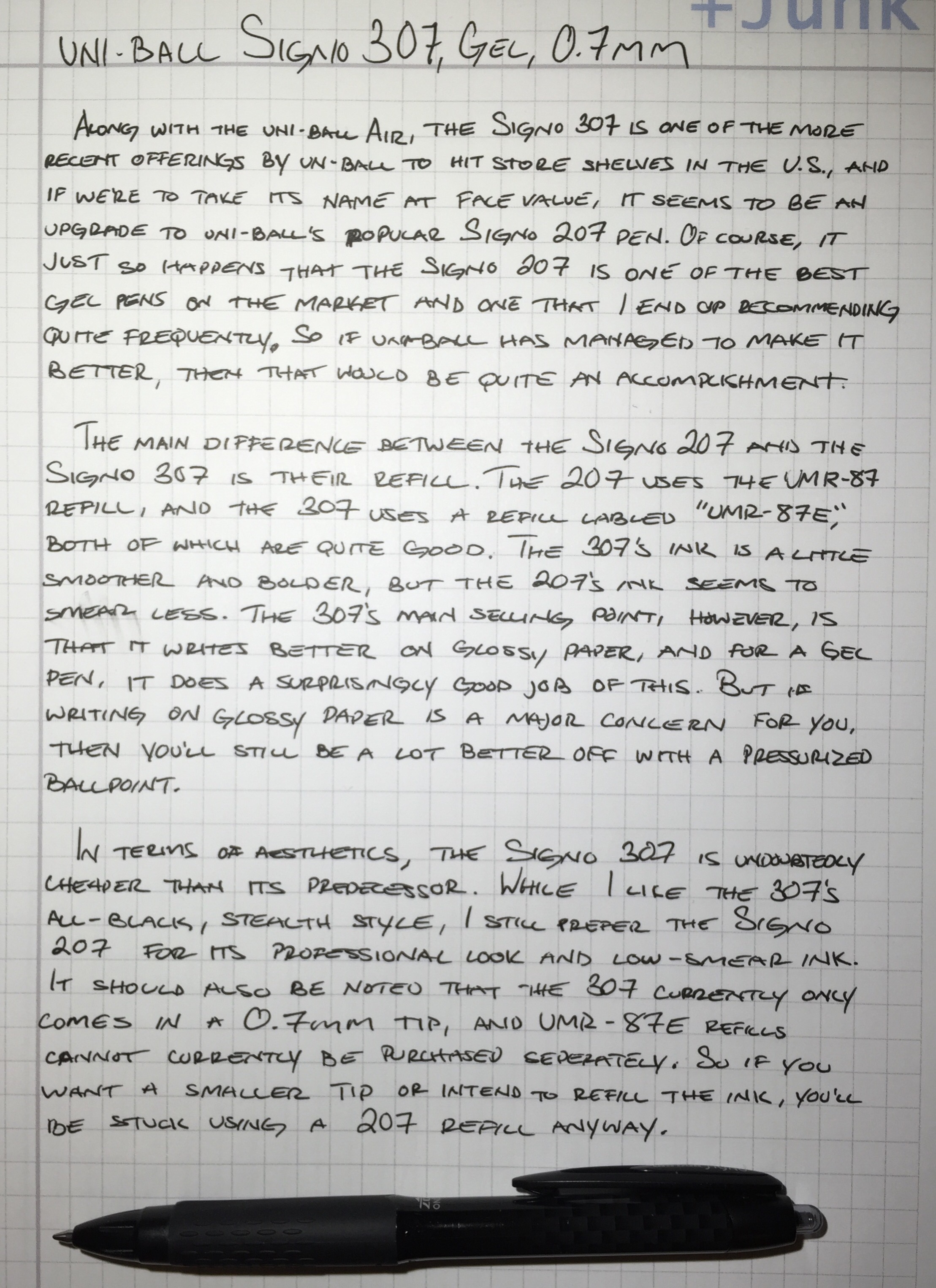
Along with the uni-ball Air, the Signo 307 is one of more recent offerings by uni-ball to hit store shelves in the U.S., and if we’re to take its name at face value, it seems to be an upgrade to uni-ball’s popular Signo 207 pen. Of course, it just so happens that the Signo 207 is one of the best gel pens on the market and one that I end up recommending quite frequently. So if uni-ball has somehow managed to make it better, then that would be quite an accomplishment.

img_3874

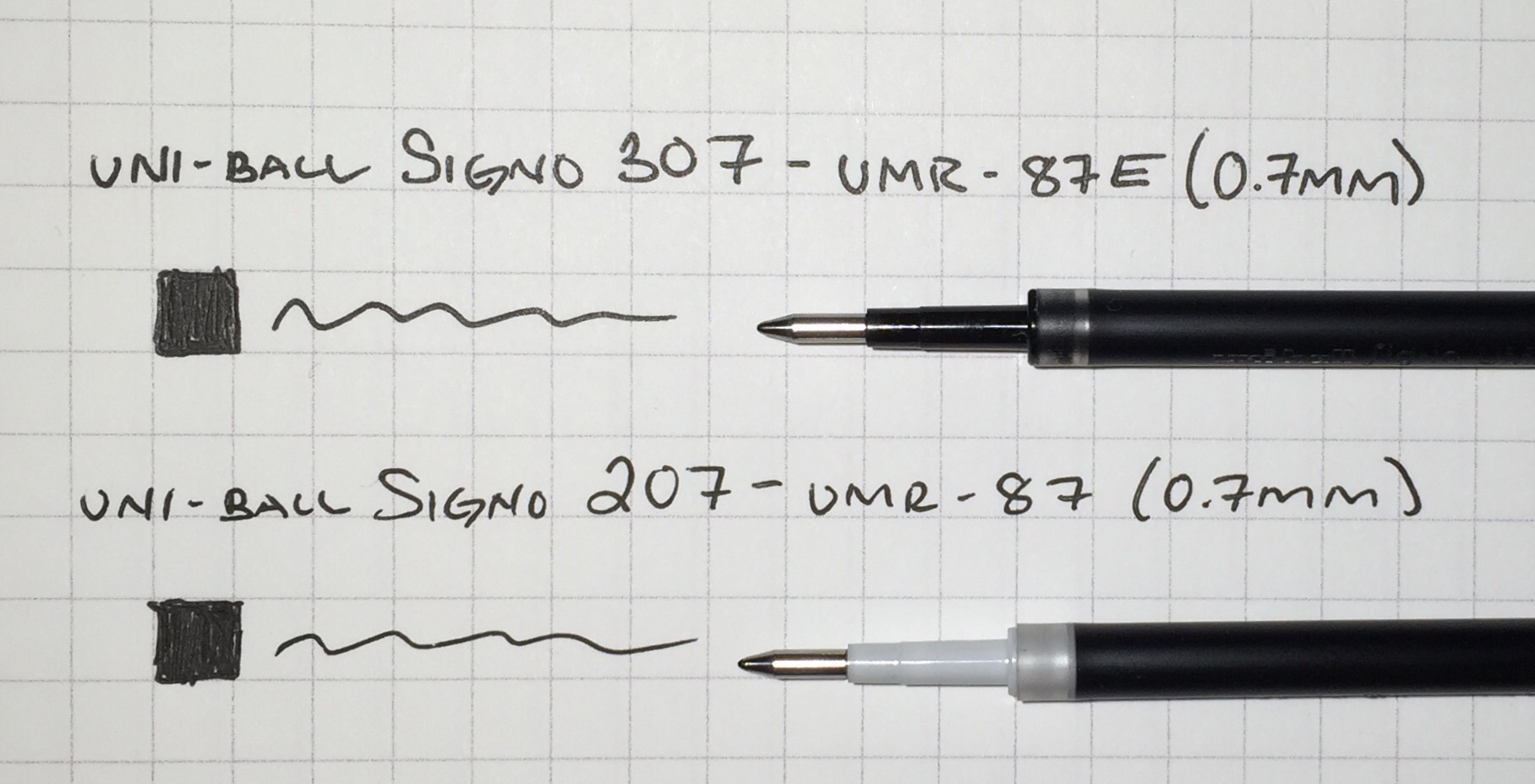
The main difference between the Signo 207 and the Signo 307 is their refill – the 207 uses the UMR-87 refill, and the 307 uses a refill labeled “UMR-87E,” both of which are quite good. The 307’s ink is a little smoother and bolder, but the 207’s ink seems to smear less. The 3o7’s main selling point, however, is that it writes better glossy paper, and for a gel pen, it does a surprisingly good job of this. But if writing on glossy paper is a major concern for you, then you’ll still be a lot better off with a pressurized ballpoint pen.

In terms of aesthetics, the Signo 307 is undoubtedly cheaper than its predecessor. While I like the 307’s all-black, stealth style, I still prefer the Signo 207 for its professional look and low-smear ink. It should also be noted that the 307 currently only comes in a 0.7mm tip, and UMR-87E replacement refills cannot be purchased separately. So if you want a smaller tip size or intend to refill the ink, you’ll be stuck using a 207 refill anyway.
img_3873

Extra Links

  • On uni-ball’s website, they show that the Signo 307 is available with a 0.5mm tip. I’ve looked high and low, and I haven’t been able to find that size available for purchase. Maybe its coming soon.
  • A review at the Penman Post shows some close-ups of the 307’s barrel, which actually has a carbon-mesh design (though he says it chips off easily). He prefers the 307’s refill to the 207, and says that it works well inside a Retro 51.
  • Check out the review at That One Pen for lots of good comparison shots between the 307 and 207 (and more).