Review: Pilot G-2 Limited, Gel Ink, 0.7mm

img_4088

Pilot has produced many iterations of the popular G-2 gel pen, but the Pilot G-2 Limited is the only one I’ve used that I’d actually consider an upgrade. Rather than simply changing the color or design of the barrel, the G-2 Limited actually uses aluminum parts. This makes for a heftier, more durable pen with a very solid clip.
img_4083

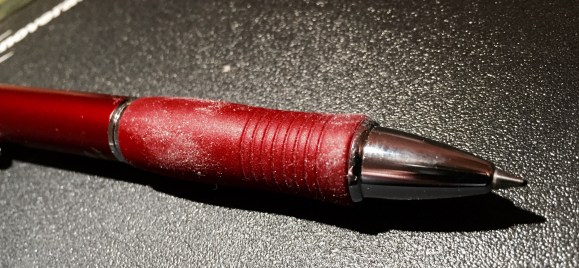
In addition to the aluminum, the G-2 Limited has a rubber grip that is noticeably softer than standard G-2’s grip – and it’s also a magnet for dust and dirt. It’s comfortable, but the downside is that this rubber grip will wear down faster than the rest of the metallic barrel. Personally, I tend to prefer a more durable grip with a metallic pen, such as the knurling on the Zebra F-701 or the ridges on the Pentel Energel Alloy RT.

Maybe it goes without saying, but if you don’t like the standard Pilot G-2, then the G-2 Limited won’t change your mind. On the other hand, if you’re a fan of the Pilot G-2, then, at around $10, the Limited might be an upgrade worth getting. And with six barrel-color options (gold, silver, purple, red, gray, and blue), you’re likely to find something that matches your style.

img_4089

Extra Links

Notes on Ambition Edition Field Notes

img_3535

Though special edition Field Notes seem to pop up quite frequently these days, I recently decided to go back in time to the Winter of 2014 when Field Notes released one of their more interesting notebook sets, the Ambition edition. Produced as part of Field Notes’ quarterly subscription service, the Ambition edition comes as a standard 3-book pack, except that each book within the pack contains different innards, which correspond to different colored covers. The “wine” book is a graph-ruled memo book , the “olive” book serves as a ledger,  and the “chocolate” book is a 52-week planner.

Right out of the package, the books look beautiful. With their gold, embossed logos and gilded pages, Ambition is probably the “fanciest” notebook set that Field Notes has ever made. In fact, it took me longer than usual to throw one of these notebooks in my back pocket, knowing that it would eventually get beaten up.

img_3536

I picked up the graph-ruled notebook first, because that’s the style I prefer. But it also wasn’t immediately clear how I’d use the other two books in this set. While the idea of a pocket datebook is interesting, I simply don’t use a datebook in this manner. Similarly, there’s no tallies or logs I need to keep track of that would necessitate a ledger-style notebook.

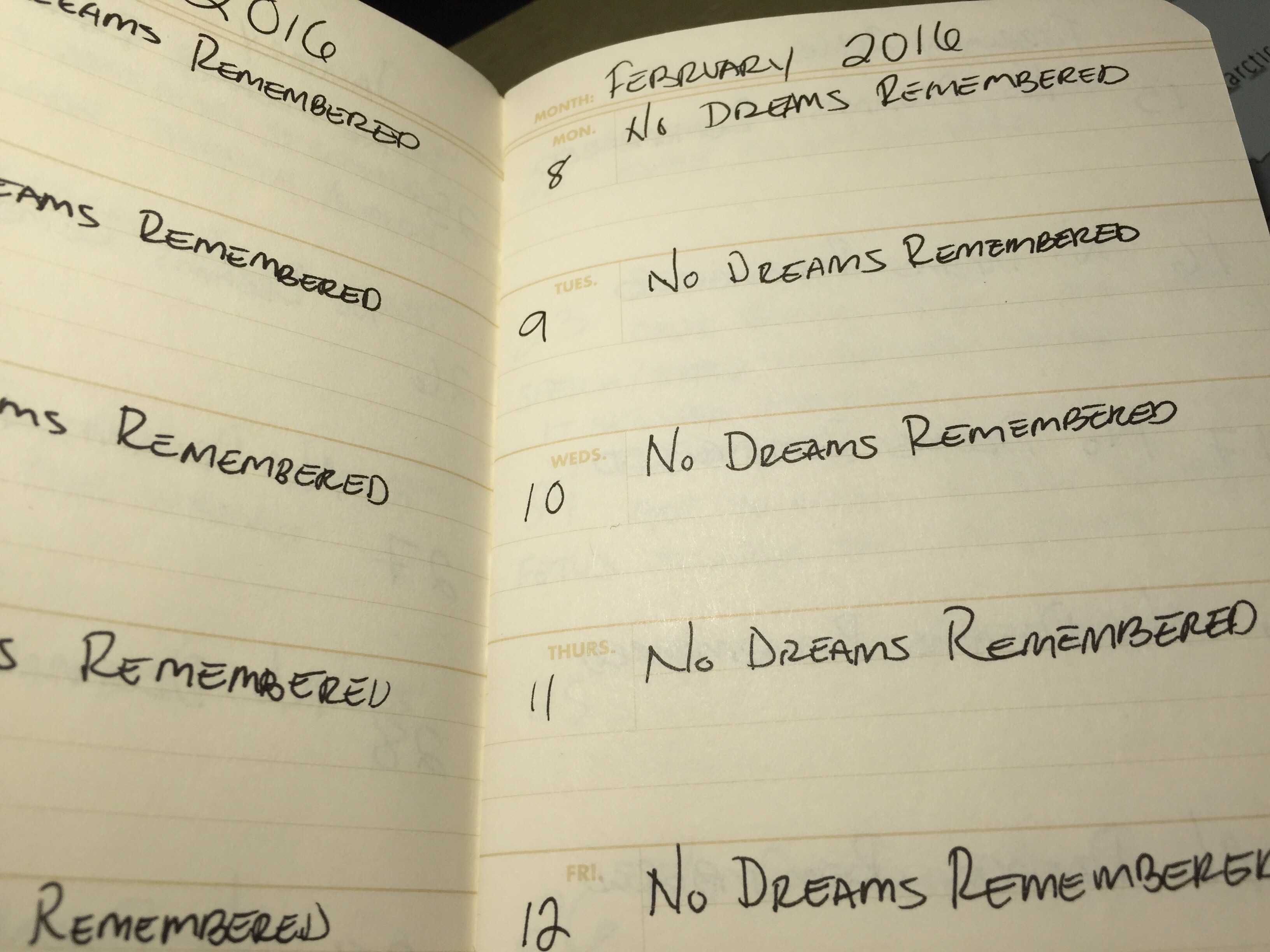
Eventually, I decided to use the datebook as a dream journal (though, it hasn’t really helped me remember any of those dreams), and I found that the ledger-style ruling was great for making lists. And after permanently losing the graph notebook at the Charlotte International Airport, the ledger book became my standard catch-all notebook, which ended up working great for that purpose.

img_3654

Ambition was definitely one of the most interesting Field Notes editions that I’ve used, but since it’s an older edition, it is sold out in retail locations. However, I’ve seen prices fluctuate anywhere from $25 to $45 per pack on the secondary market, which is a bit too pricey, in my opinion. Although, it may be worth the money if you find yourself loving those pocket-sized planners and ledger books.

Additional Notes:

  • Of the 30 “Practical Applications” listed in the notebooks’ inside-back cover, my favorites are the following: “#5. Bridges Burned”; “#10. Fax Machine: Pros and Cons”; and “#21. Crowds to Source.”
  • The original subscriber package came with a cloth bookmark, which you can see at the Three Staples review (along with a ton of other info).
  • A review at The Well-Appointed Desk reveals I’m not the only one who likes the ledger notebook. I was weary of the ledger at first, but it really grew on me.

Review: Ohto Words, Rollerball, 0.5mm

img_4054

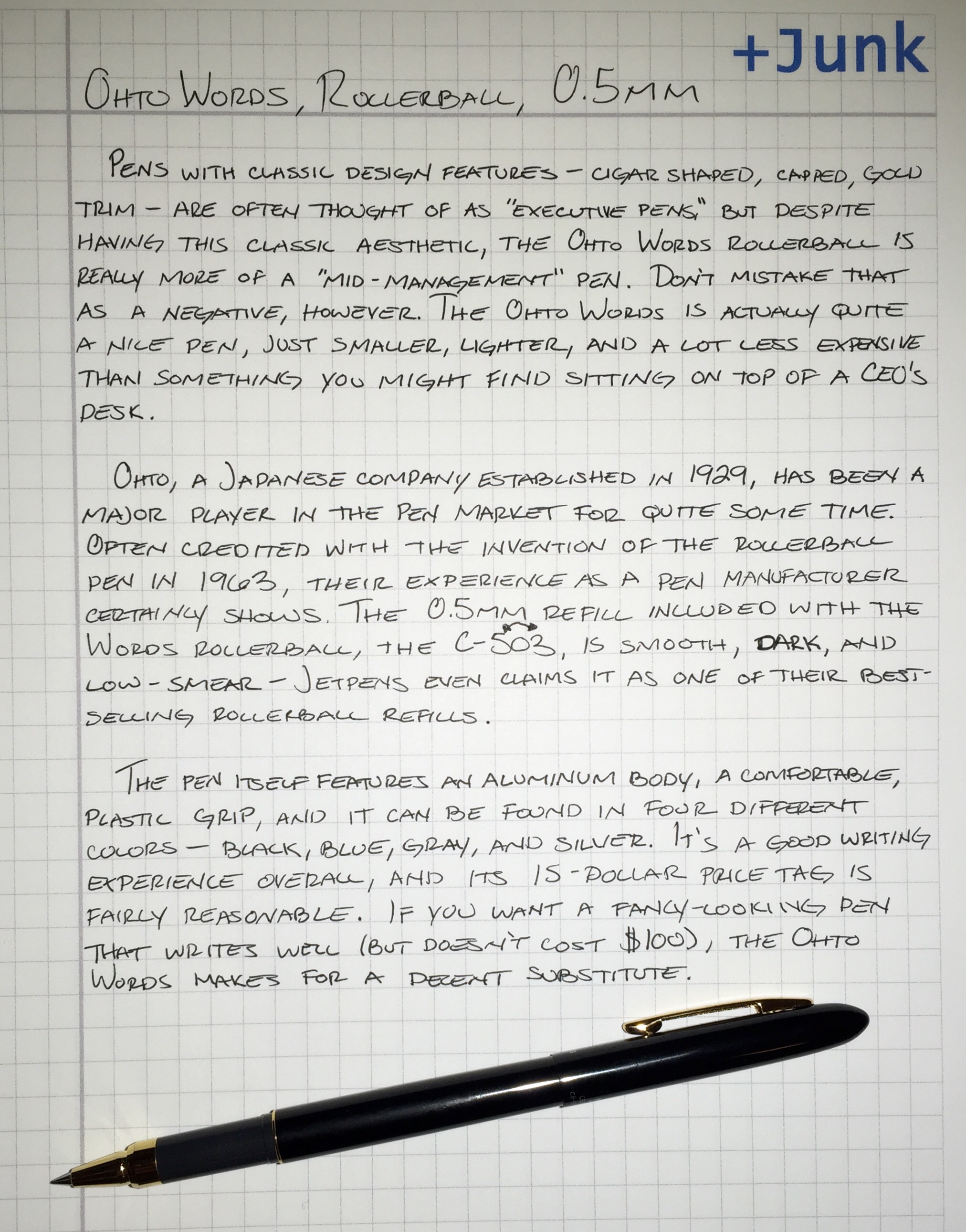
Expensive-looking pens with classic design features – cigar shaped, capped, gold trim – are often thought of as executive pens, but despite having this classic aesthetic, the Ohto Words rollerball is really more of a mid-management pen. Don’t mistake that as a negative, however. The Ohto Words is actually a good pen, just smaller, lighter, and a lot less expensive than something you might find sitting on top of a CEO’s desk.

img_4057

Ohto, a Japanese company established in 1929, has been a major player in the pen market for quite a long time. Often credited with the invention of (water-based) rollerball ink in 1963, their experience as a pen manufacturer certainly shows. The 0.5mm refill included with the Words rollerball, the C-305, is smooth, dark, and low smear – Jetpens even claims it as one of their best-stelling rollerball refills.

The pen itself features an aluminum body, a comfortable, plastic grip, and it can be found in four different colors – black, blue, gray, and silver. It’s a good writing experience overall, and its 15-dollar price tag seems fairly reasonable. If you want a fancy-looking pen without having to spend a hundred bucks, the Ohto Words makes for a decent stand-in.

img_4058

Review: uni-ball Power Tank, Pressurized Ballpoint, 0.7mm

img_4044

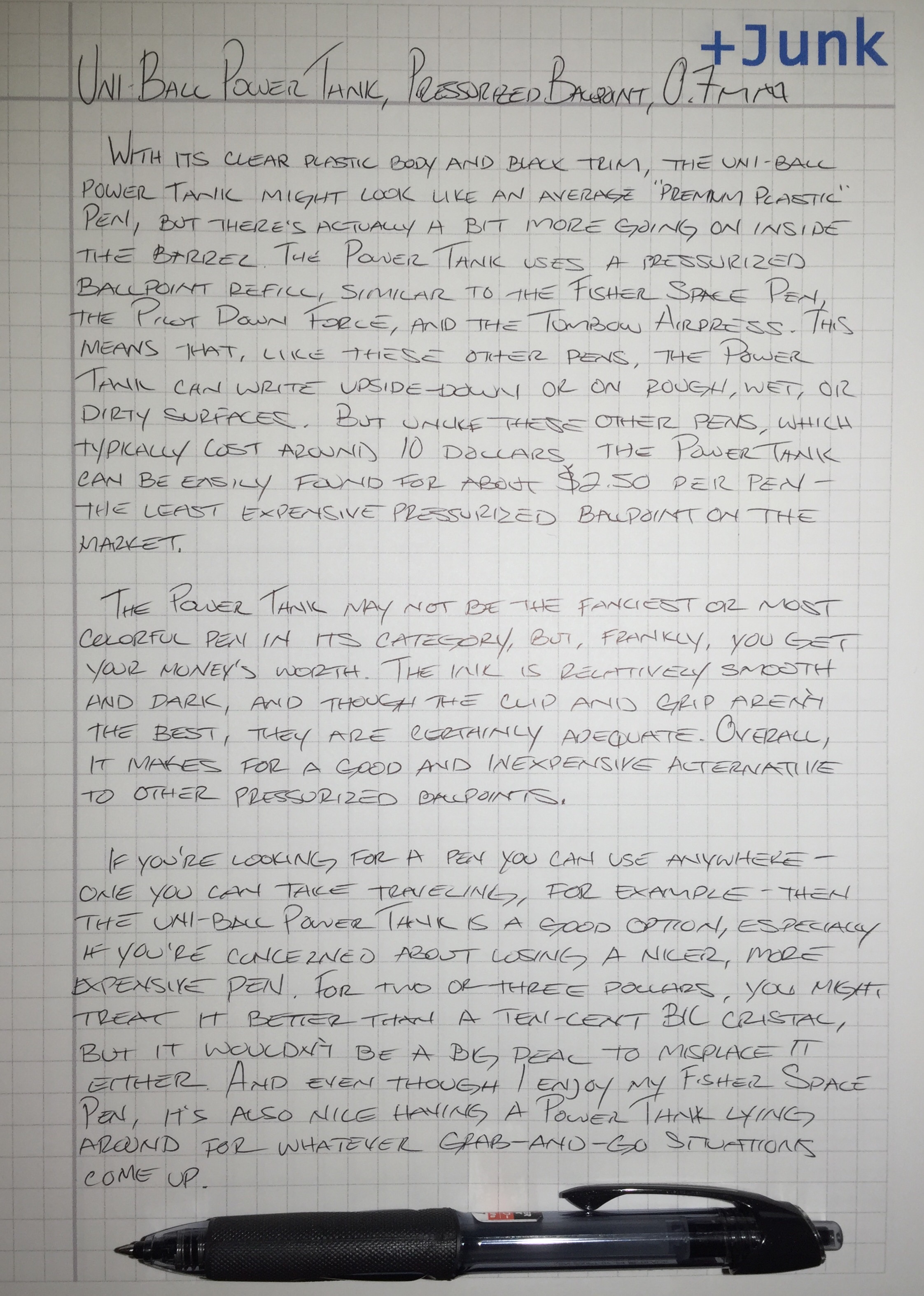
With its clear plastic body and black trim, the uni-ball Power Tank might look like an average “premium plastic” pen, but there’s actually a bit more going on inside the barrel. The Power Tank uses a pressurized ballpoint ink refill, similar to the Fisher Space Pen, the Pilot Down Force, and the Tombow Airpress. This means that, like these other pens, the Power Tank can write upside-down or on rough, wet, and dirty surfaces. But unlike these other pens, which typically cost around 10 dollars, the Power Tank can be easily found for about $2.50 per pen – the least expensive pressurized ballpoint on the market.

img_4043

The Power Tank may not be the fanciest or most colorful pen in its category, but, frankly, you get your money’s worth. The ink is relatively smooth and dark, and though the clip and grip aren’t the best, they are certainly adequate. Overall, it makes for a good and inexpensive alternative to other pressurized ballpoints.

If you’re looking for a pen that you can use anywhere – one you can take traveling, for example – then the uni-ball Power Tank is a good option, especially if you’re concerned about losing a nicer, more expensive pen. For two or three dollars, you might treat it better than a ten-cent BIC Cristal, but it wouldn’t be a big deal to misplace it either. And even though I enjoy my Fisher Space Pen, it’s also nice to have a few Power Tanks lying around for whatever grab-and-go situations come up.

img_4045

Extra Links

  • A funny review at The Ruminator. A positive review overall, but he doesn’t like the name. On the contrary, I think the Power Tank is a really cool name for a pen.
  • A review at Pen Paper Ink Letter with lots of pictures. I agree with the overall opinion here – I don’t think it would have a place as my “everyday” pen, but it’s definitely a no-brainer if you feel the advantages of a pressurized ink cartridge would be useful.
  • So, uni-ball originally made a capped version of this pen? Legomac has some info on it, but they are apparently very difficult to find. I’m okay with that, as I’d rather have a retractable model anyway.

Review: Zebra Sarasa Clip, Gel Ink, 0.5mm

img_4004

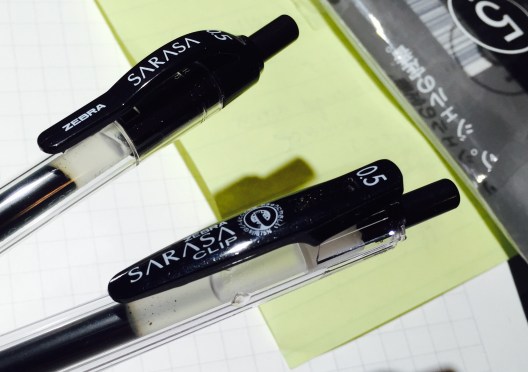
The more I use pens with spring-loaded clips , the more I invariably like them. They easily slip on and off notebooks, they stay put when clipped, and the lever gives me something to fidget with during meetings, besides the noisy clicker. That’s why the Zebra Sarasa Clip has been my go-to pen for the past couple of weeks, despite being an otherwise basic gel pen.

img_4003

The design of the Sarasa Clip is based on the generic-looking Zebra Sarasa gel pen, and aside from the aforementioned clip, their aesthetic differences are minimal. They both have the design of a typical premium plastic pen with a clear barrel, black trim, and a rubbery grip. Both pens are comfortable and reliable, but without the spring-loaded clip, the Sarasa does nothing to distinguish itself from its competitors.

Still, that spring-loaded clip definitely provides extra utility that may be worthwhile depending on the situation. For example, if you’re a fan of the Pilot G-2 and typically need a pen while out and about, it would probably be worth trying out the Zebra Sarasa Clip. In that case, also check out the Pilot Juice. The two pens are nearly identical, so go with whichever happens to be less expensive.

img_4005

Extra Links

  • A review at The Gentleman Stationer mentions that the refill of the Sarasa Clip is better than the standard Sarasa. They do come with different refills – the Sarasa uses the “Zebra JLV” refill  and Sarasa Clip uses the “Zebra JF” refill – and, I tend to agree. The Sarasa Clip’s JF refill seems to be a little darker and smoother. Click for a comparison.
  • Review at Pen Addict. He says that below 0.4mm, the pen starts to feel scratchy (though he doesn’t consider that a bad thing).
  • A review at Daydreamers Welcome shows off different Sarasa Clip colors, but she says that the lighter colors aren’t worth the money.