Nib Novice, Part 2 – The Zebra V-301

This is the second part of a series in which I’m learning to use fountain pens. For Part 1, click here.

img_3894

These days, fountain pens are no longer marketed to the general public.  If you want to buy one, there are very few options besides specialty shops and online stores – big box retailers simply don’t carry them. So, I was a surprised awhile back when I noticed this Zebra V-301 fountain pen at corner store a few blocks away from my apartment, where it was hanging between Pilot G-2s and BIC Stics. I bought it for about $4, and it became my second fountain pen.

The V-301 is based on the popular Zebra F-301, mimicking its stainless steel body and plastic, black trim, but as a fountain pen, it’s obviously much different. It uses what’s called a disposable, “cartridge-style” refill, which is basically just a small tube of ink. With some fountain pens, these cartridges are refillable, but disposable cartridges seem to be recommended to fountain pen newbies because they are very straight forward. You just pop the cartridge inside, and the ink starts flowing. At least, that’s what’s supposed to happen.

img_3901
The V-301’s ink cartridge

With this Zebra V-301, it took a lot of work to actually get the ink running. I spent at least 5 minutes scratching paper with the nib until I finally became frustrated enough to shake and bang the pen on the table. But when the ink eventually started to flow, my experience with this pen didn’t get any better.

When you look for reviews of this pen, not many people have good things to say. Azizah at Gourmet Pens calls it her “current most disliked fountain pen ever,” and the review at No Pen Intended calls it a “trainwreck of metal and ink.” And, having used it for a couple days, I fully understand their complaints.
img_3897

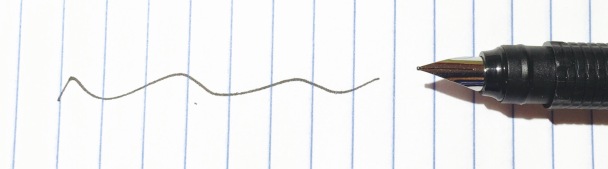
The V-301 is very finicky about the angle at which you write. You have to hold it at a very high angle, else the ink flow cuts in and out. Oddly, the ink actually flows a lot better when holding the nib upside-down with the feed facing up, and this seems to be a common complaint. Even Zebra’s product page for the V-301 has half a dozen customer complaints about this problem, and, for what it’s worth, Zebra’s customer outreach has said that the pen will soon be fixed.

If nothing else, Zebra deserves credit for being a company that dares to try something different. Still, it’s a shame that the V-301 is such a disappointment. As one of the very few mass marketed fountain pens, it’s likely to wind up in the hands of beginners who might be so turned off as to never try another fountain pen. I, on the other hand, will persist on. And, next time, I’ll be sure to try something that works better.

img_3895

Review: TGL BB-8 Pen, Ballpoint, 0.5mm

img_3885

If you hadn’t figured it out from my review of the InkWorks Projector pen, I really liked Star Wars: the Force Awakens – especially the adorable, new BB-8 droid. And, shortly after writing that review, I stumbled across another BB-8 themed pen, one with a large, molded-plastic clicker to go along with its orange and white paint job. I just couldn’t resist.

This BB-8 pen, however, is produced by TGL, a company that seems to make a lot of similar pens for Disney. Unfortunately, they only seem to be available in Asian and European markets, so it took some hunting around online to find one I could purchase in the U.S. Eventually, eBay came through, and $10 and 30-days later, my BB-8 pen arrived on my doormat directly from Malaysia.

img_3883

The pen, flat-out, looks great. It’s surprisingly detailed, with BB-8’s antennae and eyes protruding from his head. But it’s also immediately clear that this pen is not very functional for anyone with adult-sized hands. The barrel is just too thick, it doesn’t fit in a pocket, and, it probably goes without saying, I feel rather ridiculous using this pen in public. And poor BB-8’s head constantly bangs into my hand whenever I write with it.

Obviously, it’s a novelty pen, most of which look nice but function poorly. In this instance, the size of this BB-8 pen might be best suited for children’s hand. But in my case, I’m happy just to prop it up on my shelf next to my Rey bobble-head.

img_3887

Review: uni-ball Signo 307, Gel Ink, 0.7mm

img_3877

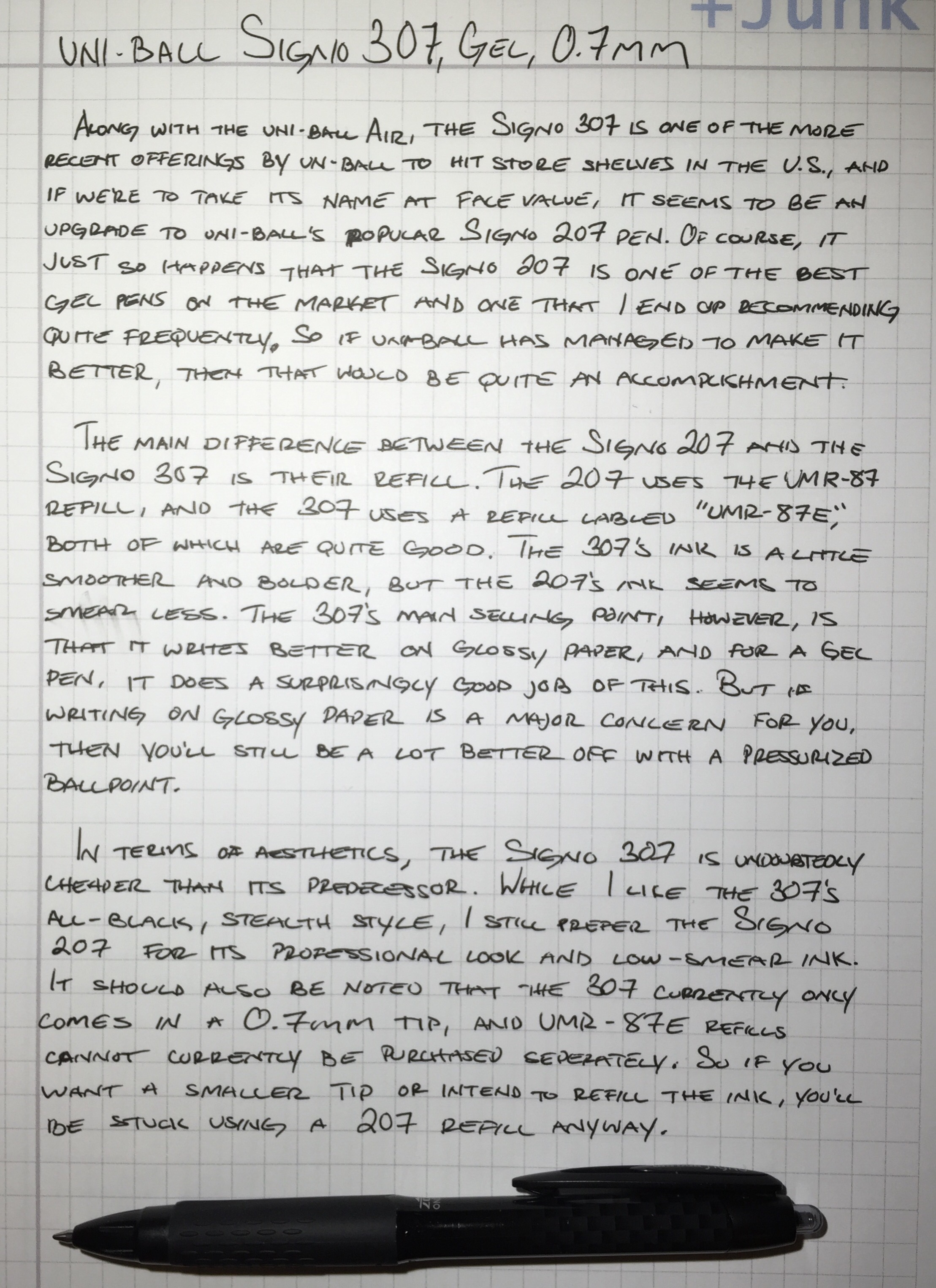
Along with the uni-ball Air, the Signo 307 is one of more recent offerings by uni-ball to hit store shelves in the U.S., and if we’re to take its name at face value, it seems to be an upgrade to uni-ball’s popular Signo 207 pen. Of course, it just so happens that the Signo 207 is one of the best gel pens on the market and one that I end up recommending quite frequently. So if uni-ball has somehow managed to make it better, then that would be quite an accomplishment.

img_3874

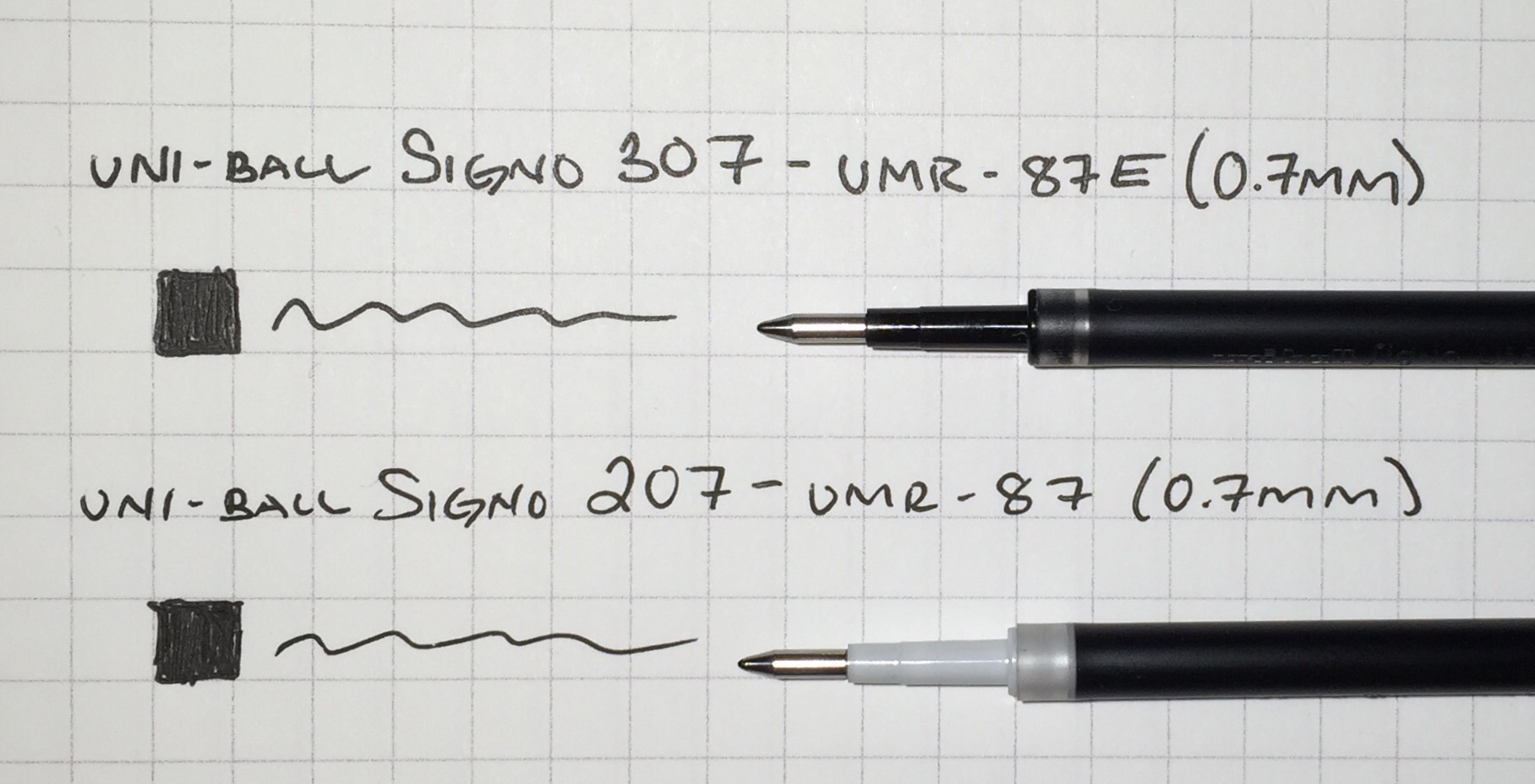
The main difference between the Signo 207 and the Signo 307 is their refill – the 207 uses the UMR-87 refill, and the 307 uses a refill labeled “UMR-87E,” both of which are quite good. The 307’s ink is a little smoother and bolder, but the 207’s ink seems to smear less. The 3o7’s main selling point, however, is that it writes better glossy paper, and for a gel pen, it does a surprisingly good job of this. But if writing on glossy paper is a major concern for you, then you’ll still be a lot better off with a pressurized ballpoint pen.

In terms of aesthetics, the Signo 307 is undoubtedly cheaper than its predecessor. While I like the 307’s all-black, stealth style, I still prefer the Signo 207 for its professional look and low-smear ink. It should also be noted that the 307 currently only comes in a 0.7mm tip, and UMR-87E replacement refills cannot be purchased separately. So if you want a smaller tip size or intend to refill the ink, you’ll be stuck using a 207 refill anyway.
img_3873

Extra Links

  • On uni-ball’s website, they show that the Signo 307 is available with a 0.5mm tip. I’ve looked high and low, and I haven’t been able to find that size available for purchase. Maybe its coming soon.
  • A review at the Penman Post shows some close-ups of the 307’s barrel, which actually has a carbon-mesh design (though he says it chips off easily). He prefers the 307’s refill to the 207, and says that it works well inside a Retro 51.
  • Check out the review at That One Pen for lots of good comparison shots between the 307 and 207 (and more).

Colors Review: Staedtler Triplus Fineliner, Porous Point, 6-Color Set

img_3567

As an instrument for writing, I wasn’t particularly fond of the Staedtler Triplus Fineliner’s barrel shape, a unique design that resembles a rounded-off triangle. But for drawing and coloring, this design seems to work pretty well. Almost like a grip, the flat edges allow for a little more control, whereas fully rounded and smooth barrels can sometimes slip in your hand.

This six-color set, is fairly standard in terms of color variation, so they could work well for utilitarian tasks like taking notes and editing papers. However, these pens are also very good at filling in areas and creating clean lines, so I’m inclined recommend them for more artistic purposes.

img_3565

It’s also worth mentioning that Triplus Fineliners are “dry safe,” which means that you don’t have to worry too much about capping and uncapping these pens – they take days to dry out. So, if you’re working on something especially detailed, it will save you an extra step when going back and forth between colors.

But no matter what you might use them for, they are really a quality set of pens. In fact, I might have to look into adding a few more colors to my collection.

img_3564

Note: that alien looks a lot more menacing than I intended.


Review: BIC Round Stic, Ballpoint, 0.8mm

img_3569

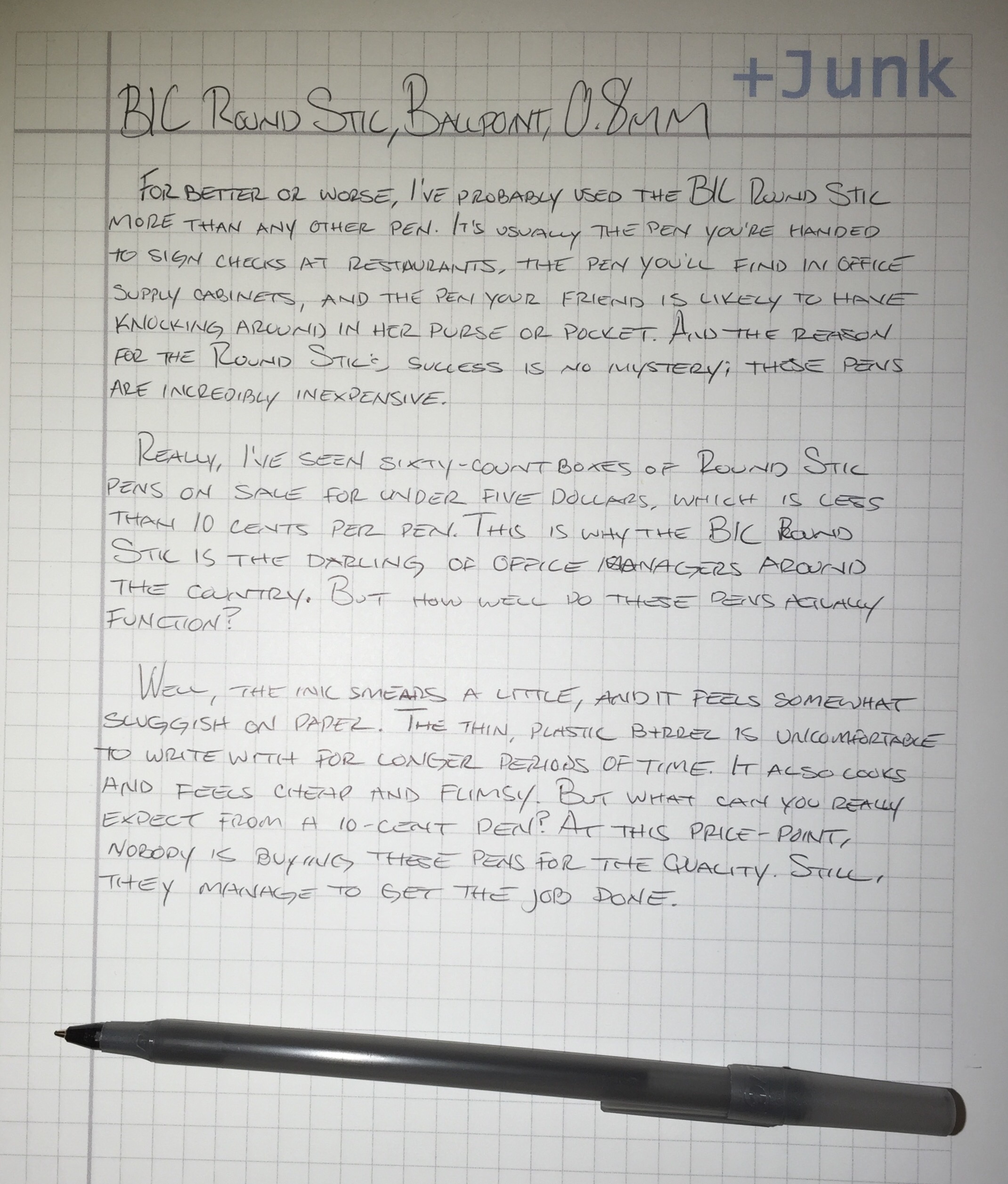
For better or worse, I’ve probably used the BIC Round Stic more than any other pen. It’s usually the pen you’re handed to sign checks at restaurants, the pen you’ll find in office supply cabinets, and the pen your friend is likely to have knocking around in her purse or pocket. And the reason for the Round Stic’s wild success is no mystery; these pens are incredibly inexpensive.

img_3571
About as close to a “dime-a-dozen” pen that you can get.

Really, I’ve seen sixty-count boxes of Round Stic pens on sale for under five dollars, which is less than 10 cents per pen. This is why the BIC Round Stic is the darling of office managers around the country. But how well do these pens actually function?

Well, the ink smears a little, and it feels somewhat sluggish on paper. The thin, plastic barrel is uncomfortable to write with for longer periods of time. It also looks and feels cheap and flimsy. But what can you really expect from a ten-cent pen? At this price-point, nobody is buying these pens for the quality. Still, they manage to get the job done.

img_3568