Review: uni-ball Power Tank, Pressurized Ballpoint, 0.7mm

img_4044

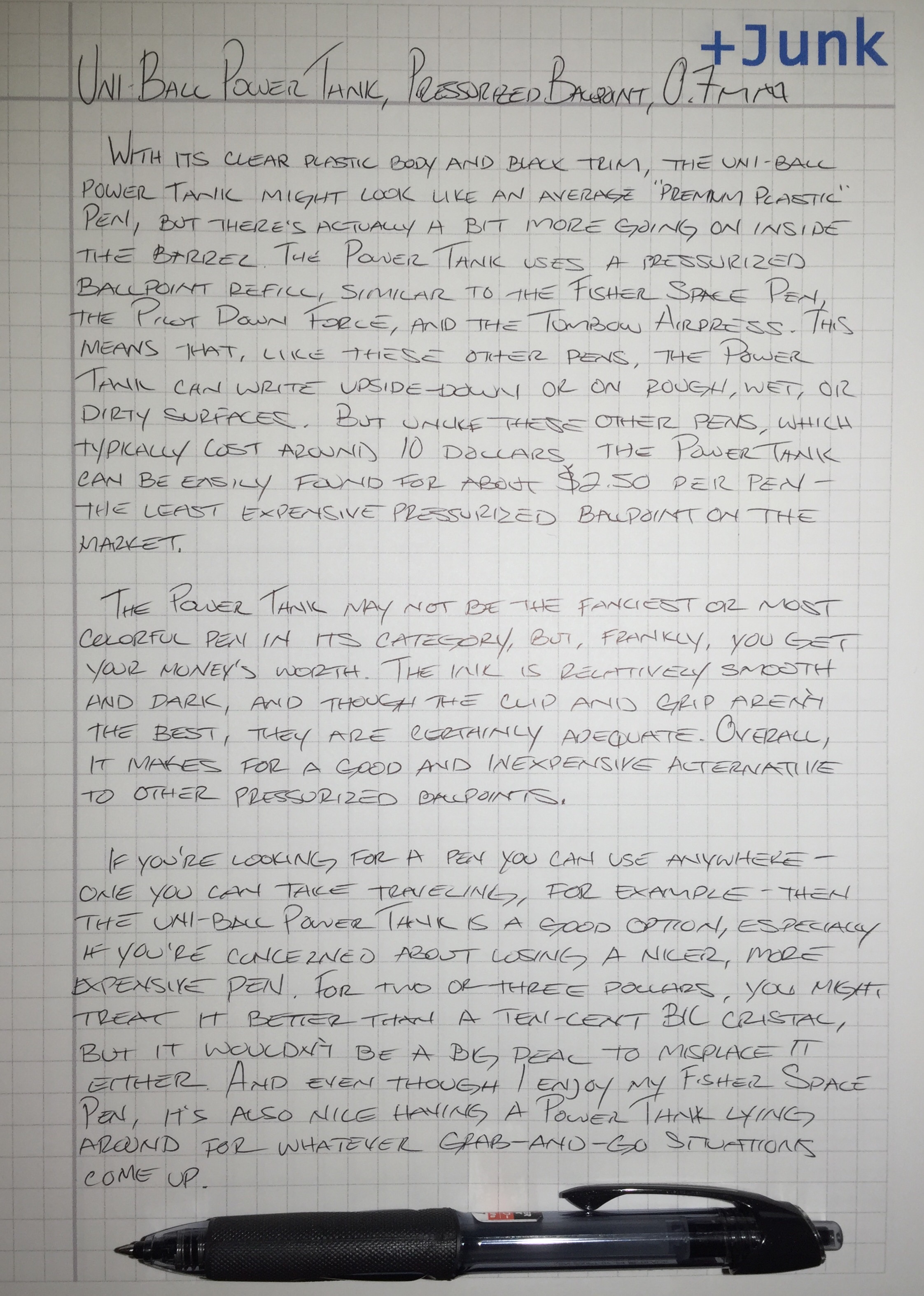
With its clear plastic body and black trim, the uni-ball Power Tank might look like an average “premium plastic” pen, but there’s actually a bit more going on inside the barrel. The Power Tank uses a pressurized ballpoint ink refill, similar to the Fisher Space Pen, the Pilot Down Force, and the Tombow Airpress. This means that, like these other pens, the Power Tank can write upside-down or on rough, wet, and dirty surfaces. But unlike these other pens, which typically cost around 10 dollars, the Power Tank can be easily found for about $2.50 per pen – the least expensive pressurized ballpoint on the market.

img_4043

The Power Tank may not be the fanciest or most colorful pen in its category, but, frankly, you get your money’s worth. The ink is relatively smooth and dark, and though the clip and grip aren’t the best, they are certainly adequate. Overall, it makes for a good and inexpensive alternative to other pressurized ballpoints.

If you’re looking for a pen that you can use anywhere – one you can take traveling, for example – then the uni-ball Power Tank is a good option, especially if you’re concerned about losing a nicer, more expensive pen. For two or three dollars, you might treat it better than a ten-cent BIC Cristal, but it wouldn’t be a big deal to misplace it either. And even though I enjoy my Fisher Space Pen, it’s also nice to have a few Power Tanks lying around for whatever grab-and-go situations come up.
img_4045

Extra Links

  • A funny review at The Ruminator. A positive review overall, but he doesn’t like the name. On the contrary, I think the Power Tank is a really cool name for a pen.
  • A review at Pen Paper Ink Letter with lots of pictures. I agree with the overall opinion here – I don’t think it would have a place as my “everyday” pen, but it’s definitely a no-brainer if you feel the advantages of a pressurized ink cartridge would be useful.
  • So, uni-ball originally made a capped version of this pen? Legomac has some info on it, but they are apparently very difficult to find. I’m okay with that, as I’d rather have a retractable model anyway.

Review: Zebra Sarasa Clip, Gel Ink, 0.5mm

img_4004

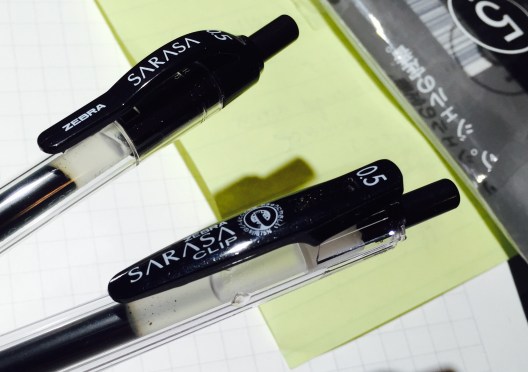
The more I use pens with spring-loaded clips , the more I invariably like them. They easily slip on and off notebooks, they stay put when clipped, and the lever gives me something to fidget with during meetings, besides the noisy clicker. That’s why the Zebra Sarasa Clip has been my go-to pen for the past couple of weeks, despite being an otherwise basic gel pen.

img_4003

The design of the Sarasa Clip is based on the generic-looking Zebra Sarasa gel pen, and aside from the aforementioned clip, their aesthetic differences are minimal. They both have the design of a typical premium plastic pen with a clear barrel, black trim, and a rubbery grip. Both pens are comfortable and reliable, but without the spring-loaded clip, the Sarasa does nothing to distinguish itself from its competitors.

Still, that spring-loaded clip definitely provides extra utility that may be worthwhile depending on the situation. For example, if you’re a fan of the Pilot G-2 and typically need a pen while out and about, it would probably be worth trying out the Zebra Sarasa Clip. In that case, also check out the Pilot Juice. The two pens are nearly identical, so go with whichever happens to be less expensive.

img_4005

Extra Links

  • A review at The Gentleman Stationer mentions that the refill of the Sarasa Clip is better than the standard Sarasa. They do come with different refills – the Sarasa uses the “Zebra JLV” refill  and Sarasa Clip uses the “Zebra JF” refill – and, I tend to agree. The Sarasa Clip’s JF refill seems to be a little darker and smoother. Click for a comparison.
  • Review at Pen Addict. He says that below 0.4mm, the pen starts to feel scratchy (though he doesn’t consider that a bad thing).
  • A review at Daydreamers Welcome shows off different Sarasa Clip colors, but she says that the lighter colors aren’t worth the money.

Review: Pilot G-2 Pro, Gel Ink, 0.7mm

img_3971

The Pilot G-2 is such a ubiquitous and popular pen, it’s really no surprise that Pilot has attempted to build on the brand by creating this “upgraded” version, the Pilot G-2 Pro. The G-2 Pro is little beefier: it’s slightly thicker, slightly heavier, and has a larger “clicker.” It’s a nice pen, but at double the price of the standard G-2, it’s hard to find a compelling reason to spend the extra money.

img_3972

When it comes right down to it, the G-2 Pro is mostly an aesthetic upgrade. Instead of the cheap, clear plastic of the original, the G-2 Pro comes with a painted barrel. Four color options are available – gray, dark blue, olive green, and maroon. The upgraded design even includes a faux-metal trim. But don’t be fooled; the body is still entirely made of plastic.

For an upgrade like this to make sense, it should give die-hard G-2 users something worthwhile. For example, Pentel produced the Energel Alloy RT, a durable, aluminum version of the popular Energel Deluxe RTX. The G-2 Pro, on the other hand, is more of a paint job. So, unless you’re really itching for a prettier G-2, it’s hard to justify purchasing the G-2 Pro.

img_3968

Review: Pilot Down Force, Pressurized Ballpoint, 0.7mm

img_3955

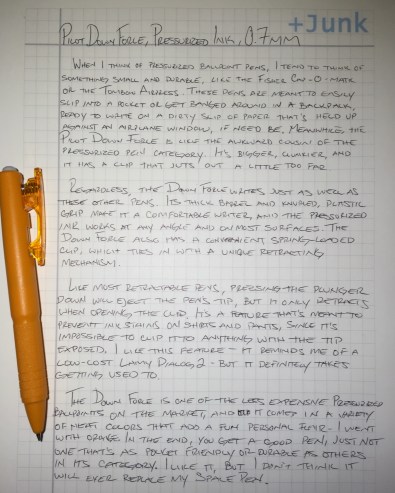
When I think of pressurized ballpoint pens, I tend to think of something small and durable, like the Fisher Cap-O-Matic Space Pen or the Tombow Airpress. These pens are meant to slip easily into a pocket or get banged around in a backpack, ready to write on a dirty slip of paper held up against an airplane window, if need be. Meanwhile, the Pilot Down Force is like the awkward cousin of the pressurized pen category. It’s bigger, clunkier, and it has a clip that juts out a little too far.

Regardless, the Down Force writes just as well as these other pens. Its thick barrel and knurled, plastic grip make it a comfortable writer, and the pressurized ink works at any angle and on most surfaces. The Down Force also has a convenient spring-loaded clip, which ties in with a very unique retracting mechanism.

DownForceRetract

Like most retractable pens, pressing the plunger down will eject the pen’s tip, but it only retracts when opening the clip. It’s a feature that’s meant to prevent ink stains on shirts and pants, since it’s impossible to clip the pen to anything with its tip exposed. I like this feature – it reminds me of a low-cost version of the Lamy Dialog 2 – but it definitely takes a little getting used to.

The Down Force is one of the less expensive pressurized ballpoints on the market, and it comes in an array of neat colors that add a fun personal flair – I went with the orange. In the end you get a good pen, just not one that’s as pocket-friendly or durable as others in its category. I like it, but I don’t think it will ever replace my space pen.

img_3956

Extra Links

Review: Zebra F-701, Ballpoint, 0.7mm

img_3942

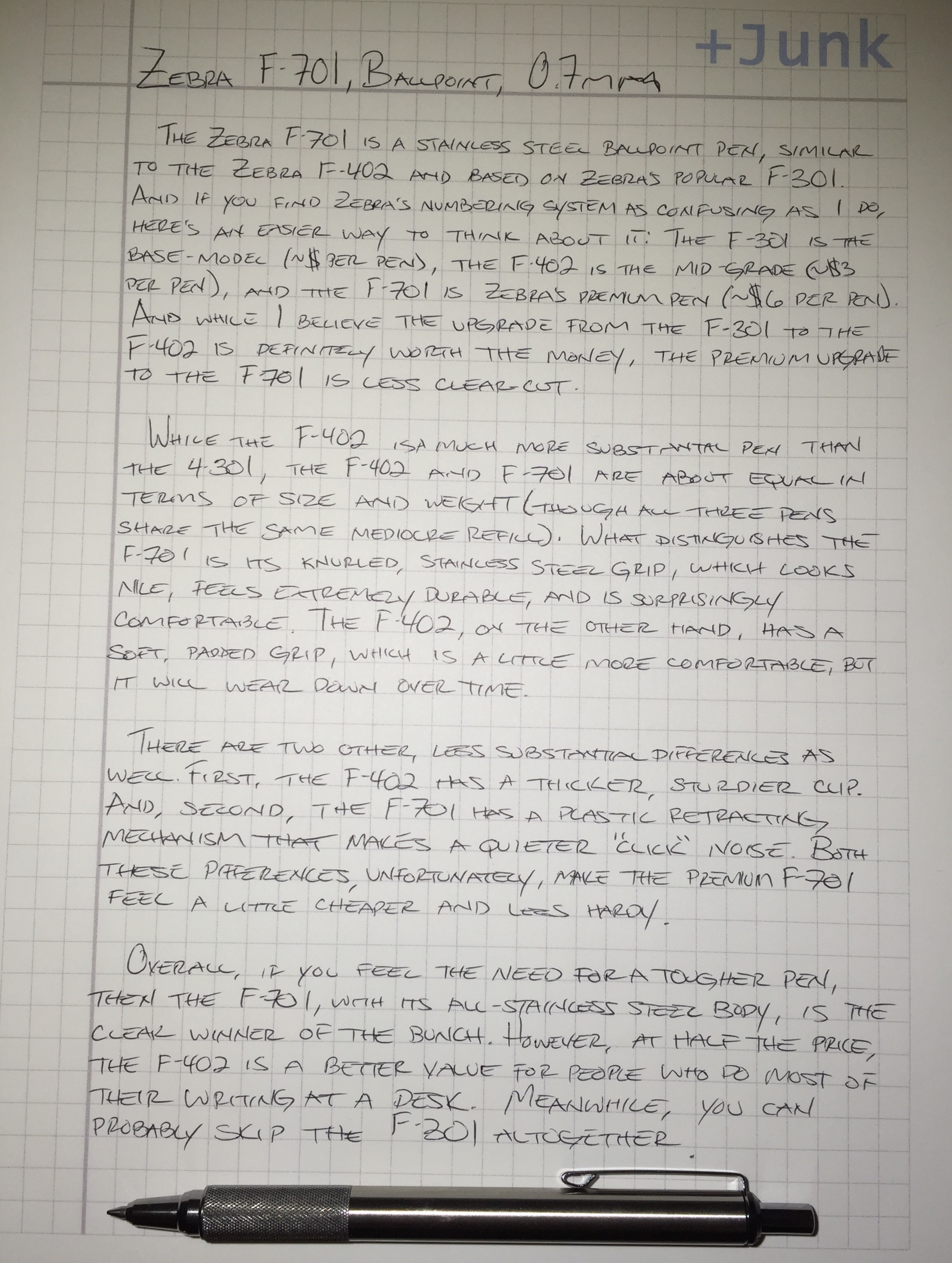
The Zebra F-701 is a stainless steel ballpoint, similar to the Zebra F-402 and based on Zebra’s popular F-301. And if you find Zebra’s numbering system as confusing as I do, here’s an easier way to think about it: the F-301 is the base-model (~$2 per pen) , the F-402 is the mid-grade (~$3 per pen), and the F-701 is Zebra’s premium pen (~$6 per pen). And while I believe the upgrade from F-301 to F-402 is definitely worth the money, the premium upgrade to the F-701 is less clear-cut.

img_3941
The F-301 (top) has a hard-plastic grip, the F-402 (middle) has a rubberized grip, and the F-701 (bottom) has a stainless steel grip.

While the F-701 is a much more substantial pen than the F-301, it’s about equal to the F-402 in terms of size and weight (though all three pens share the same mediocre ballpoint refill). What distinguishes the F-701 is its knurled, stainless steel grip, which looks nice, feels extremely durable, and is surprisingly comfortable. The F-402, on the other hand, has a soft, padded grip, which is a little more comfortable but will wear down over time.

There are two other, less substantial differences as well. First, the F-402 definitely has a thicker, sturdier clip. And, second, the F-701 has a plastic retracting mechanism that makes a quieter “click” noise. Both these differences, unfortunately, make the premium F-701 feel a little cheaper and less hardy.

Still, if you feel the need a tougher pen, then the F-701, with its all-stainless steel body, is still the clear winner of the group. However, at half the price, the F-402 is a better value for people who are less hard on their pens, such as those who do most of their writing at a desk. Meanwhile, you can probably skip the F-301 altogether.

img_3944

Extra Links